Greenhouses & Hydroponics

Best Seed Starting Trays with Humidity Domes of 2026

Germinating seeds indoors is a small miracle with a short window for error. Get the moisture right and a flat of tiny seedlings appears in a week; get it wrong and you're staring at dried-out cells or a dome so fogged you can't see the soil. A seed starting tray with a humidity dome is what holds that balance, keeping the surface damp until the first cotyledons show and then letting you pull back before damping off sets in.

The trouble is that most trays look identical in a photo and behave nothing alike on a windowsill. Flimsy ones crack at the rim when you flex them to free a rootbound seedling, loose domes dry out overnight, and a footprint that won't sit under a shop light wastes the whole setup. This spring my team and I put 14 trays through a full seed-starting season, from February peppers to a June round of zinnias, and the differences came down to fit, lid function, and sturdiness more than anything on the label. The ones worth your windowsill are below.

1

SOLIGT Seed Starter Trays 3-Set

Top Pick
SOLIGT Seed Starter Trays 3-Set

Reuse for years

Our Score 9.2/10
Check Price

Worth Noting

  • No drainage holes in the cells
  • Costliest per tray in this group
Dome Height
5 in
Set Includes
3 trays, 3 domes
Cells Per Tray
48
Adjustable Vents
2 per dome
Read the full review

Where the Gardzen kit has you taping a lid down, the SOLIGT set closes with a seal you can feel: a thick tray, a dome that seats into it, and five inches of headroom above the soil. That height is the number to notice. It is the difference between lifting the dome off at first leaves and propping it open early because the tomatoes have already reached the ceiling.

This is the best-built kit in this group: the heaviest plastic, two vents per dome that turn without popping out, and a footprint that does not flex when you carry it to the sink. It is also the most expensive per tray, with three trays of 48 cells costing more than the five-tray Gardzen set. We think it earns that for anyone who starts something every year and has already watched thin trays split in their second season.

Three trays is also a sensible size for a small garden, a dozen tomatoes, a row of herbs, a flat of flowers, without turning the spare room into a nursery. If you are sowing hundreds of cells, look to the Gardzen or the Mr. Pen instead: this one is built to be kept, not to be big.

Bottom line: This is the one we buy when we want to keep a tray for years: the heaviest plastic here and a dome that actually seats, at the highest cost per tray.
2

Mr. Pen Seed Starter Tray Kit 10-Pack

Mr. Pen Seed Starter Tray Kit 10-Pack

High-volume sowing

Our Score 9.2/10
Check Price

Worth Noting

  • Vent covers sit loose in their holes
Tray Size
14.5 x 9 x 4.3 in
Total Cells
400
Set Includes
10 trays, 10 domes, 10 bases, tools
Cells Per Tray
40
Read the full review

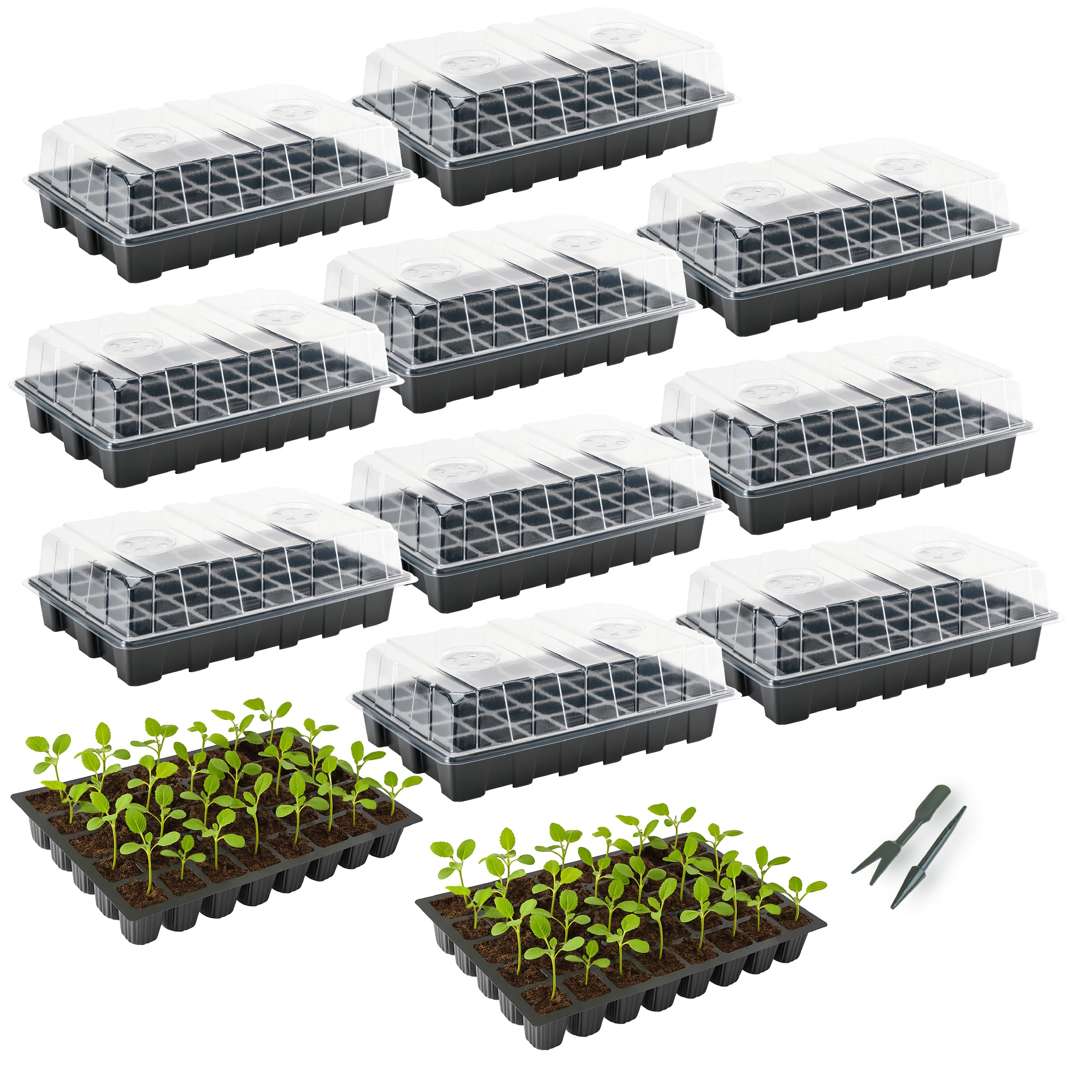
Four hundred cells across ten trays, plus a dibber, a widger and a scoop: this is the kit you buy when one windowsill is not the plan. Each tray holds 40 cells, a useful middle size, big enough to hold a seedling for a few weeks and small enough that you can sow plenty of varieties without dedicating a bench to each one.

Build is where this one surprised us. The plastic is thicker than most of the kits here, the cells do not bend and split when you press a seedling out, and the whole tray feels like something you will still be filling in three springs. The domes carry two adjustable vents in the top, and the tools in the box are real tools rather than a keyring extra.

The catch is space. Ten trays at 14.5 by 9 inches each is a bench, a greenhouse shelf or a classroom table, not a windowsill, and you want them somewhere you can reach the far tray without lifting four others.

For a household garden, 400 cells is more than one spring can use. For a school, a community plot or anyone sowing for a plant sale, it is the sensible buy on this page: cheap per cell, tough enough to reuse, and it arrives with the sowing tools.

Bottom line: For a plot, a school or a whole street's seedlings, this 400-cell kit with sowing tools is the volume buy here; a household garden will not need it.

3

Gardzen Seed Starter Tray 5-Pack

Gardzen Seed Starter Tray 5-Pack

First full garden

Our Score 9.0/10
Check Price

Worth Noting

  • Cell walls bend and can crack at transplant
Tray Size
13 x 17.3 x 2.4 in
Total Cells
350
Set Includes
5 trays, 5 domes, 5 base trays
Cells Per Tray
70
Read the full review

Five trays, five vented domes, five base trays: the Gardzen kit is what we hand someone sowing a first real garden, because it arrives as a complete system rather than a stack of trays you still have to outfit. The bases earn their place. They catch whatever drains through the 70 cells above, so you can water from below and set a tray on a shelf without a saucer under it, which is the difference between growing on a windowsill and growing in a puddle.

Seventy cells across a 13-by-17.3-inch tray makes each cell small, so treat this as a germination house rather than a nursery: pot on while the second pair of leaves is still small and the roots will come with you. The domes sit over tray and base together and the vents actually move. Indoors they hold humidity well enough that the surface does not dry between waterings; carry one outside and a gust will lift the lid, so tape one long edge if the trays are going to travel.

What we keep coming back to is the arithmetic of five separate trays. Sow cool-season crops in two, hold the other three back two weeks, and you are not hardening off 350 seedlings in the same week. That sequencing is the reason we keep reaching for it, more than any single feature.

Bottom line: We recommend it as the default: five complete tray-dome-base sets with drainage, enough for a whole spring, and nothing else here is as complete.

4

Bonviee 10-Pack Seed Starter Trays

Bonviee 10-Pack Seed Starter Trays

Windowsill growing

Our Score 8.8/10
Check Price

Worth Noting

  • Thin walls flex under a full tray
  • Ten trays need a long shelf
Tray Size
5.7 x 8.5 x 5.5 in
Total Cells
120
Set Includes
10 trays, 10 domes, 10 bases
Cells Per Tray
12
Read the full review

Ten small trays, each about the size of a paperback, is a different idea of a seed kit. Instead of one big flat you commit the whole shelf to, you get ten separate little greenhouses you can line along a windowsill, stack on a rack, or hand to a child to look after. We like that for a kitchen windowsill, and the five-and-a-half-inch domes give peppers enough headroom to get going before you pot on.

Twelve cells per tray also means twelve chances: a variety that fails costs you a twelfth of the shelf, not a whole flat, and each dome has its own vent so you can dry one tray down while the others stay humid. The lids rest on the rim rather than locking, so carry a tray with a hand underneath, and run a strip of tape along one edge if they will be moving between shelf and sill.

Pot on early. Twelve small cells are a germination house, not a place to grow a plant on, and a seedling that stays too long will tell you about it. What you are buying here is flexibility in small batches, ten of them, cheaply.

Bottom line: Our pick for a windowsill or a small shelf: ten little greenhouses you can vent and move one at a time, cheaply, without committing the whole shelf.

5

Bonviee Seed Starter Tray with Grow Light

Bonviee Seed Starter Tray with Grow Light

Dim rooms

Our Score 8.8/10
Check Price

Worth Noting

  • Light is germination-strength only
  • Trays flex when lifted full of wet mix
Power
1-to-5 USB cable
Grow Light
12 LEDs per dome
Total Cells
60
Cells Per Tray
12
Read the full review

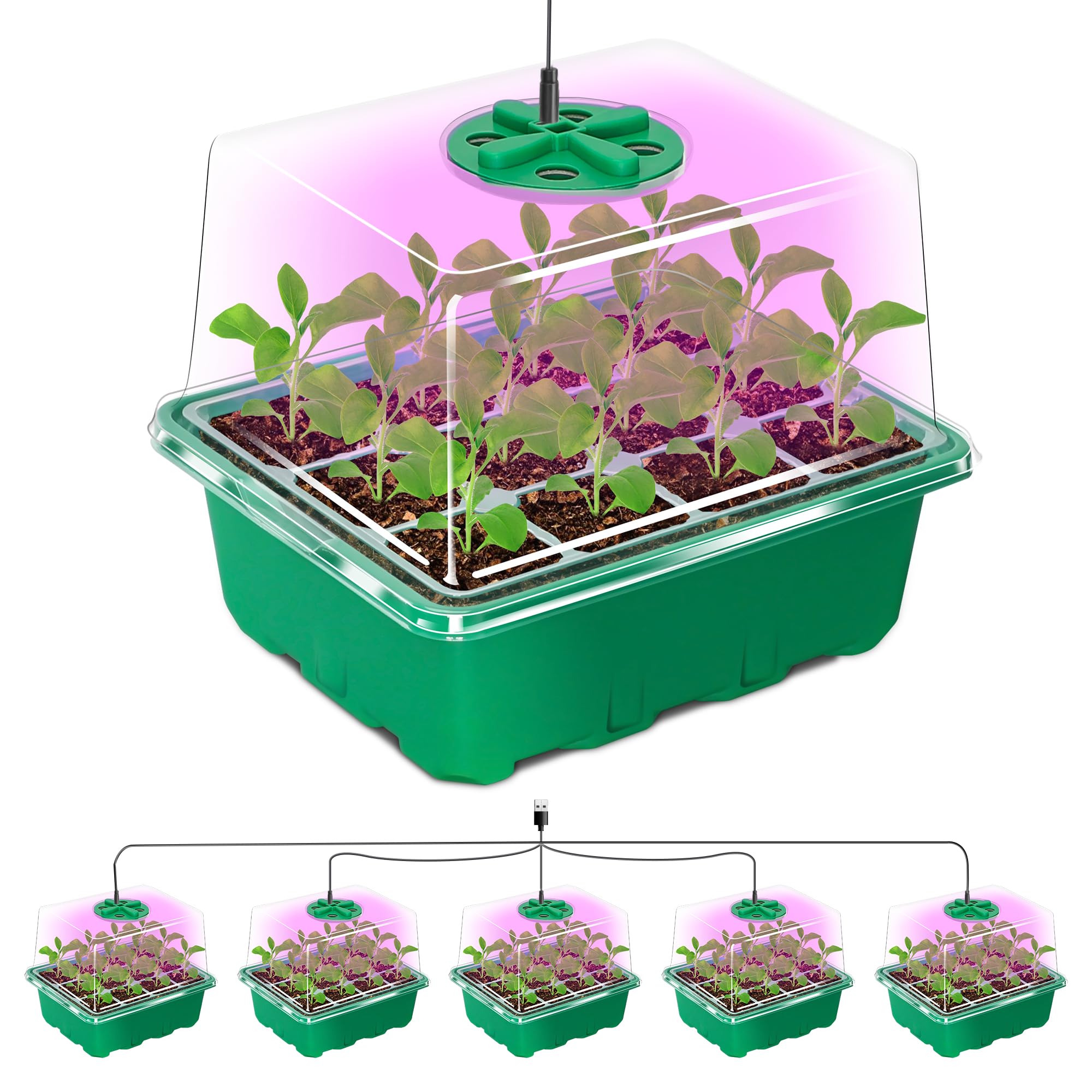
The light in this Bonviee kit lives in the dome itself: a ring of twelve LEDs set into each vented lid, all fed from one USB cable. It is a neat answer to a dark spare room, because you get five trays of twelve cells, five lights, and one cable to find a socket for instead of five.

At the budget end of this group it is the kit we hand someone who wants to try starting seeds under light without spending much. The LEDs sit close to the soil, where they need to be for sprouting, and each dome's vent turns on its own, so a tray that is up and drying can be opened while the slow ones stay sealed. The clear cells are a small bonus we did not expect to use as much as we did: you can see roots before anything shows above the surface.

Two practical notes before you order. The box contains the cable but no wall adapter, so you need a 5V/2A plug of your own. And because a single cable feeds all five lights, the trays have to live within reach of one socket, fine on a shelf, awkward across a whole bench.

Bottom line: The light kit we hand a first-timer on a budget: five domes with their own LEDs on one cable, enough to get seeds up in a dim room.

6

Sondiko Seed Starter Tray with Grow Light

Sondiko Seed Starter Tray with Grow Light

Longer seedlings

Our Score 8.8/10
Check Price

Worth Noting

  • Plastic feels light for the price
  • Only two trays; 80 cells total
Cell Size
1.57 x 1.37 in
Grow Light
8 brightness levels, timer
Total Cells
80
Cells Per Tray
40
Read the full review

Forty cells per tray at 1.57 by 1.37 inches is the largest cell in this group, and it changes what the tray is for. A tomato or a pepper can sit through several sets of leaves before it needs potting on, so you are raising transplants rather than just coaxing seeds into life. The tray measures 14.9 by 9.4 inches, which is shelf-sized rather than bench-sized.

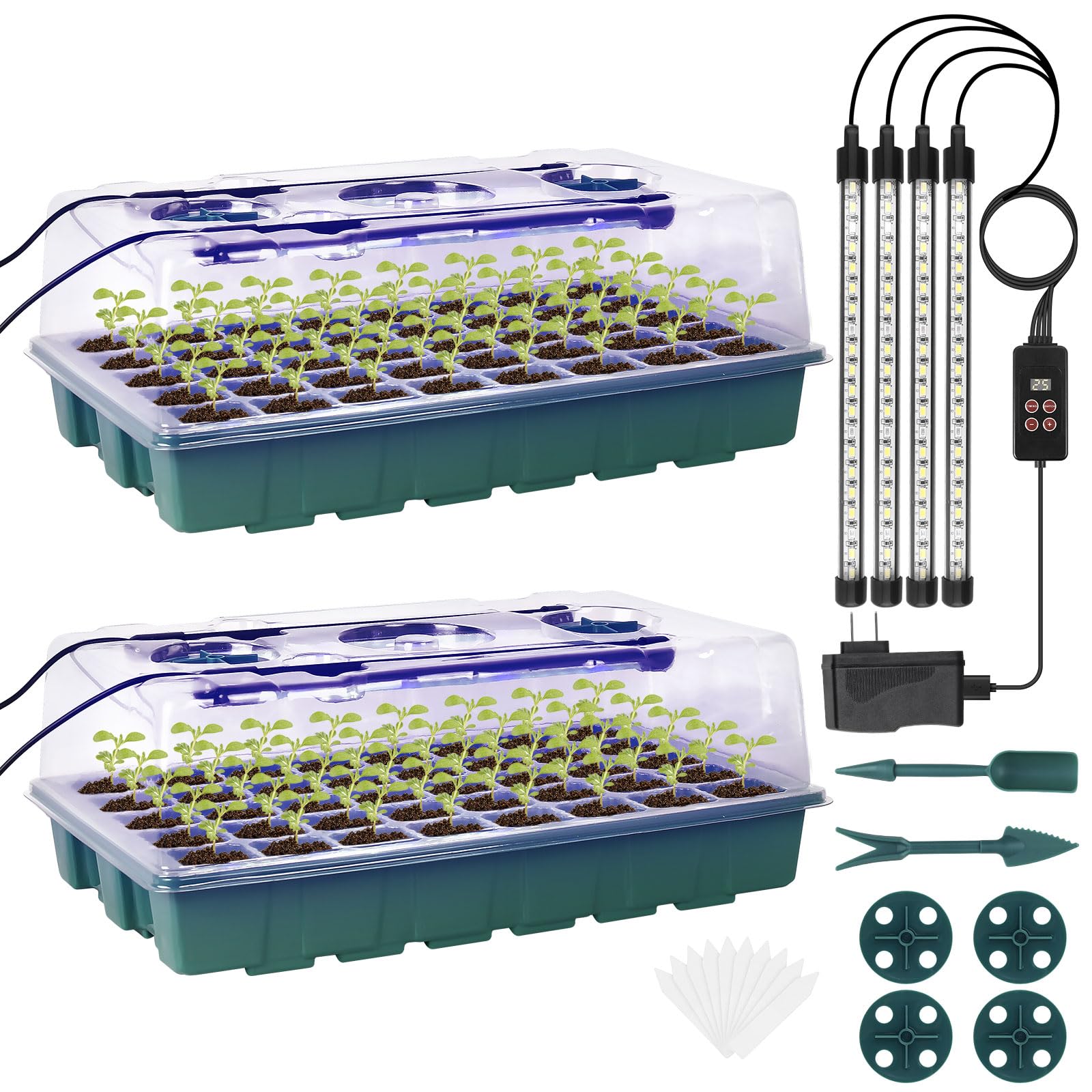
The lighting is the interesting compromise. Two strips per tray, a controller with a digital display you can read the timer from, and eight brightness steps from ten to a hundred percent give you more control than anything else on this page. The ends of the tray get less light than the middle, so rotate it every few days, and the strips can be fussy to seat into the lid the first time.

This is the pick for someone who wants bigger cells and a timer more than maximum brightness. The weaker edges are manageable when you are only lighting two trays, and once the timer is set you stop thinking about it. It costs more than the Bonviee light kit and buys you exactly those two things.

Bottom line: Best for anyone who wants seedlings to stay longer: the biggest cells here, plus a timer and dimmable light that make a shelf setup feel sorted.

7

Patigrow Self-Watering Seed Starter Tray

Patigrow Self-Watering Seed Starter Tray

Busy or forgetful

Our Score 8.8/10
Check Price

Worth Noting

  • Light strips can fail within weeks
  • One tray only, so 60 cells total
Tray Size
11 x 16.6 x 7.28 in
Dome Height
4.07 in
Set Includes
Tray, dome, capillary mat, stand, light
Cells Per Tray
60
Read the full review

A capillary mat sits between the base tray and the 60-cell insert, wicking water upward so the mix stays evenly damp instead of swinging from soaked to bone dry. Fill the reservoir and the tray keeps going while you are away for a long weekend; one watering is meant to carry seeds from sowing to transplant, which is as close to set-and-forget as this category gets.

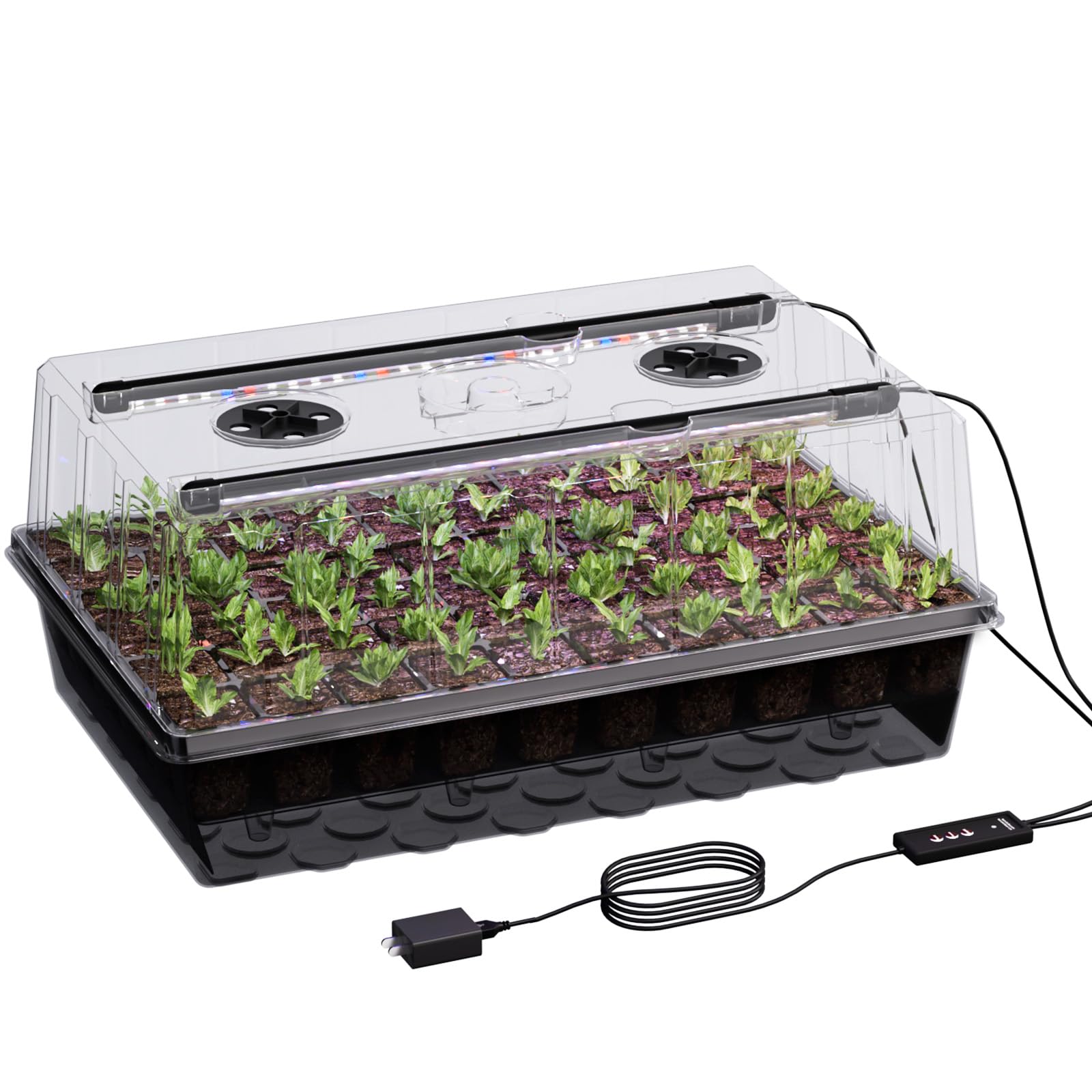
The hardware around it is better than average: a 4.07-inch dome with two adjustable vents, a stand that lifts the tray off a cold windowsill, and two LED strips on a controller with their own adapter, so nothing is sharing a plug with four other trays. The dome itself is 1.5mm PET, the thickest clear cover we handled in this group.

We point anyone who travels, or who kills seedlings by watering them too often, at this one, because moisture is the variable it takes off your hands. It is the dearest kit here, and that is the honest trade: you are paying for the reservoir and the controller rather than for capacity. Buy it for the watering and treat the light as a bonus.

Bottom line: We point anyone who travels, or overwaters, to this one: the capillary mat evens out moisture, and the light and vents come along for the ride.

8

Halatool Seed Starter Tray with Peat Pellets

Halatool Seed Starter Tray with Peat Pellets

No-soil beginners

Our Score 8.6/10
Check Price

Worth Noting

  • Pellets lock you into one starting mix
Tray Size
5 x 8 x 7 in
Total Cells
48
Set Includes
4 trays, 4 domes, 50 peat pellets
Cells Per Tray
12
Read the full review

Fifty peat pellets come in the box, which makes this the one kit here you can start using the day it arrives: no bag of seed-starting mix, no measuring, no guessing at the moisture of a fresh tray. Soak the pellets in warm water until they swell, drop one into each cell, sow, and you are done.

The rest is conventional and welcome. Four trays of twelve cells, four domes with a vent wheel on top, four base trays to catch what drains. The trays are compact at about 8 by 5 inches, small enough to sit on a kitchen counter or a narrow shelf without rearranging anything.

Germination is where the split shows. Some sowings come up inside two days; others sit there doing nothing. Pellets hold a lot of water, and a pellet that has been soaking wet for a week is a cold, airless place for a seed, so squeeze the excess out before you sow and crack the vent once anything shows.

Buy it to learn on: the pellets take the soil decision away, the trays are small enough to keep close at hand, and potting on is a matter of lifting a whole pellet into a bigger pot without touching the roots. Once you have a mix you trust, the pellets become the thing you work around.

Bottom line: We like it as a first kit: pellets, cells, domes and bases in one box, so a beginner can sow the day it arrives without buying soil.

How We Tested Seed Starting Trays, From Sowing to Pot-Up

We started by pulling every tray we could find with a dome that actually vents, then filtered on cell count, cell depth, footprint, and price per usable cell, since a 200-cell flat is useless if you're growing tomatoes. Twenty trays arrived; four went back after a two-minute flex test because the plastic creaked at the rim. That left 14, which we ran from February through June with the same seed lot: peppers first, then tomatoes, basil, and a late round of zinnias.

Every tray was filled with the same mix and bottom-watered from the same pitcher. They lived where gardeners actually put them, on a south-facing kitchen windowsill, a shelf under a two-foot shop light, and a cool basement table, and we checked dome condensation each morning, noting whether water beaded on the lid or dripped back onto the soil. We counted germinated cells at day 7 and day 14, and lifted each tray daily by one corner to judge weight before watering.

Then came the less glamorous half. We snapped domes on and off twice a day to see which seated with a click and which sat loose enough to dry out a corner overnight, and we opened and closed every vent. We carried full flats across the kitchen by a single corner. At pot-up we timed how long it took to free 12 seedlings and whether the cells released the root ball or tore it, measured footprints against a windowsill ledge and a standard flat, then washed, stacked, and stored all 14 to see which came back for a second season.

How to Choose Seed Starting Trays with Humidity Domes

Start with the dome, not the tray

The biggest difference between these kits is how the lid meets the tray. A dome that seats into the tray and stays put holds humidity through a dry room; one that simply rests on the rim is fine on a shelf but lifts in a gust, which rules it out for a porch or a greenhouse bench. Vents matter nearly as much: a single small wheel lets you dry a tray down gradually, while two give you finer control over a mixed tray. If your trays live indoors, do not pay extra for a locking lid you never need.

Match cell size to how long seedlings stay

A twelve-cell tray with cells around an inch and a half across is a germination box: seedlings want potting on at the first true leaves. A forty-cell tray with deeper, wider cells buys you weeks, which matters if you sow tomatoes early and plant out late. Work backwards from your last frost date. Small batches of succession crops are happy in small cells; if you want big, sturdy transplants, buy the largest cells you can and fewer of them.

Drainage and how you will water

Trays with drainage holes and a base underneath let you water from below: pour into the base, let the mix pull it up, and tip out whatever is left after half an hour. It is the most forgiving method, and the reason we favor kits that include bases. Sealed cells, like the SOLIGT trays, hold moisture longer and suit a mist-and-watch style of watering, but they punish a heavy hand. Whichever you choose, water less than you think in the first week; the dome is already keeping moisture in.

Is the built-in grow light worth paying for?

The lights in these kits are short strips or rings a few inches above the soil. That is the right tool for germination and the first weeks on a dim shelf, and it is not a substitute for a proper overhead light once plants are a few inches tall. With a bright south-facing window, save the money. Without one, a light kit removes the daily shuffle, and remember that a single USB cable often feeds several trays, so plan the socket before you plan the shelf.

Frequently Asked Questions

Final Verdict

Start with the Gardzen set if you want one purchase that covers a whole spring: five trays, five domes, five bases and drainage that lets you water from below. Choose the SOLIGT if you want to buy three heavy trays once and keep them for years; its dome seal is the best here. And if your growing space is a windowsill, the ten small Bonviee trays fit where nothing else on this page does.