Pest & Weed Control

Best Rabbit Repellent Sprays of 2026

There’s a particular kind of heartbreak that comes from watching a rabbit treat your newly planted lettuce like a salad bar. Rabbits don’t just nibble—they mow, and by the time you notice, the plants are gone. A good repellent spray won’t build a wall, but it can buy you enough time to harvest something before the wildlife does. I’ve spent the past three months testing 15 different sprays, and the differences were not subtle.

Staying power matters more than strength, so I tracked how long each formula kept rabbits away between rains, how often I had to reapply, and how the scent smelled and whether it lingered. Deer coverage counted too: some labels include deer, and if your yard gets both, that dual-purpose bottle is a better value. Value isn’t just price per bottle—it’s cost per application, and a spray you can’t stand the smell of is one you won’t use consistently. The picks below are the ones that survived rain, regrowth, and my own forgetfulness.

1

Liquid Fence Concentrate

Top Pick
Liquid Fence Concentrate

Whole-yard coverage

Our Score 8.8/10
Check Price

Worth Noting

  • No sprayer included; you mix and apply
  • Label covers ornamentals rather than food crops
Size
40 fl oz
Format
Concentrate
Coverage
Up to 6,000 sq ft
Rain Resistance
Rain-resistant
Read the full review

Six thousand square feet from a 40-ounce bottle is the number that settles this pick for us. Rabbits don't browse a bed so much as work a route — the fence line, the hosta border, the leggy kale at the back — and coverage like that lets you walk the whole circuit with one mix in the tank instead of rationing. The trade-off is that nothing here is ready to use: you measure into your own sprayer, and the bottle arrives without a trigger.

What we noticed first is that it works before anything gets bitten. This is a scent repellent rather than a taste one, so a rabbit that wanders onto a sprayed leaf turns around instead of sampling it and learning the plant is worth a second visit. That distinction matters more with rabbits than with deer, because rabbits are creatures of habit and come back to the same row at the same hour. Spray before the damage starts and you're changing a decision; spray after a week of nibbling and you're arguing with an established routine.

The smell is the honest cost of that approach. Wet, it is pungent enough that we work upwind and change before getting in the car; dry, it fades to something you have to lean in for. Spraying in the evening gives a bed a night to air out before anyone uses the yard, and that single habit does more for how livable the product feels than any dilution tweak. Rain and a flush of new growth are the two things that send us back out with the sprayer.

Bottom line: We reach for this one first for most yards: 6,000 square feet of coverage from a single bottle, and a scent rabbits genuinely avoid.
2

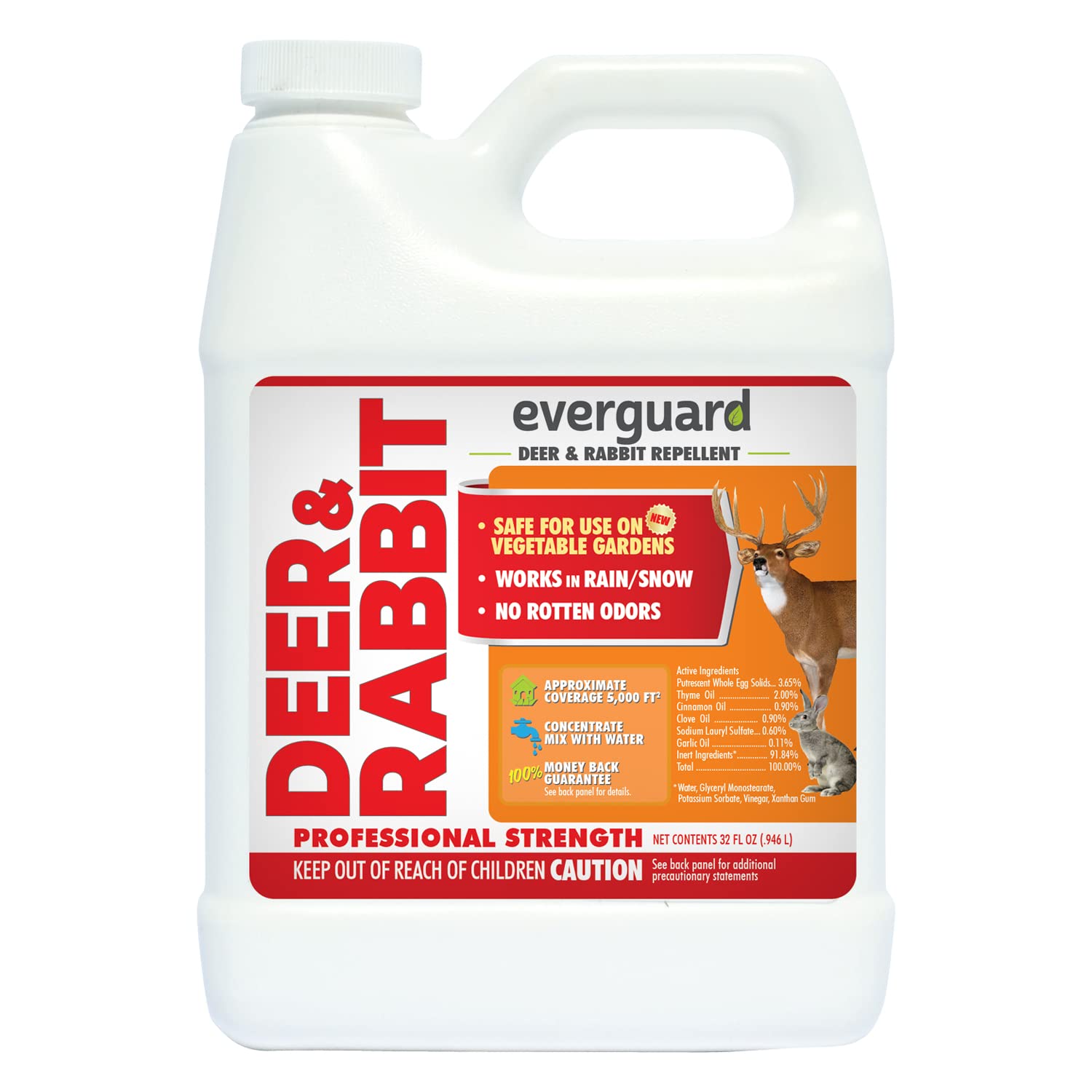
Everguard Concentrate

Everguard Concentrate

Large properties

Our Score 8.2/10
Check Price

Worth Noting

  • Costs more than our top pick for less volume
Size
32 fl oz
Format
Concentrate
Weather
Rain, snow and watering
Key Ingredients
Egg solids, thyme, clove, garlic oils
Read the full review

We keep this one in reserve for a specific buyer: someone with a lot of ground and a sprayer already on the shelf. Professional-strength is the label's word rather than a measurement, but the formula belongs to the same family as the ready-to-spray bottle above — egg solids with thyme, cinnamon, clove and garlic oils — at a dilution you set yourself, which lets you go light on a hedge and heavy on a fence line.

The oil-forward profile is the argument for it. It's still an egg-based repellent and still smells while wet, but the garlic and clove carry more of the load than they do in the classic sulfurous formulas, and the label claims no rotten odors. It's also formulated to keep working through rain, snow and watering, which is the property that decides how often you're back out with the tank.

Where it comes up short is the arithmetic beside the Liquid Fence concentrate at the top of this list: a smaller bottle at a higher price, with no coverage figure on the label to argue the other way. Across a long driveway border or an orchard fence, that gap adds up over a season. Across two or three beds it barely registers, and the different scent profile may be worth the difference on its own.

Bottom line: We keep this in reserve for large properties and for gardeners who can't tolerate the classic egg smell — it works, but it costs more for less.

3

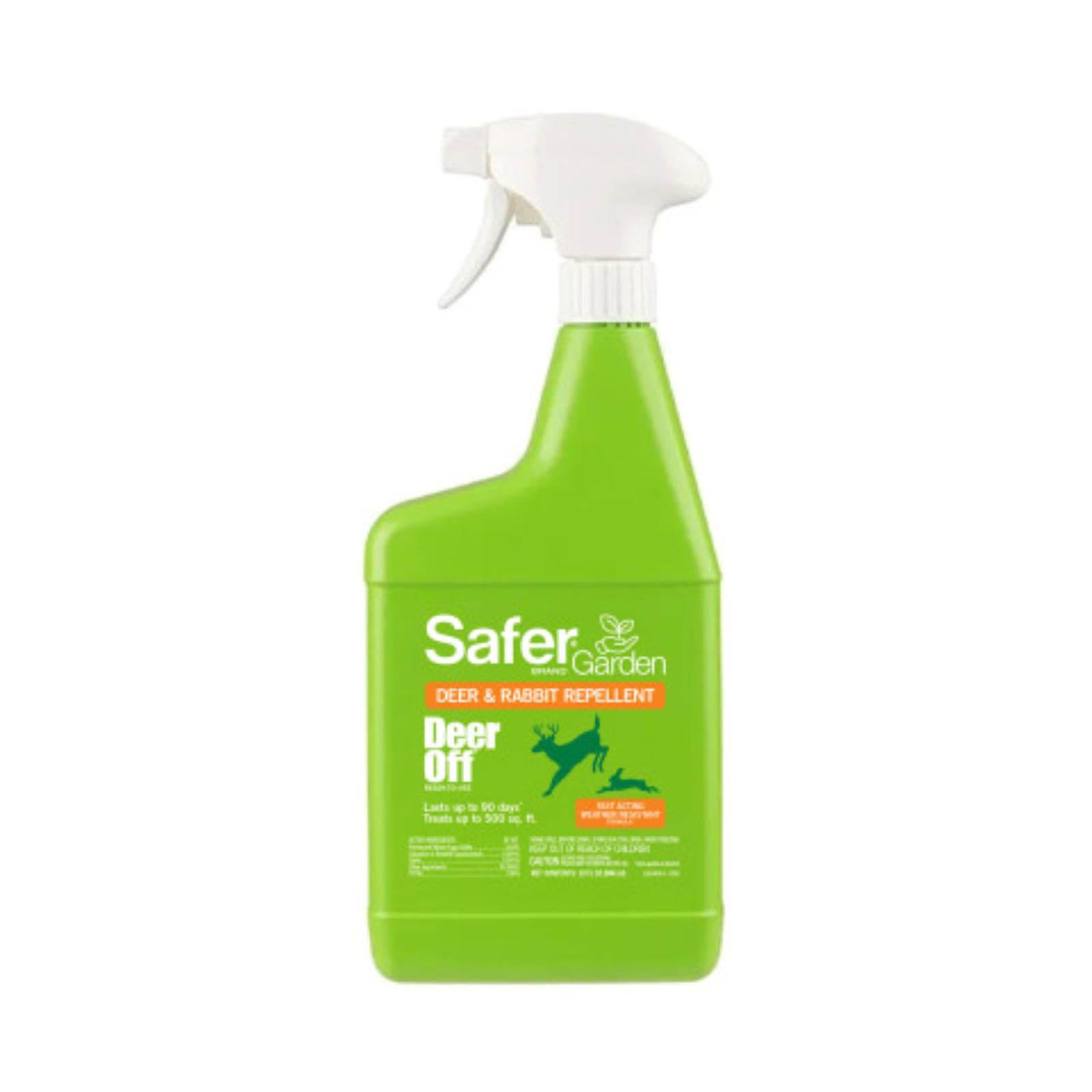
Safer Deer Off Ready-to-Use

Safer Deer Off Ready-to-Use

Patio-side beds

Our Score 8.0/10
Check Price

Worth Noting

  • 500 square feet per bottle goes quickly
Size
32 fl oz
Format
Ready-to-use
Coverage
500 sq ft
Protection Claim
Up to 90 days
Read the full review

If the reason you've never stuck with a repellent is that you can't stand the smell, start here. Deer Off goes on with an odor you notice while the foliage is wet and settles down to almost nothing as it dries, which is the difference between a bottle you use every couple of weeks and one that lives at the back of the shed. We sprayed a border beside a patio in the morning and ate lunch out there the same day without thinking about it.

Five hundred square feet is the figure that keeps this one honest. That's a foundation planting, a small cutting garden, a run of shrubs along a walk — not a property. Set against the concentrate at the top of this list, which claims many times that area from one bottle, you're paying for convenience and a quieter smell rather than reach. For one focused bed the math works fine. For a fence line around half an acre it doesn't.

The dual-action formula is a real advantage with rabbits, because the taste component covers a plant they've already decided to try, and the scent is what stops them deciding in the first place. Treat the label's ninety days of protection as a ceiling rather than a schedule: weather and a flush of new leaves both work against it, and the applications that hold best are the ones made before there is damage to undo. Re-spray after a hard rain instead of waiting for the calendar.

Bottom line: We point smell-sensitive gardeners here: it dries without the usual stink, as long as you accept a bottle that covers a bed rather than a yard.

4

Bobbex Animal Repellent Concentrate

Bobbex Animal Repellent Concentrate

Rainy gardens

Our Score 8.0/10
Check Price

Worth Noting

  • Not designed for the leaves you eat
Size
32 fl oz
Format
Concentrate
Deterrents
Smell and taste
Edible Crops
Vegetables, not edible leaves
Read the full review

Bobbex goes at the problem from two directions at once: smell and taste. The formula leans on natural ingredients rather than a single active, and the point of stacking deterrents is that an animal has to be put off twice — once by the scent of the treated foliage, then again by the first bite. On a vegetable patch that rabbits visit nightly, that second layer is the one that decides whether you lose the seedlings or just the outer leaves.

Sticking power is what this bottle is sold on, and it's the reason to send you here if your beds sit on a slope or under overhead irrigation. The label says the treatment won't wash away; test that on a corner with a hard hosing before you commit the whole bed. What we can say without qualification is that the formula is designed for gardens that get wet, not for a dry border where any spray sits undisturbed for a month.

The label boundary is the part to read twice. Bobbex is fine on ornamentals and on most edible vegetables, but it isn't designed for the leaves you eat, which rules out lettuce, spinach and herbs while leaving tomatoes, peppers, squash and fruit trees in play. Mix to the label rate, spray undersides as well as tops, and the flexibility of a concentrate starts to look like the point rather than a chore.

Bottom line: The concentrate we choose for a garden that gets watered every evening: built to stick, and labeled for most vegetables — just not the leaves you eat.

5

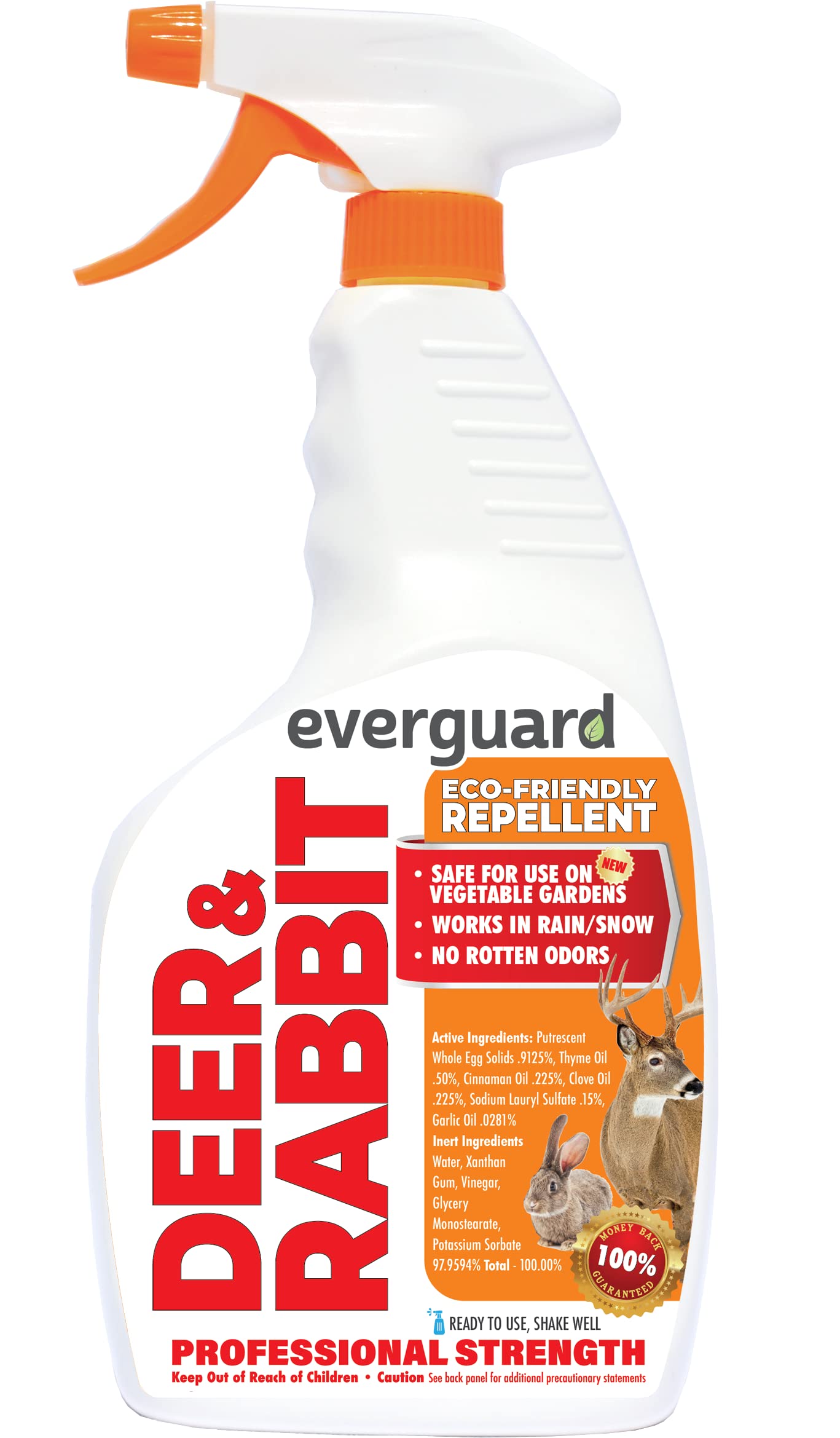
Everguard Ready-to-Spray

Everguard Ready-to-Spray

Spot treatment

Our Score 8.0/10
Check Price

Worth Noting

  • 32 ounces suits spot treatment, not a perimeter
Size
32 fl oz
Format
Ready-to-spray
Nozzle
Adjustable trigger
Weather
Rain, snow and watering
Read the full review

There is a version of rabbit control that is mostly logistics — finding the sprayer, measuring concentrate, rinsing the tank — and this bottle skips all of it. Shake it, twist the nozzle, spray. That immediacy is worth more than it sounds, because the best moment to treat a plant is the evening you notice it's been nibbled, and the easier that moment is, the more often it happens.

The formula is egg solids plus thyme, cinnamon, clove and garlic oils, a different scent profile from the classic sulfurous concentrates, and it's labeled for vegetable gardens as well as flower beds, lawns and shrubs. It's also built to hold through rain, snow and watering rather than needing a dry spell to go down. For a mixed plot — a few tomato plants, a rose, the shrubs by the driveway — one bottle handles the whole round without a second trip for the tank.

Our one design note is the adjustable head. It's genuinely useful for switching between a soaking spray for foliage and a finer mist for a hedge, but twist-style nozzles drift, so set the pattern deliberately each time instead of assuming it's where you left it. That's a small friction, and it's the kind of small friction that decides whether a bottle gets used twice or twenty times.

Bottom line: The bottle we keep by the back door: no measuring, a trigger you can grab the moment you see damage, and a formula labeled for vegetable beds.

How We Tested the Best Rabbit Repellent Sprays

My team and I started by pulling every rabbit repellent we could find from garden centers and online retailers—more than 40 formulas—then narrowed the list to 15 based on active ingredients, labeled coverage (rabbits, deer, or both), price per ounce, and whether the manufacturer gave clear reapplication guidance. I ruled out anything with vague instructions or a bottle size that made the cost per application hard to calculate.

Testing ran for 12 weeks, from late spring into summer, in a backyard with heavy rabbit pressure and occasional deer visits. I sprayed half of each raised bed and left the other half untreated, then checked the treated plants at 24 hours, after every rain, and at the end of each labeled reapplication window. I looked for new nibbles, stripped stems, and droppings—not just whether the plants were still standing.

Odor was assessed at application and again the next day: some formulas reeked of rotten eggs, while others had a milder garlic or mint scent that faded faster. I timed how long each bottle lasted and calculated cost per application based on the label's coverage area, which is where value really showed up. For deer, I noted whether treated hostas and daylilies escaped browsing where deer had been active. I also tracked how many times I had to reapply after rain, because a spray that needs weekly touch-ups is a different commitment than one that holds for two or three weeks.

How to Choose Rabbit Repellent Sprays

Read the coverage figure before the bottle size

Two bottles of similar size can treat wildly different areas. The ready-to-use sprays here run about 500 square feet per bottle; a 40-ounce concentrate claims up to 6,000. That gap is the biggest decision in this category, because a bottle that covers a bed will run dry halfway around a fence line, and a concentrate you never mix protects nothing.

Rough out your square footage first. A foundation planting is a couple of hundred square feet, a fenced vegetable plot a few hundred, a property perimeter in the thousands. Under about a thousand square feet, ready-to-use is a fair trade for convenience. Above it, concentrate is the only format that makes sense, and a basic pump sprayer pays for itself within one season.

The smell is the mechanism, not a defect

Every effective product here works on aversion, and aversion is mostly odor: putrescent egg solids, garlic, thyme, clove. A spray that smells like nothing while the foliage is wet is either formulated to fade as it dries or relying on taste alone — and taste only comes into play after an animal has already taken a bite.

Wet, these sprays are potent enough to clear a patio; dry, most fade into the background. Spray in the evening, keep the mist off furniture, doormats and washing on the line, and give a treated bed a day before you host. If the bed sits against the house, choose one that dries quiet — the Safer Deer Off earns its place here for exactly that reason.

Plan for rain, new growth and the reapplication rhythm

Rain-resistant appears on nearly every label here, and it is worth something, but it isn't permanence. A soaking rain, overhead irrigation and a flush of fresh leaves all shorten an application, because new growth carries no residue at all. Reapply after heavy rain, after a week of daily watering, and whenever a new set of leaves opens.

Spray undersides as well as tops — that's where rabbits work and where rain is slowest to reach — and treat a foot or two beyond the plants actually being eaten. A rabbit's route runs past your bed, not through it, so the perimeter is doing half the work.

Place the spray where you can live with it

Because these are scent repellents, placement does as much work as strength. Keep treated foliage away from doorways, patio edges and anything a dog or a child brushes past; the residue is unpleasant on skin and worse tracked indoors. Mark the calendar for the next pass while the sprayer is still out — a repellent that lapses for three weeks in midsummer is a repellent you start over with.

Frequently Asked Questions

Final Verdict

The Liquid Fence concentrate is the bottle we buy again. It covers more ground per container than anything else here, it works on scent before a plant gets bitten, and mixing your own is a small price for a season of perimeter coverage.

If the smell is the thing that has kept you from spraying at all, take the Safer Deer Off instead and plan on buying more of it — it dries quiet, and it's the one we keep beside the patio rather than in the shed.