Pest & Weed Control

Best Deer Repellent Sprays of 2026

The first time deer find your garden, they don't sample it — they mow it. I walked out one June morning to hostas clipped to the stems and a row of arborvitae nibbled into lollipops. A deer repellent spray doesn't fence anything; it makes your plants smell or taste wrong enough that a deer moves on down the street instead. The catch is that the formulas doing the hardest work are usually the ones you can smell from the driveway.

Over the past five months I've put 14 sprays through the same beds with a trail camera watching the damage, and the deciding factors turned out duller than the labels suggest: how far a bottle goes, how a spray holds up after rain, how often it needs reapplying, and whether the odor fades or hangs around all weekend. Deer are creatures of habit, too, so a formula that gets ignored after three weeks is less a failure than a signal to alternate scent- and taste-based types. The picks below are sorted by the situation each one suits.

1

Deer Out Concentrate 32 oz

Top Pick
Deer Out Concentrate 32 oz

Everyday deer defense

Our Score 8.8/10
Check Price

Worth Noting

  • Must be mixed before spraying
Form
Concentrate
Scent
Mint
Volume
32 fl oz
Rain Resistance
Rain-resistant
Read the full review

A concentrate only earns its keep if you are going to spray more than once, and that is exactly the gardener Deer Out is built for. The 32-ounce bottle gets mixed in a pump sprayer, so you can make a batch for the hostas, another for the fruit trees, and leave the rest for the next round. We like that the formula is rain-resistant rather than merely rain-tolerant: two sticker ingredients are meant to hold it on the leaf through a shower.

The scent is what makes this the easiest one to live with. Mint is a real advantage when you are spraying near a patio or front walk; you do not have to clear the yard for the afternoon. It is still a repellent, not a perfume, so apply it on a calm day and keep the mist where you want it. The all-natural labeling and year-round use make it a reasonable default for a mixed garden.

Longevity is the part to manage. Rain-resistant does not mean rainproof, and new growth comes in untreated, so the beds that get the most deer pressure will need another pass sooner than the label suggests. If mixing is a chore, I Must Garden's ready-to-use jug is the easier choice; if you want a concentrate that earns its shelf space, this is the one we recommend first.

Bottom line: We recommend Deer Out's concentrate as the default deer spray: it has the strongest balance here of rain resistance, a livable mint scent, and concentrate value for repeat applications.

2

Liquid Fence Concentrate 1 Gal

Liquid Fence Concentrate 1 Gal

Large properties

Our Score 8.8/10
Check Price

Worth Noting

  • Premium price for a concentrate
  • Requires a separate sprayer
Form
Concentrate
Volume
1 gal
Coverage
Up to 20,000 sq ft
Rain Resistance
Rain-resistant
Read the full review

The first thing to understand about Liquid Fence's gallon concentrate is the scale. It is meant for the person with a long driveway, a hedge line, or a windbreak of shrubs, not someone with three pots by the door. The label puts coverage at up to 20,000 square feet, and the concentrate format means you can mix a fresh batch in your own sprayer rather than carrying several ready-to-use bottles around the property.

The second thing is the smell. This is a repellent that announces itself while you are mixing and spraying, and it is the reason some gardeners never get past the first application. We think the trade-off is worth it for a large planting, but timing matters: spray on a still morning, keep the nozzle low, and give treated foliage time to dry before anyone uses the yard. Once it settles, the garden is usable again, but the jug should stay sealed and out of the car.

As a large-area pick, it makes the most sense where deer pressure is steady and you are already committed to a spraying routine. The formula is labeled rain-resistant and year-round, and it targets rabbits as well as deer. If you want a lower-odor concentrate, Deer Stopper is the one to look at; if you need to cover real distance, this gallon is the more practical tool.

Bottom line: Our pick for a large property is Liquid Fence concentrate: the gallon size and stated coverage go far, provided you can tolerate a pungent mix.

3

I Must Garden Mint 1 Gal

I Must Garden Mint 1 Gal

Ready-to-use convenience

Our Score 8.6/10
Check Price

Worth Noting

  • Needs reapplication after rain and new growth
Form
Ready-to-use
Scent
Mint
Safety
Pets and pollinators
Volume
1 gal
Read the full review

We reach for I Must Garden first when the spray is going near the house. The mint scent is pleasant enough that you do not feel you have ruined an afternoon, and the label says it is safe for pets and pollinators. That combination is rarer than it should be in this category: a lot of effective deer sprays make you want to stay indoors for the rest of the day.

The other convenience is that it is ready to use. There is no measuring, no concentrate to decant, no separate sprayer to clean. A gallon jug with a trigger is the whole kit, and that matters if you are spot-treating new damage every few days or spraying a border before a garden party. The formula is built for plants damaged by deer, and it includes sticking agents, so it is not just a quick mist.

The ready-to-use format is the point. There is no mixing, so you can grab the jug for a quick pass on the roses and put it away. That makes it the one we keep by the door for small-to-mid beds, especially where children or pets use the yard.

Bottom line: We reach for I Must Garden when we want a ready-to-use spray that smells like mint and is labeled safe around pets and pollinators.

4

Deer Stopper Quart Concentrate

Deer Stopper Quart Concentrate

Edible gardens

Our Score 8.4/10
Check Price

Worth Noting

  • Requires mixing and a separate sprayer
Use
Fruits and vegetables
Form
Concentrate
Drying
Dries clear, odor-free
Volume
32 fl oz
Read the full review

The 30-day claim is the headline, but the reason to choose Deer Stopper is what it does not do: it dries clear and odor-free, and it does not leave a sulfur cloud hanging over the patio. For a bed beside a front door or a vegetable patch you actually use, that matters as much as the repellent itself.

It is a concentrate, and the label is where it earns its keep: fruits and vegetables are explicitly in scope, which is a narrower club here than you might expect. We like it for a kitchen garden or a row of blueberries because you can treat the plants you are going to harvest without wondering whether the label allows it. The all-natural, food-grade labeling reinforces that role.

The 30-day window is a useful planning number, not a force field. Heavy rain, irrigation, and new growth all shorten the real interval, and the label's weather claim should not stop you from walking the bed after a wet week. If you want a low-odor concentrate for edibles and do not mind mixing, this is the one we point to first.

Bottom line: For beds near the house or edibles, we prefer Deer Stopper's concentrate: it dries clear and low-odor and is labeled for fruit and vegetable gardens.

5

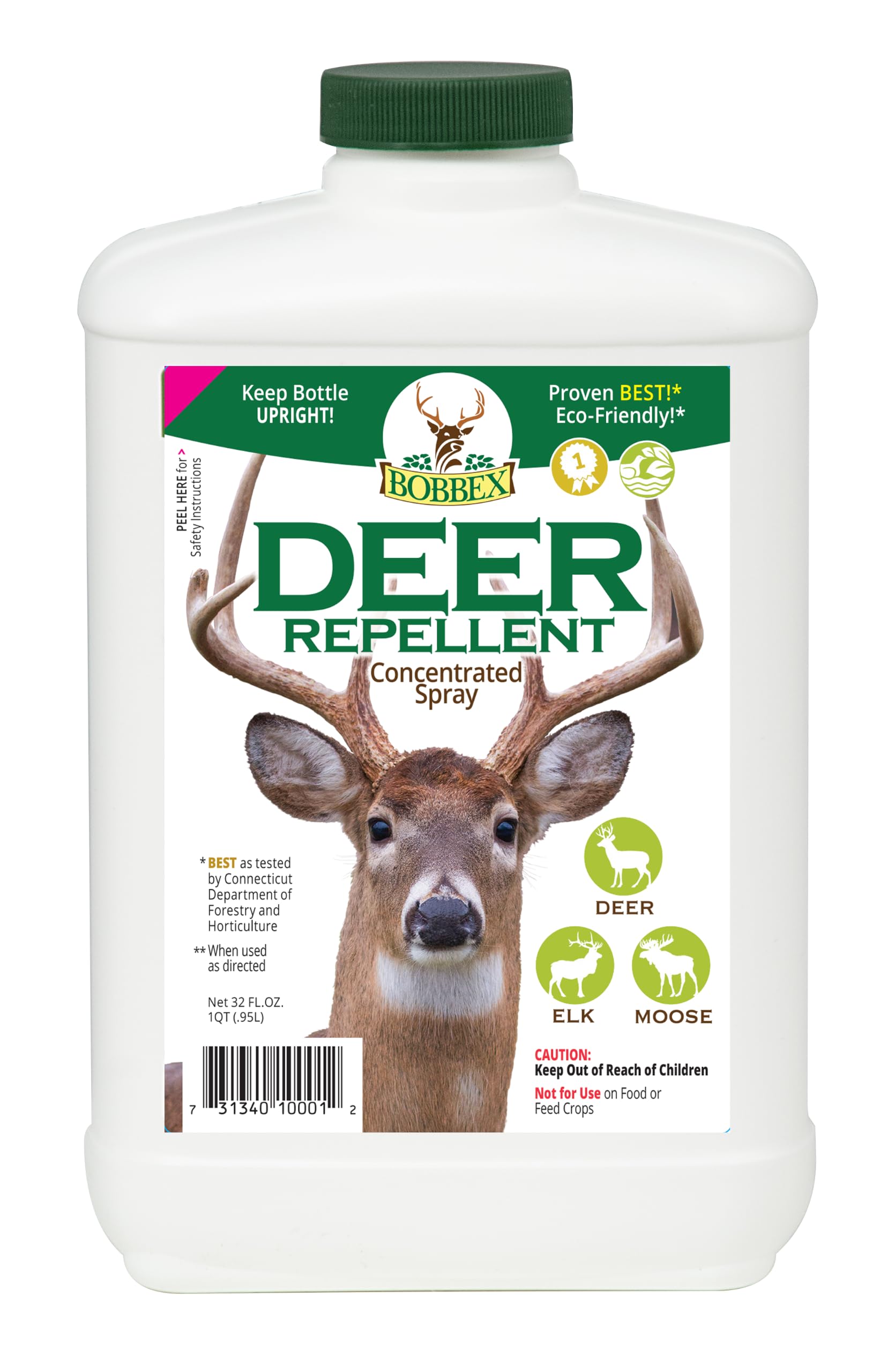
Bobbex Concentrate 32 oz

Bobbex Concentrate 32 oz

Heavy deer pressure

Our Score 8.4/10
Check Price

Worth Noting

  • Not intended for most edible leaves
Form
Concentrate
Action
Smell and taste deterrents
Safety
Harmless to wildlife
Volume
32 fl oz
Read the full review

Bobbex takes a different approach from the mint-scented sprays: it goes after both smell and taste, with a sticker that is meant to keep the formula on the leaf. That combination is why we reach for it when deer have already browsed and a single-sense repellent has not changed their route.

The cost is a genuinely strong odor while you are mixing and spraying. It is not a subtle garden product, and we do not spray it right before guests arrive. But the odor fades once the foliage dries, and the label allows use on most plants, so it fits an ornamental border where you can work in the early morning and leave the rest of the day for the smell to settle.

As a concentrate, it is a decent value for a gardener who already has a sprayer and will keep up with applications during active growth. The 32-ounce bottle is not the biggest jug here, but the sticking formula means you are not necessarily spraying after every light shower. If your deer pressure is heavy and you want a multi-action deterrent, Bobbex is the serious option; if odor is the deciding factor, Deer Stopper is the calmer choice.

Bottom line: Our choice for heavy deer pressure is Bobbex concentrate, whose smell-and-taste approach and sticking formula suit ornamentals that have already been browsed.

6

Plantskydd Ready-to-Use 1.3 Gal

Plantskydd Ready-to-Use 1.3 Gal

Dormant-season jobs

Our Score 8.4/10
Check Price

Worth Noting

  • Strong blood-meal odor while wet
Form
Ready-to-use
Volume
1.3 gal
Coverage
500-600 plants at 1 ft
Rainfast
Within 24 hours
Read the full review

Plantskydd is the one we think of when the forecast is ugly. Its label says it becomes rainfast within 24 hours, and the schedule stretches to every three to six months in the dormant season, which is a different rhythm from the typical growing-season spray.

The 1.3-gallon jug is ready to use but does not include a trigger, so plan on a separate sprayer. The coverage claim is unusually practical: 500 to 600 plants at one foot high, rather than a vague acreage number. That makes it suited to a nursery bed, a row of small shrubs, or a property with a lot of individual plants to walk past.

We like it most for late fall and winter, when deer are still browsing and you want one application to carry through a long stretch. The jug is heavy and the formula is a specialist, but for a dormant-season job on many small plants, it is a sensible tool. If you need a pleasant-smelling spray for the patio, look elsewhere in this group.

Bottom line: We keep Plantskydd for dormant-season and high-plant-count jobs, where its rainfast blood-meal formula and large jug make sense.

7

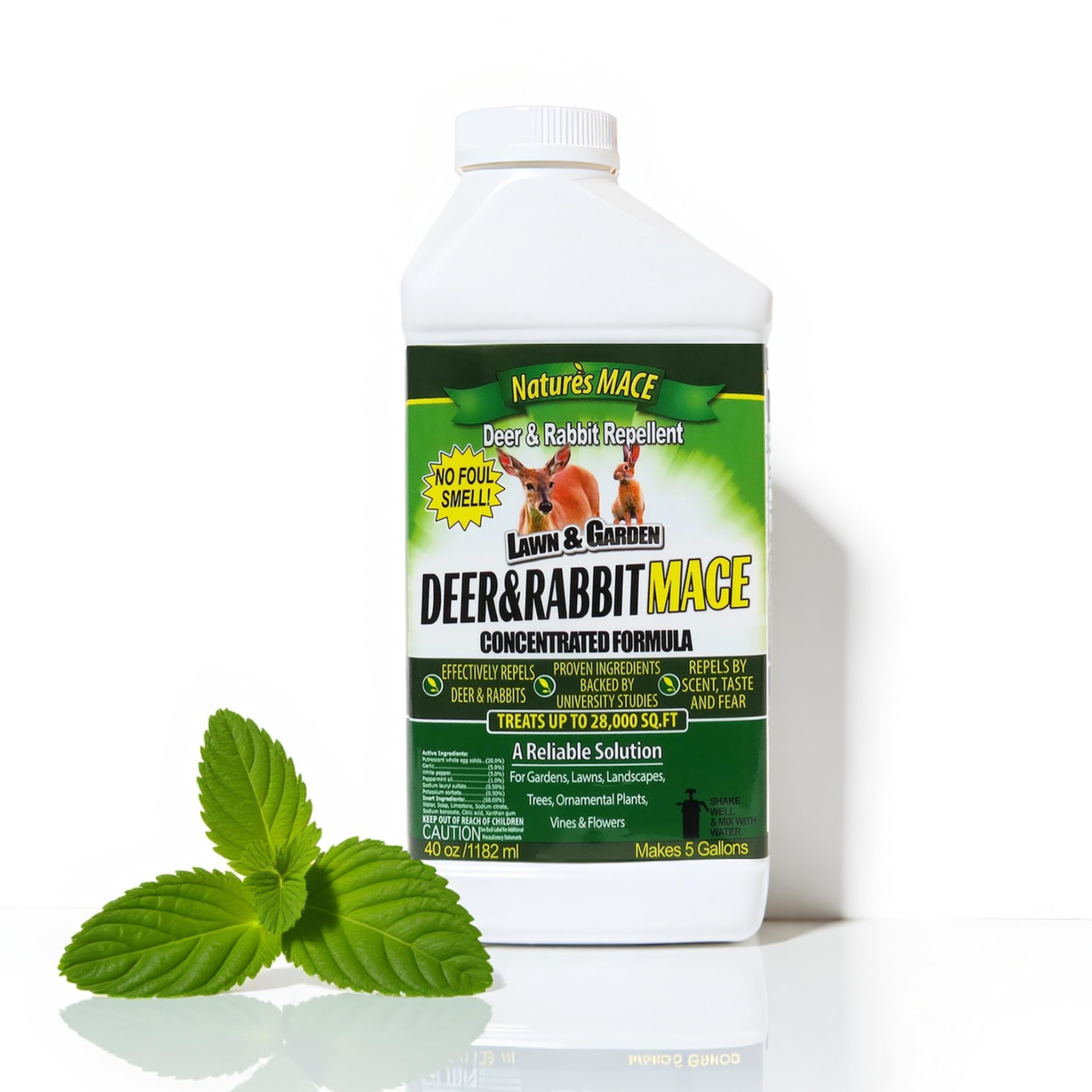
Nature's MACE Concentrate 40 oz

Nature's MACE Concentrate 40 oz

High-coverage plantings

Our Score 8.2/10
Check Price

Worth Noting

  • Can clog some sprayers
Form
Concentrate
Volume
40 fl oz
Coverage
Up to 28,000 sq ft
Mixed Yield
5 gal
Read the full review

If you measure a repellent by how much ground it covers, Nature's MACE is the numbers pick: 40 ounces of concentrate makes five gallons of spray and treats up to 28,000 square feet. That is more area than the Liquid Fence gallon claims, and it makes this a candidate for a large planting or a long property line.

The formula uses a three-pronged approach of fear, scent, and taste, and carries a minty scent rather than a rotten-egg one. We like that for a garden you have to walk through while spraying. It is labeled pet-safe and safe for plants, which broadens the places you can use it, though the label still decides the details.

The catch is application. The mix needs to go on thoroughly if it is going to bind to the foliage. Coverage on paper is not the same as coverage on a dense hedge; plan to slow down and keep the nozzle moving, especially when the leaves are layered.

For a big job, it is a strong choice: the yield is generous, the scent is workable, and the coverage claim is easy to plan around. We do not make it the default for a small bed where a ready-to-use bottle is simpler, but it earns a place on a long fence line or a large planting.

Bottom line: We see Nature's MACE as a high-coverage concentrate for big plantings, with the caveat that its sprayer-clogging habit demands a careful application.

8

Safer Garden Deer Off 32 oz

Safer Garden Deer Off 32 oz

Patio-side plants

Our Score 8.0/10
Check Price

Worth Noting

  • Covers only 500 square feet
Form
Ready-to-use
Volume
32 fl oz
Coverage
500 sq ft
Protection
Up to 90 days
Read the full review

An odorless deer repellent sounds like a contradiction, but that is the promise here: dual-action scent and taste, with a formula that dries without a lingering smell. For a patio border or a front walk, that is a real social advantage.

The label claims up to 90 days of protection, and the weather-resistant formula is meant to hold up between applications. On a small bed, that is a convenient schedule, and the ready-to-use bottle keeps the job simple.

What we like is the role it fills: a first line of defense around a deck, a path, or a small bed you walk past every day. It is easy to grab, easy to apply, and it does not make the yard unpleasant. That makes it a reasonable choice for someone who wants to spray without planning the day around the smell.

The limit is staying power under pressure. We treat this as a spot treatment for lighter browsing, not a whole-property solution. If deer are already stripping the shrubs, a stronger-smelling concentrate is the better tool.

Bottom line: We treat Safer Garden Deer Off as a low-odor spot treatment for lighter deer pressure, not as a whole-property solution.

How We Tested 14 Deer Repellents Through a Full Browsing Season

We started by rounding up more than 40 sprays sold at garden centers and online, then cut the list to 14 by dropping anything that required a backpack sprayer, anything whose per-application cost worked out to more than a few dollars per bed, and near-duplicates sharing the same active ingredient. What survived covered concentrates, ready-to-use triggers, and hose-end bottles, so we weren't just comparing one format against itself.

Testing ran five months, from the first spring flush through early fall, across two yards backed by woods — the kind of deer pressure where an unprotected hosta doesn't stand a chance. Each week we sprayed at dusk, staked treated and untreated plants side by side, and counted browsed stems the following morning. A trail camera on the tree line told us whether deer walked the row and turned away or never slowed down at all.

Rainfastness got its own test: we ran a sprinkler over treated foliage for 20 minutes and rechecked those plants three days later. Odor was judged the unglamorous way — standing downwind at one hour, the next day, and after a week — because a spray that keeps deer off but ruins the patio isn't a win. We also logged reapplication intervals, measured how many square feet a bottle actually covered before it ran dry, and noted whether trigger heads clogged or sputtered halfway through a bed.

How to Choose Deer Repellent Sprays

Concentrate or Ready-to-Use

The first choice is not which brand but which format you will actually use. A concentrate needs a pump sprayer, measuring, and a rinse routine, but it lets you mix a batch for the job and usually costs less per mixed gallon. A ready-to-use jug is grab-and-go, better for spot treatments and small beds, and easier to keep near the door.

If you already own a sprayer and have more than a few shrubs, a concentrate is the practical default. If your garden is a porch border and you spray every week, the convenience of ready-to-use wins. Do not buy a concentrate without checking that your sprayer's nozzle and seals are up to the formula; thick or blood-based products can clog a fine mister.

What the Smell Is Buying You

Repellents work on deer through smell, taste, or both, and the strongest smells are often the most reliable. Mint and lavender formulas are easier to live with; sulfur, garlic, egg, and blood-meal formulas are harder to ignore and often harder for deer to ignore too. Consider where you will spray: near a patio, a mint scent is worth a lot; along a back fence, effectiveness matters more.

Spray on a calm morning when neighbors are not outside and when rain is not due immediately. The smell should fade as the foliage dries, but your sprayer, gloves, and clothes will carry it longer. Keep a dedicated sprayer for repellents, or rinse thoroughly, because the next job might be something you plan to eat.

Rain, New Growth, and the Reapplication Habit

A rain-resistant label is not a season-long pass. Stickers help the formula stay on older leaves, but new growth comes in untreated, and heavy rain or overhead watering can still shorten the interval. The practical routine is to walk the bed after a storm and after a flush of new shoots, then spot-spray the tips the deer will find first.

Follow the label's interval, but treat it as a starting point. If deer are browsing new damage, shorten the interval or switch to a formula with a stronger taste or smell. Coverage matters as much as frequency: a light mist on the outside of a shrub leaves the inner tips unprotected.

Coverage, Edibles, and the Safety Label

Coverage numbers are not interchangeable. Some products quote square footage, others plant counts, and concentrates quote mixed gallons. Match the number to your job: a 500-square-foot bottle is a patio treatment, while a 20,000-square-foot concentrate is a property tool. For a dense hedge, assume you will use more than the open-lawn figure suggests.

Read the plant-safety line before you spray anything you plan to eat. Some formulas are labeled for fruit and vegetable gardens; others are for ornamentals only. The same goes for pets and pollinators: a product labeled safe around them is a better choice near a deck or a flowering border. When the label is silent on a crop, do not spray it.

Frequently Asked Questions

Final Verdict

We recommend Deer Out's concentrate for most gardeners because it gets the balance right: a mint scent you can live with, a rain-resistant sticker, and a concentrate format that rewards a routine. If you are treating a large property, Liquid Fence's gallon is the broader tool; if mixing is the obstacle, I Must Garden's ready-to-use jug is the easier one to keep by the door. Start with the format you will actually use often, because deer repellent works on repetition more than on any single bottle.