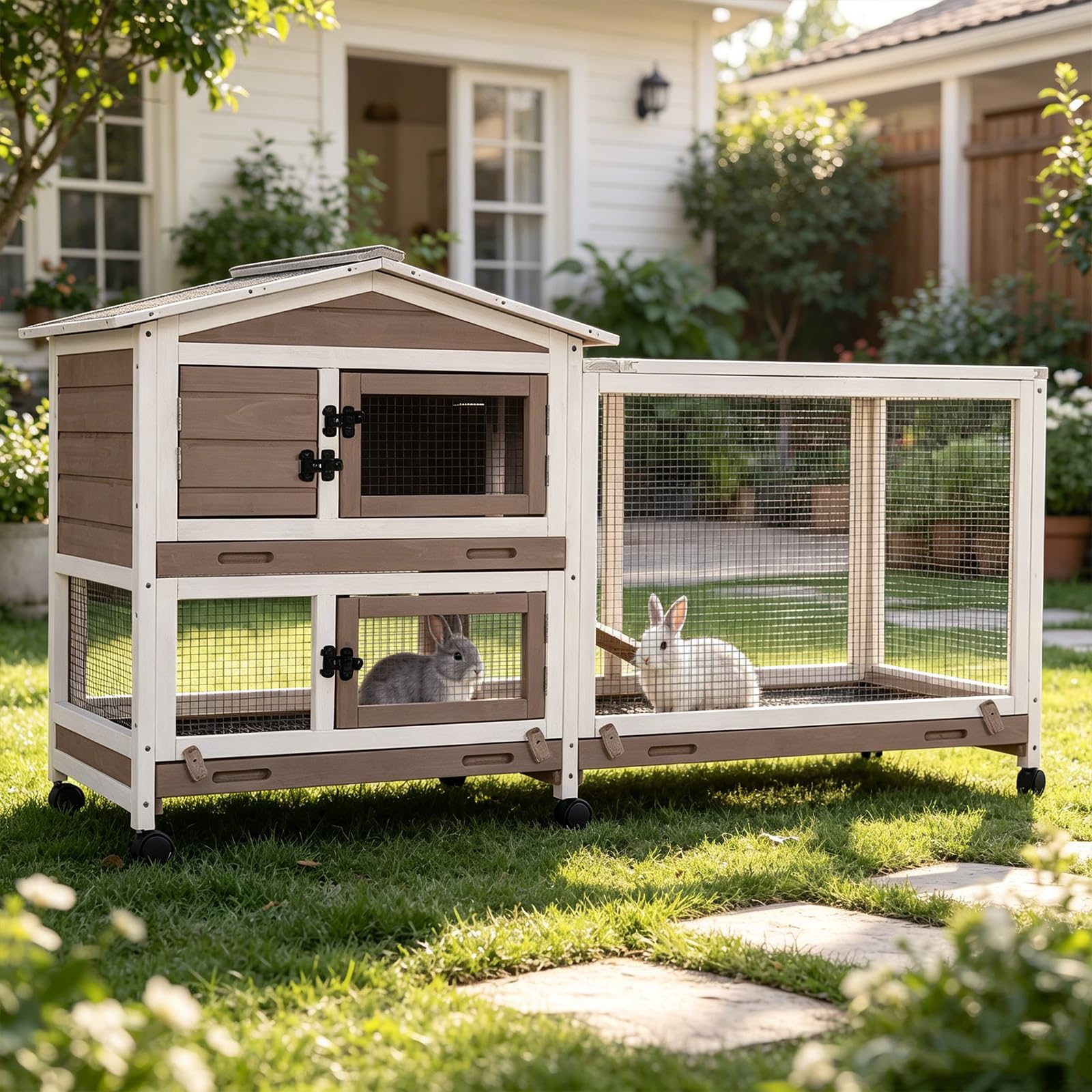
Poultry & Livestock

Best Rabbit Hutches of 2026

Nothing takes the shine off a rabbit hutch faster than finding the door open at dusk. Raccoons and foxes are strong and startlingly clever with latches, and a rabbit that gets out is a rabbit you may not get back. So a hutch has to do two jobs at once: keep your rabbit in and everything else out. After that, the difference between one hutch and another comes down to how it goes together, how pleasant it is to clean out on a cold morning, and whether it's still square after a season of rain and chewing.

I've kept rabbits long enough to know a hutch is a bedroom, not a whole home — pair it with a fenced run and you'll have a far happier animal. Over the past six months my team assembled, weathered, and cleaned out 12 hutches, and the ones that earned a place here had thick wire, real hardware, and a footprint that suits a rabbit at full size, not just as a kit. Below you'll find picks for small yards, tall rabbits, and everything between.

1

PetsCosset Expandable Rabbit Hutch

Top Pick
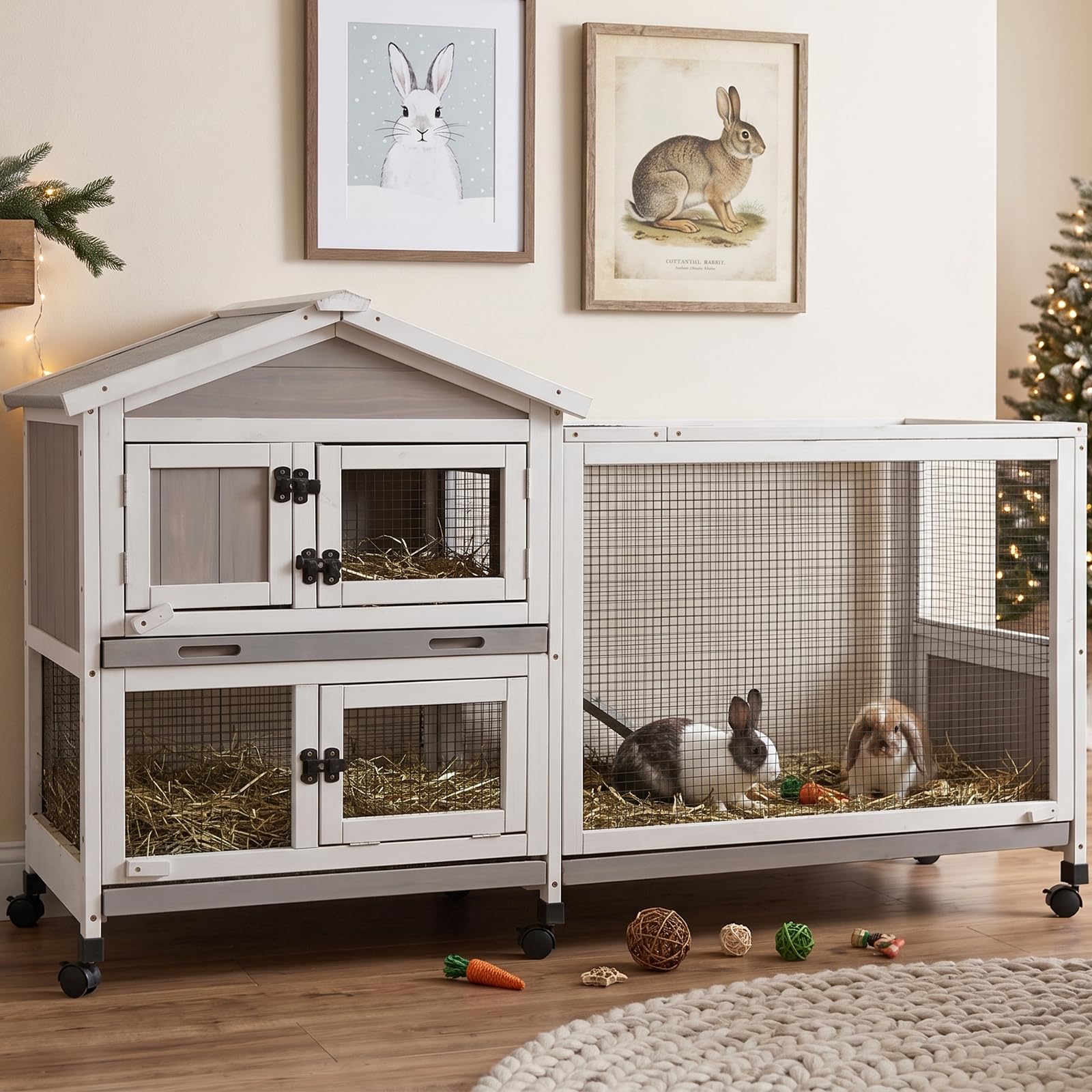
PetsCosset Expandable Rabbit Hutch

Budget large setups

Our Score 8.8/10
Check Price

Worth Noting

  • 90-day warranty is the shortest here
Wheels
6
Pull-out Trays
3
Total Floor Space
About 9.9 sq ft
Overall Dimensions
60.2"L x 22.1"W x 35"H
Read the full review

This is the least expensive full-size hutch here, and it gives up surprisingly little to get there: 60.2 by 22.1 inches, about 9.9 square feet across two levels, three trays, six wheels. Set it beside our top pick and you're saving real money for an inch or two of run. That's why it's the value pick for anyone who wants a big hutch without paying large-hutch money.

The detail we appreciated most is the roof over the run — it lifts, so you can reach down into the lower level from above instead of crouching at a door. Five access doors and three separately sliding trays make a daily clean quick, and the side access panels come off so a second matching hutch can bolt on. That's a neat answer to a growing pair, though it does mean buying twice.

Give the ramp time. Rabbits don't always take to a new incline on the first afternoon, so expect a few days of encouragement, and put the food bowl upstairs for a week if yours is hesitant. Assembly is straightforward for most builds, and the pre-drilled panels reward patience over force.

Bottom line: Spend less, get nearly the same footprint: this is the full-size hutch we recommend when the top pick's price is the sticking point.

2

GDLF 58-Inch Rabbit Hutch

GDLF 58-Inch Rabbit Hutch

Narrow indoor walls

Our Score 8.8/10
Check Price

Worth Noting

  • One full-length tray instead of three
Wheels
6 locking
Bar Spacing
11 millimeters
Pull-out Trays
1
Overall Dimensions
57.7"L x 17.8"W x 34.6"H
Read the full review

17.8 inches of depth is the whole argument for this hutch. Every other full-size hutch here is 22 inches or deeper, and that four-inch difference is what lets this one sit along a hallway wall or at the end of a sofa without eating the room. At 57.7 inches long it still gives you a real run and a raised sleeping level.

It's the best-finished of the wooden hutches here, built in spruce and pre-painted with a water-based varnish the listing describes as non-toxic. Bar spacing is 11 millimeters, the tightest in this group, which matters if you're housing a small breed or guinea pigs rather than a big rabbit. The ramp has timber ridges cut across it for grip, and the sleeping level closes behind a sliding door.

Assembly is well thought out — numbered bags, labeled panels, a visual manual — with one caveat we'd pass on to anyone building it: don't use a drill. The wood is soft enough that a powered screw splits it, so drive everything by hand and leave the screws loose until the frame is square.

Bottom line: The one to buy when the space is a wall rather than a corner: narrow, well-finished, and tight enough in the bars for a small rabbit.

3

Aivituvin Extra Large Rabbit Hutch

Aivituvin Extra Large Rabbit Hutch

Two rabbits

Our Score 8.6/10
Check Price

Worth Noting

  • Fir panels split; casters fail first
Levels
2
Wheels
6 casters, 2 locking
Pull-out Trays
3
Overall Dimensions
62"L x 22.6"W x 33.5"H
Read the full review

Sixty-two inches is the number that settled it. At 62 by 22.6 inches this is the longest hutch in this group, just under 10 square feet of footprint split between a sheltered upper box and an open run, and that length is the difference between a rabbit that can take three hops and one that can only turn around. It's our default recommendation because it gets the two things that matter most here right at full size: usable run and fast cleaning.

Three deep trays do the cleaning work — one under the sleeping box, two under the run — each sliding out on its own, so you can muck out one zone while your rabbit sits in another. The ramp between levels carries metal edging on both sides, a small detail in exactly the spot where a bored rabbit starts chewing. Six casters, two of them locking, let you roll the whole thing out to sweep behind it and lock it back down.

The sloped asphalt roof covers the enclosed house only; the run below and beside it is open mesh. Against a house wall or under a porch that's plenty of protection. In the middle of an open lawn it isn't, and that's the thing to plan around before delivery.

One caution on the size, because the number can mislead. Subtract the upper box that sits over part of that 62 inches and the run is smaller than it sounds, and in a room it reads smaller than the listing photos suggest. Measure the lower level against your rabbit rather than ordering off the overall length.

Bottom line: Our pick for most rabbits: the longest run in this group, three trays that clean one zone at a time, and casters that make sweeping under it a one-person job.

4

Gutinneen Rabbit Hutch with Chew-Resistant Ramp

Gutinneen Rabbit Hutch with Chew-Resistant Ramp

Rabbits that chew

Our Score 8.4/10
Check Price

Worth Noting

  • Only the ramp is metal-guarded; panels are bare fir
Ramp
Aluminium alloy edge
Access Doors
6
Pull-out Trays
3, leakproof
Overall Dimensions
61.2"L x 22.6"W x 33.5"H
Read the full review

Chew-resistant on this hutch refers to the ramp, not the cage. Both long edges of the ramp carry an aluminium alloy strip, and that's precisely where a bored rabbit starts — the route it uses a dozen times a day. The panels, the doors, and the frame are still fir, and no strip changes that.

The door count is what earned it a place. Six openings, including roof panels over the run, mean you can reach any corner without lifting the whole hutch, and the three leakproof trays slide out from the front or the back depending on which side you've pushed against a wall. For slightly less money than our top pick you get the most flexible access in this group, which matters most with a rabbit that won't be herded.

It's also the heaviest of the full-size hutches at 49.5 pounds. On a hard floor the six casters — two of them braked — carry that fine, but plan the route before you build, because you won't want to lift it up a step once it's together.

Bottom line: Buy it for the doors: six ways in and trays that come out either side make this the easiest full-size hutch here to clean around a bunny that won't move.

5

PawHut 49-Inch Wooden Rabbit Hutch

PawHut 49-Inch Wooden Rabbit Hutch

Grass-access runs

Our Score 8.4/10
Check Price

Worth Noting

  • Roof covers the house only, not the run
Roof
Composite asphalt
Run Box
24"L x 20.75"W x 24"H
Main House
21.5"L x 20.75"W x 21.75"H
Overall Dimensions
48"L x 24.75"W x 36.25"H
Read the full review

The floor is the feature. This hutch has no bottom in its run, so it sits directly on grass and a rabbit grazes through the mesh instead of standing on a plastic tray. In a garden that's a different way of keeping a rabbit, and for a lawn with a sheltered corner it's the right one.

The 48-inch footprint splits into a 21.5-inch enclosed house under a composite asphalt roof and a 24-inch run, with a ramp between them and a lockable door at ground level so your rabbit can hop back in on its own. Of the wooden hutches here this is the one that goes together fastest — two people, an afternoon, no drama. The light blue paintwork is also the prettiest finish in this group, reading as garden furniture rather than livestock housing.

Understand what the roof does: it covers the house, not the run. Rain and sun reach the lower level, so site it against a wall or under an eave, and add clips or a small padlock to the turn latches before you leave a rabbit out overnight. Move the whole thing every few days, too, or the grass underneath gives up and you're left with a mud patch.

Bottom line: If the hutch is going on a lawn rather than a patio, start here: the open run is the point, and the build takes an afternoon.

6

Gutinneen 2-Story Rabbit Hutch

Gutinneen 2-Story Rabbit Hutch

Small indoor rooms

Our Score 8.0/10
Check Price

Worth Noting

  • Realistically houses one small rabbit
Warranty
2 year manufacturer
Access Doors
5
Pull-out Trays
2, locking
Overall Dimensions
39.3"L x 22"W x 36.8"H
Read the full review

For one small rabbit in the corner of a spare room or a flat, this is the shape that works: 39.3 by 22 inches of footprint, 36.8 inches tall, so it grows upward instead of spreading sideways across the floor.

The details are better than the price suggests. Five doors, two locking trays, a ramp with metal edging down both full-length sides, four casters with two brakes, and a two-year manufacturer warranty — the longest on this page. The upper level is where a rabbit will sleep; the lower level is where it lives.

Two things to know before you order. The ramp is steep, steeper than on the longer hutches here, so a young rabbit or an older one may need a grip strip or a temporary step for the first week. And be honest about capacity: two levels don't double the floor, and the lower level alone is one small rabbit's worth of space.

Four casters rather than six is the difference you notice in use. At this size it pivots on the spot instead of gliding, which is handy in a bedroom and annoying on a rug, so plan on a hard floor under it.

Bottom line: For a single small rabbit and a tight floor plan, this is the compact hutch we point to — tall, well-equipped, and covered for two years.

7

Mayugardening 2-Story Rabbit Hutch

Mayugardening 2-Story Rabbit Hutch

Tight corners

Our Score 8.0/10
Check Price

Worth Noting

  • Instructions are thin and slow the build
Wheels
4 locking
Main Level
3.98 sq ft
Upper Level
1.8 sq ft
Overall Dimensions
36"L x 17.8"W x 36.7"H
Read the full review

At 36 by 17.8 inches this is the smallest wooden footprint here, a hutch shaped for an alcove, a landing, or the end of a shed rather than a stretch of wall. Two levels take it up to 36.7 inches tall, so it uses height where it can't use floor.

What you get for that footprint is sensible: two deep pull-out trays, four locking wheels, a solid wood frame under a waterproof asphalt roof, and metal bars reinforcing the run where teeth reach. The upper level sits over part of the main floor rather than doubling it, which is the honest way to build a small hutch.

Build it slowly. Assembly is the weakest part of the package and the instructions are thin, so the way through is to leave every screw finger-tight until the whole frame is square, then go around and snug them up by hand. Overdrive one and the wood marks or splits.

Which brings us back to the rabbit count. The listing says two to three; 3.98 square feet on the main level and 1.8 upstairs is one small rabbit's worth of space. Judged that way, this is the hutch we'd choose for a single rabbit in a small room — and at 31.5 pounds assembled it's the lightest wooden hutch here, light enough for one person to lift onto a slab or into a shed for winter.

Bottom line: A well-priced little hutch for one small rabbit, as long as you judge it on its real 5.8 square feet and not the rabbit count on the box.

8

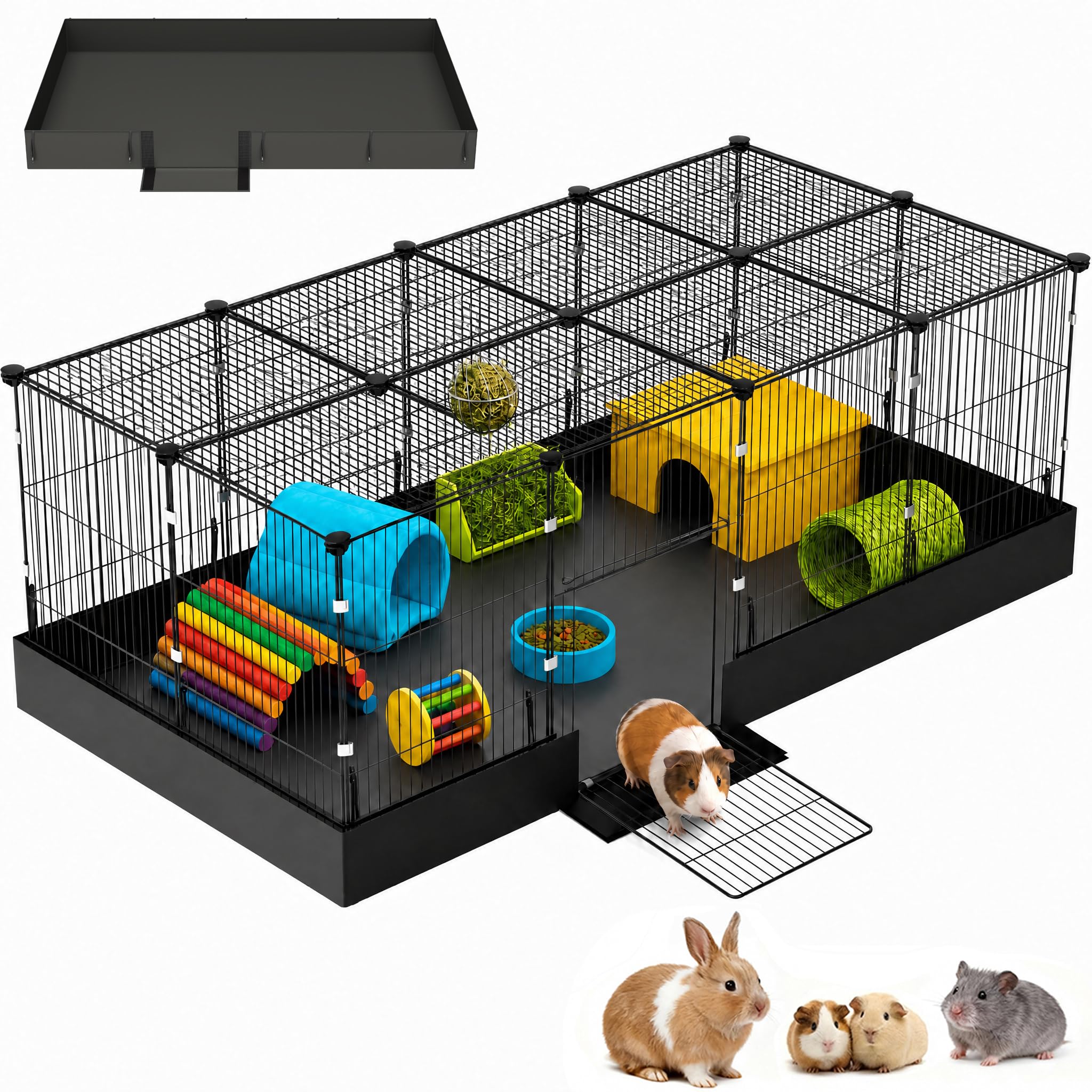
SNAAT 20-Panel Small Animal Cage

SNAAT 20-Panel Small Animal Cage

Indoor floor pens

Our Score 8.0/10
Check Price

Worth Noting

  • 16-inch walls won't hold a jumper
Mesh
0.6 inch
Liner
Waterproof, hooks on
Panels
20
Assembled Size
48"L x 24"W x 16"H
Read the full review

This isn't a hutch, and it shouldn't be sold as outdoor housing. It's 20 wire panels with a waterproof liner that hooks on outside the frame, 48 by 24 inches of floor, 16-inch walls, no roof, and 10 pounds in the box. Outdoors it offers nothing a determined predator can't get past.

Indoors it solves a real problem. The 0.6-inch mesh keeps small pets in, the liner keeps urine off a wood floor, and the panels come apart and store flat between uses. It's also the least expensive thing here by a wide margin, and the simplest way to give a rabbit more floor than a hutch provides — bolted onto the side of a hutch, it becomes an extension run.

The liner is the part to watch. Hanging outside the frame keeps it away from teeth, but it's what wears out, and the fit of the base mat isn't always as tight as the panels themselves. Order it knowing you may end up cutting a mat to size.

Sixteen inches is the number that decides whether it works for you. That's plenty for guinea pigs and for a calm rabbit that stays on the ground, and not enough for a rabbit that likes to jump — those need a lid or a taller panel set. Read it as indoor floor space with walls rather than as a cage with a top, and it earns its place.

Bottom line: Buy it as indoor floor space, not as a hutch: the least expensive way here to give a rabbit more room, provided it isn't a jumper.

How We Tested 12 Rabbit Hutches

We started with more than 60 hutches from large pet retailers and small woodworking shops, then cut anything with a wire floor, a latch that flips open with one claw, or interior space too tight for a full-grown rabbit. That left 12, ranging from budget kits to solid-wood builds. I assembled each one alone using only the tools in the box and timed it from opening the carton to tightening the last screw, noting which models needed a second pair of hands, which had holes that didn't line up, and which shipped with hardware worth keeping.

Every hutch then lived outside for six months, through a wet spring and a cold snap. After each storm I checked roof panels and joints and whether the wood had swelled enough to jam a door, and I leaned on each frame to see whether it racked or the staples pulled. At dusk I worked every latch with garden gloves on and pushed against the wire to see how much it flexed — a rabbit-proof hutch also has to be raccoon-proof.

Cleaning was a weekly job: hose out, scrape, fresh bedding, and a note on where urine soaked into the wood instead of running off. I let rabbits work the corners, ramps, and door edges and inspected for chew damage every few weeks, measured floor space and opening sizes against both a small and a large rabbit, and checked whether each hutch would fit through a standard gate or into the back of a car. Last, I weighed price against what you actually get — thick wire, solid joins, hinges that don't rust — and looked at each one from across the yard, since a hutch sits in your garden for years.

How to Choose Rabbit Hutches

Measure the Floor Before You Trust the Rabbit Count

A hutch's second level is a bedroom, not a run: a rabbit still needs horizontal space to take three hops in a row. Multiply the length by the width of the lower level and compare that number across the hutches on your shortlist. Our longest pick works out to just under 10 square feet of footprint; the smallest wooden hutch here gives roughly 4 square feet downstairs.

Listings that promise two or three rabbits usually count the upper deck in the total. Buy for the floor your rabbit will actually stand on, and treat a hutch as shelter plus a base rather than the whole territory.

Work Out What the Roof Covers

On most of these hutches the asphalt or composite roof sits over the enclosed sleeping box only. The run below and beside it is open mesh, which is fine against a house wall or under a porch eave and much less fine in the middle of an open lawn. Decide where the hutch will stand before you decide which one to buy.

Floor type matters as much. A solid pull-out tray holds bedding and keeps a rabbit off cold ground; a floorless run, like the PawHut's, lets it graze but has to be moved every few days before the grass underneath turns to mud.

Count the Trays and the Doors

Cleaning is where a cheap hutch gets expensive in time. Three smaller trays beat one long one, because you can lift out the soiled section without emptying the whole floor, and trays that pull out from either the front or the back let the hutch sit against a wall.

Then count doors on the side you'll stand on. Five or six openings is common on the larger hutches and it's the difference between reaching in and climbing in.

Expect Chewing, and Buy for the Parts It Reaches

Fir and spruce are soft woods and a rabbit's teeth win in the end. Metal edging on a ramp protects the route the rabbit uses most often; an iron frame protects more of the structure, at a price. No hutch in this group is chew-proof, whatever the listing says.

Whatever you choose, drive screws by hand rather than with a drill. Soft panels split at the fastener, and a split is where water gets in. Give the rabbit apple wood or a chew block and the hutch stops being the target.

Ramps, Wheels, and Daily Handling

A steep ramp is the most common thing a rabbit refuses. Look for one with cross-ridges or a metal edge, and be ready to add a grip strip for a young or an older animal.

Casters are for hard floors: six wheels roll a 40-pound hutch across a patio and sink into grass. Check that at least two of them lock, and think about the route before you build, because a 40- to 50-pound hutch is not something you carry up a step on your own.

Frequently Asked Questions

Final Verdict

Our recommendation is the Aivituvin Extra Large. At 62 inches it has the most usable run of any hutch here, the three trays turn a weekly clean into a ten-minute job, and the casters mean you can roll it out to sweep underneath. Give it a wall or a porch corner rather than open lawn, since the roof covers the sleeping box only.

Choose the PetsCosset instead if you want that footprint for much less money and can live with a short warranty. Choose the GDLF if the wall you have is 18 inches deep rather than 23. And if the hutch is going on grass, the PawHut's floorless run is worth the smaller footprint.