Poultry & Livestock

Best Poultry Feed of 2026

Good poultry feed isn't just scratch grain in a bag. It's the daily ration that keeps a flock laying steadily, growing feathers back after a molt, and acting like themselves at the feeder. I've kept a small backyard flock long enough to know that a bag of feed can look fine and still turn out dusty, ignored, or hard on digestion. The right feed fixes all three: birds clean it up, droppings stay consistent, and you stop pouring money into a bag that ends up as coop litter.

Over the past five months, my team and I put 12 different poultry feeds through the same morning-and-evening routine with a mixed flock of hens. We watched which crumbles held together in the feeder instead of breaking into dust, which pellets the birds actually finished, and how each feed held up when scattered on wet ground or in a water dish. One thing first-time keepers learn fast: the cheapest bag is rarely the cheapest feed once you count what gets wasted. The picks below reflect that math, along with the labels and the birds themselves.

1

Manna Pro Chick Starter

Top Pick
Manna Pro Chick Starter

New chicks

Our Score 9.4/10
Check Price

Worth Noting

  • Five pounds goes fast in a full brooder
Form
Crumbles
Bag Size
5 lb
Age Range
Hatch to 16 weeks
Medication
Non-medicated
Read the full review

This is a sixteen-week feed, not a lifetime one, and that is the first thing to understand about it. Manna Pro's chick starter is formulated for the brooder, from hatching until roughly the point of lay, as a 5-pound bag of non-medicated crumbles with vitamins and minerals added and no antibiotics in the formula.

Non-medicated is the right default for most backyard setups: it keeps the coccidiosis decision in your hands rather than in the bag, and it is the version Manna Pro lists for ducklings and goslings as well as chicks. The crumble is small and soft, which is the entire point for a bird a few days old — anything coarser gets billed out of the feeder onto the shavings. If there are ducklings in with the chicks, though, check the niacin on the label first, because a chick formula is balanced for chicks and ducks need more of it than that.

The bag is the real limitation. Five pounds sounds generous until there are a dozen birds in the brooder, and then it is gone before they are feathered out. We minded that less than we expected, since starter is the one feed where a fresh bag beats a bargain sack, but plan on buying twice before the first egg shows up.

Bottom line: For a brooder full of new chicks, this is the simplest start: non-medicated crumbles small enough for a day-old to handle, with nothing to mix in.

2

Purina Layena Layer Crumbles

Purina Layena Layer Crumbles

Laying hens

Our Score 9.2/10
Check Price

Worth Noting

  • Costs more per pound than bulk farm-store sacks
Form
Crumbles
Bag Size
25 lb
Life Stage
Adult laying hens
Shell Support
Calcium, manganese, trace minerals
Read the full review

A layer feed has one job the other bags do not: carry enough calcium for an eggshell a day without shorting the hen. Layena is built around that, with calcium, manganese and trace minerals for shell strength, marigold-derived xanthophyll for the deep yellow yolk people expect from backyard eggs, and lysine and methionine alongside vitamins A, D and E. For a flock that is already in lay, it is the bag we tell people to buy.

The crumble matters more than it sounds. Coarse crumbles sit in a feeder instead of sifting straight through the trough, and they give a bantam or a young pullet something she can actually pick up — a pellet often ends up on the ground where the bigger hens cannot be bothered and the mice can. Purina lists this one for small and medium breeds, which covers most backyard flocks. Crumbles do break down into dust at the bottom of the bag, so tip it gently and do not pour the last cupful into a wet feeder.

Where it gives up ground is price: pound for pound, a farm store's bigger sack usually beats it. What you get for the difference is a 25-pound bag sized for a backyard rather than a barn, and a formula you do not have to supplement. One thing worth knowing before you switch: blend the new crumble into the old over a week or so. Hens that refuse a sudden change will make good feed look bad.

Bottom line: Our pick for a laying flock: one complete crumble with the calcium, minerals and yolk color already in it, so there is nothing to add.

3

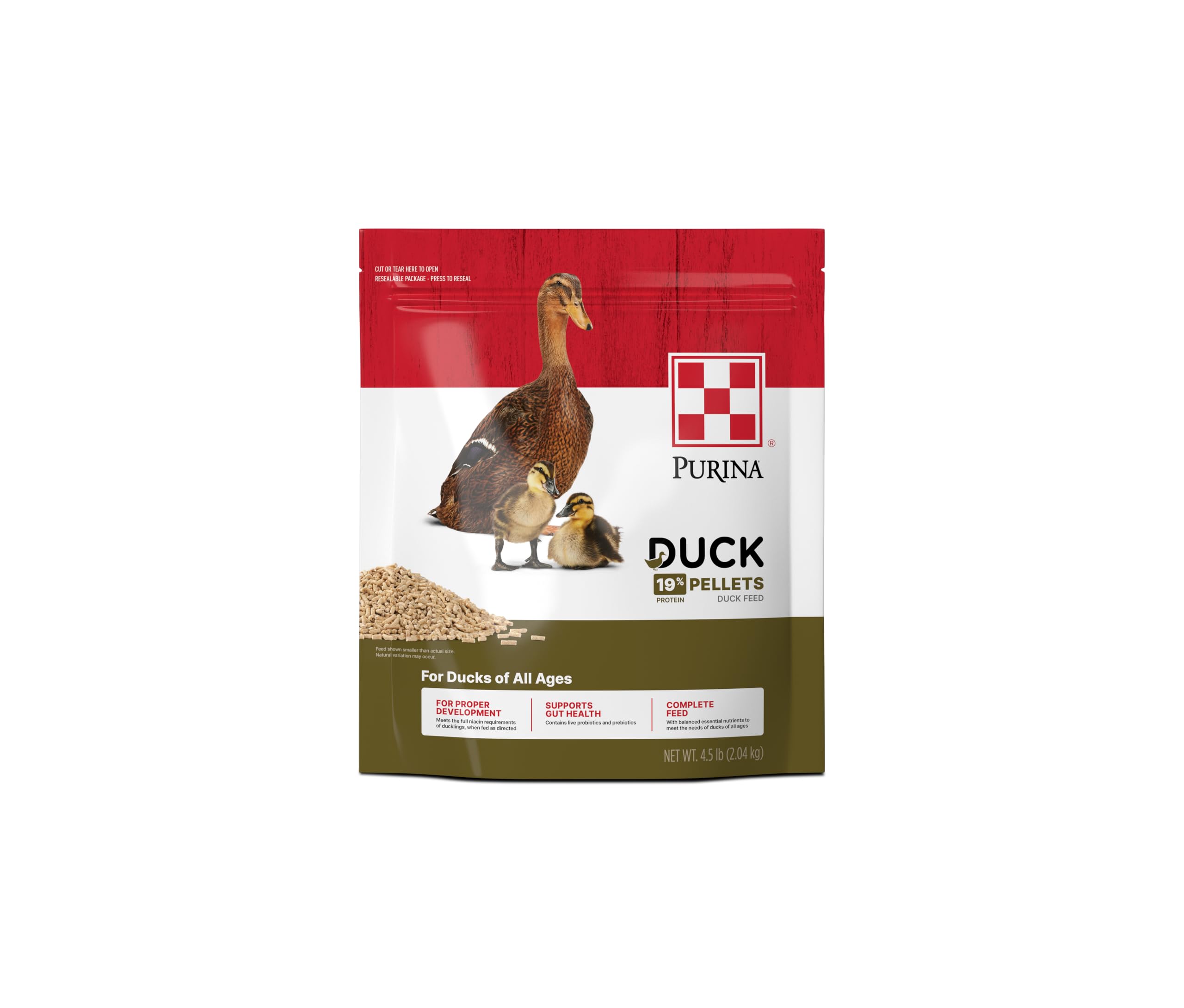
Purina Duck Feed

Purina Duck Feed

Ducks of any age

Our Score 9.2/10
Check Price

Worth Noting

  • Pellets sink, so no good thrown on open water
  • Small bag for more than a pair of ducks
Form
Pellets
Niacin
At least 60 ppm
Protein
19%
Bag Size
4.5 lb
Read the full review

Sixty parts per million is the number that justifies this bag. Ducklings need more niacin than chicks do — it is what their legs are built on — and Purina's duck formula states at least 60 ppm of it, alongside 19% protein and added prebiotics and probiotics. It is an all-life-stages feed, so the same pellet goes from a week-old duckling to a laying duck without a change in between.

We like that it is a pellet rather than a crumble. Ducks do not peck the way chickens do; they scoop, and a pellet gives them something to grab and carry to the water dish instead of sifting through fines. The niacin is also exactly the thing backyard duck keepers get wrong by leaving ducklings on chicken ration, and having it stated on the bag removes the guesswork. If you keep ducks, this is the one feed here formulated for them specifically.

Two practical limits are worth knowing up front. The pellets sink — this is not a floating feed, so a handful tossed onto a pond is gone below the surface in a moment; scatter it at the bank or feed in a shallow dish where they can reach it. And 4.5 pounds does not go far past a pair of ducks, so a bigger flock will be reordering often enough that the cost per pound becomes the real complaint.

Bottom line: Duck keepers should start here: the niacin ducklings need for their legs is already in the bag, at a level a chicken formula is not built to carry.

4

Manna Pro All Flock Crumbles

Manna Pro All Flock Crumbles

Mixed backyard flocks

Our Score 8.8/10
Check Price

Worth Noting

  • Not a layer formula
  • Pricier than a layer sack of the same size
Form
Crumbles
Protein
16%
Species
Chickens, ducks, geese, turkeys, gamebirds
Bag Size
25 lb
Read the full review

Chickens, ducks and geese in the same pen create a feeding problem no single-purpose bag solves: layer feed carries more calcium than a drake needs, and a starter is too low in calcium for a hen in lay. Manna Pro's All Flock is aimed straight at that pen — one 16% protein crumble for chickens, ducks, geese, turkeys and gamebirds, with probiotics added, no artificial colors or flavors, and no added antibiotics.

Soybean meal is the protein source the listing names, which is ordinary and effective. The more useful part is that this is a complete ration rather than a scratch mix with a flock-friendly label on it, and the crumble is coarse enough for a turkey yet small enough for a bantam to work through. What it is not is a layer formula: the daily shell-building calcium is the layer bag's job, so a hopper of oyster shell on the fence is part of the setup rather than an optional extra. Hens take what they need and the rest of the pen ignores it.

For a genuinely mixed flock we think this is the bag to keep in the bin, and the price per pound is the trade — 25 pounds of all-flock costs more than a layer sack of the same size. That premium buys flexibility, and flexibility is only worth paying for if you actually have more than one species out there. A pen of nothing but laying hens is spending on a problem it does not have.

Bottom line: If chickens, ducks and geese share a pen, buy this one and put out oyster shell for the hens — it is the simplest way to feed everybody from one bin.

How We Tested Poultry Feed With a Backyard Flock

We started by reading guaranteed analyses and ingredient lists, then narrowed the field by life stage, pellet or crumble size, and cost per pound; we also ruled out anything that was mostly dust at the bottom of the bag. That left 12 feeds, which we used over five months in a backyard coop with a mixed flock of hens. Every morning and evening I filled the same hanging feeders, then stood back and watched who came running, what got scratched out, and what was still sitting there an hour later.

Taste showed up as cleanup rate: some feeds disappeared before I finished topping off the water, while others were sifted through and left. For digestibility, I checked droppings for whole grains and loose consistency, and noted whether the coop smelled sharper than usual. Effectiveness was measured in egg numbers, shell strength, and how quickly molting birds grew feathers back; healthiness showed up in weight, energy, and whether anyone looked off. We also compared the guaranteed analysis to what the birds actually did with it—a high protein number means little if the flock won't eat it.

Crumble quality got its own check: I poured each bag into a clean bucket, shook it, and looked at how much broke down into fines. Size mattered too—small birds had trouble with oversized pellets, and big hens scattered tiny crumbles. For value, I weighed what went in against what got wasted and how long a bag lasted. And for anyone feeding waterfowl, I dropped a handful into a shallow water dish to see whether it floated, sank, or turned to mush before the birds could get to it.

How to Choose the Right Poultry Feed

Start With the Bird, Not the Bag

Species and age come first, and they are not negotiable in either direction. Chicks need a starter, hens in lay need a layer formula with calcium built in, ducks need enough niacin for their legs, and a pen holding several species needs an all-flock feed plus a separate hopper of oyster shell for the hens that are laying. The trap is the bag that says for all poultry and gets fed to a heavy-laying flock with nothing on the side; shells thin out over weeks rather than days, so you never connect the two.

What the Numbers on the Tag Tell You

Protein is the headline and the least useful number on its own — the feeds here that state one sit at 16% and 19%, both reasonable for backyard birds. Calcium decides whether a bag is a layer feed; niacin decides whether it is a duck feed, and Purina's duck formula carries at least 60 ppm because ducklings need far more of it than chicks. You cannot patch a niacin shortfall by feeding more chick starter, so if there are ducklings in the brooder, buy the duck formula.

Crumbles, Pellets, and the Feeder

Crumbles suit chicks, bantams and mixed-size flocks because every bird can pick them up; pellets suit ducks, which scoop rather than peck, and hold their shape better in a wet dish. Whichever you buy, expect the bag to sort itself out in storage — the fines end up at the bottom, and a torn sack in a humid shed turns them into a brick. A lidded metal bin keeps feed dry and keeps rodents out, and it is the cheapest thing you will buy for the coop.

Buy the Size You Will Finish

A laying hen eats roughly a quarter pound of feed a day, so 25 pounds is about 100 hen-days: a month for four hens, a fortnight for eight. Run that sum before you order, and aim to empty a bag within six weeks or so of opening it. The big farm-store sacks are cheaper per pound, but only if you have somewhere cool and dry to keep them and enough birds to get through one before it goes stale.

Frequently Asked Questions

Final Verdict

If your hens are already laying, buy Purina Layena. It is the pick here that treats a layer's calcium, minerals and yolk color as the whole job, in a sack sized for a backyard flock rather than a barn.

Keep ducks and the decision flips to Purina's duck feed, with its niacin built for ducklings. Keep chickens and ducks in the same pen and it is Manna Pro All Flock with oyster shell on the side. Starting a brooder means the small starter bag, and switching at the first egg.