Planters & Plant Supports

Best Plant Propagation Stations of 2026

A row of glass tubes holding pothos cuttings can make a kitchen windowsill feel alive. The trouble starts when the station wobbles as you refill it, the tubes don’t fit the stand, or the whole thing looks like a lab experiment you forgot to put away. A good propagation station fixes that small daily annoyance: it keeps cuttings upright, makes water changes easy, and earns its spot on the sill long enough for roots to form.

I’ve rooted more than my share of supermarket basil and pothos clippings, and I’ve learned that the pretty ones aren’t always the sturdy ones. We tested 12 stations over six months, moving them between a kitchen window, a bathroom shelf, and a desk, and watched how they handled real cuttings, regular water swaps, and the occasional bump. Some looked great but arrived as a pile of parts; others were built like tanks but too bulky for a narrow sill. The picks below got the basics right and were worth the counter space.

1

Mkono 3-Tier Wall Station

Top Pick
Mkono 3-Tier Wall Station

Large wall displays

Our Score 9.6/10
Check Price

Worth Noting

  • Fifteen tubes is fifteen water checks
Included
Frame, 15 tubes, cleaning brush
Tube Size
1 inch diameter x 4.3 inches deep
Test Tubes
15
Overall Height
35 inches
Read the full review

Where our top pick sits on a counter, this one hangs on a wall, and the trade is easy to state: you give up the carry-it-to-the-sink tray and get fifteen tubes in the wall space a picture frame would take.

Setup is a cord rather than a drill. The twine arrives already knotted to the three wooden rails, the rails are 14.2 inches wide, and the whole ladder hangs 35 inches tall — enough to fill a narrow strip beside a window without touching the sill. A cleaning brush comes in the box, and the tubes are 4.3 inches deep, so a cut stem stands upright instead of flopping over the rim.

The tubes are one inch across, and that is the honest limit. Pothos, tradescantia, African violet leaves, basil and mint go in fine. A monstera node with aerial roots will not, and neither will a thick begonia stem, so if your cuttings run chunky, one of the jar-based stations here is the better shape for you.

What this gives you that nothing on a counter can is scale: fifteen cuttings at once, in three rows you can read at a glance, hung high enough that a cat cannot get to them. We like sorting the tiers by date so the row that rooted first is obvious. For the person whose pothos needs a haircut every spring, that is the whole argument.

Bottom line: We hang this when there is wall space and a dozen cuttings: fifteen tubes, a cord that goes up in minutes, and roots you can read from across the room.
2

K KAXYEW Test Tube Station

K KAXYEW Test Tube Station

Budget setups

Our Score 9.6/10
Check Price

Worth Noting

  • Five tubes fill fast on a big trim
Assembly
None required
Tube Size
1.18 inch diameter x 4.33 inches high
Test Tubes
5
Capacity Per Tube
75 ml
Read the full review

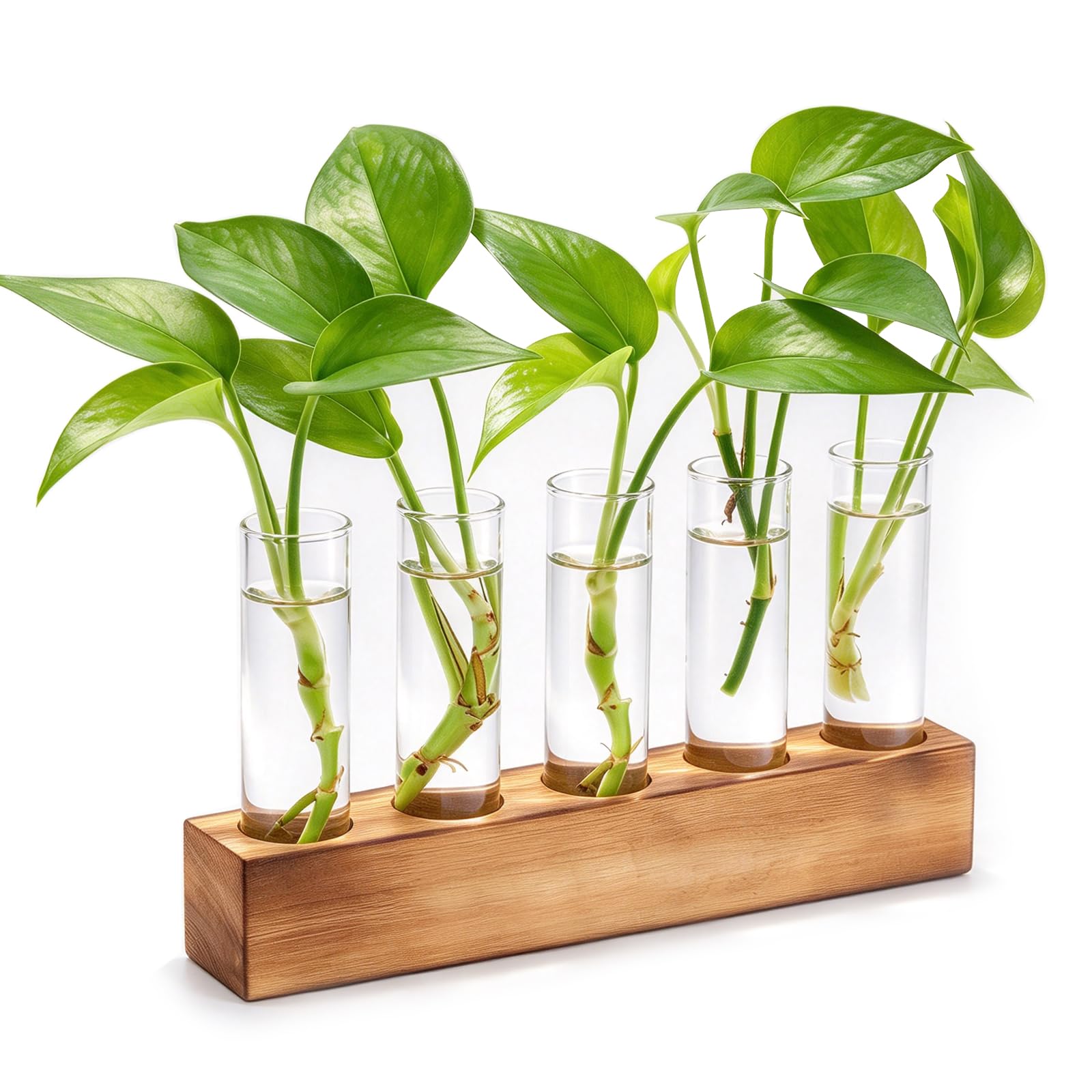
Five borosilicate tubes sit in a pine stand 9.45 inches long, boxed with a cleaning brush and a spare tube, and there is no assembly at all — the tubes are already seated when it comes out of the wrap. The base is 4.9 inches high and 1.57 inches deep, which is shallow enough for a desk, a bookshelf or the narrow sill of a bedroom window.

As the least expensive station in this set, it is the one we keep recommending for a first setup, a dorm room or a gift that should not need explaining. The tubes are 1.18 inches across, wider than the one-inch tubes on several racks here, so a slightly thicker stem still goes in without stripping the lower leaves. The trade is volume: five tubes at 75 ml each fill up fast when a plant needs a serious trim, and then you are back to a jar.

Bottom line: The cheapest station here is also one we keep on a desk: five tubes, no assembly, a spare in the box, and a base that sits flat.

3

XXXFLOWER 9-Tube Wall Station

XXXFLOWER 9-Tube Wall Station

Narrow wall space

Our Score 9.6/10
Check Price

Worth Noting

  • Nine tubes is a modest round of cuttings
Mounting
Pre-knotted twine
Tube Size
4.3 inches long x 1 inch diameter
Test Tubes
9
Overall Dimensions
7.9 x 27.9 inches
Read the full review

This is the narrow option: 7.9 inches wide and 27.9 inches tall, three rails and nine tubes, hung on twine that arrives already knotted. That width is the reason to buy it. Plenty of walls have a slim strip beside a window or between a door frame and a cabinet where a 14-inch rack simply will not go, and this fills it without looking cramped.

The extras are better than the price suggests. A spare tube and a small bristle brush come in the box, and the brush earns its place within a month, because a tube that goes cloudy hides the roots. Hanging takes minutes rather than an afternoon: the rope is pre-knotted, and the only adjustment is sliding the rails until the ladder sits level.

Where it earns the spot in this list is tight spaces and modest ambitions. Nine 4.3-inch tubes hold a small round of cuttings — a few pothos vines, a tradescantia or two — and the one-inch opening means slim stems only. We treat it as a wall accent that happens to propagate, which is exactly what most people are shopping for.

Bottom line: Our pick for a narrow strip of wall: nine tubes on a seven-inch-wide ladder, already knotted, with a spare tube and brush in the box.

4

Mkono 5-Bottle Desktop Station

Mkono 5-Bottle Desktop Station

Narrow windowsills

Our Score 9.6/10
Check Price

Worth Noting

Bottles
5
Included
Metal stand, cleaning brush
Dimensions
12 x 2.5 x 7.1 inches
Capacity Per Bottle
125 ml
Read the full review

Two and a half inches deep is the number that matters. This rack is 12 inches long, 7.1 inches tall and shallow enough to sit on the sill of a kitchen window that will not take a normal vase, which is the sort of window most people actually have.

Five 125 ml bottles sit in a black metal stand, and the tray separates from the frame so you can carry the glass to the tap rather than the whole thing. A cleaning brush comes in the box. Hand-wash the stand — the finish will not survive a dishwasher cycle, and that is the only upkeep note worth passing on.

Among the tabletop options here, this is the one for tall cuttings in a tight space: the bottles are narrow and deep, so a leggy pothos vine stands up instead of lolling over the rim, and the glass is clear enough to watch a root tip appear against the black frame. It is the neatest of the small stations, and the one that disappears into a windowsill rather than taking it over.

Bottom line: We recommend this for a shallow sill: five bottles across twelve inches and only two and a half inches deep, on a tray that lifts out for refills.

5

THYGIFTREE 5-Jar Station

THYGIFTREE 5-Jar Station

Desks and counters

Our Score 9.4/10
Check Price

Worth Noting

  • Jars hold 4.32 ounces, so refills come often
  • No spare jar in the box
Jars
5
Assembly
None required
Dimensions
13.6 x 3 x 4.3 inches
Capacity Per Jar
4.32 oz
Read the full review

Five clear jars sit in a black metal tray, and the tray has a handle at each end. That detail is why this is the station we recommend first: when the water clouds up, you carry the whole thing to the sink in one trip instead of ferrying one vase at a time across the kitchen and back.

There is nothing to assemble. It comes out of the box as a stand and five jars, with a cleaning brush included and anti-slip pads already doing their job underneath. We filled it on a windowsill and had cuttings in it within a couple of minutes, which is not true of the flat-pack stands that arrive as two rails, a bag of screws and a diagram.

The proportions are what make it easy to live with. At 13.6 inches long and roughly four inches tall it slides under a window sash or along the back of a counter without stealing light from anything behind it, and the dark powder-coated tray makes the glass and the roots the thing you notice. Each jar holds 4.32 ounces, enough that a pothos or philodendron cutting sits with a few inches of stem under water.

What settles it for us is the ratio of effort to results. A station that is awkward to empty is a station that sits dry by February, and this one asks almost nothing: lift, pour, refill, set back down. If the propagation corner is going to be a kitchen counter rather than a wall, start here.

Bottom line: We point most people here: five jars on one handled tray, nothing to assemble, and a stand that stays put when you lift a cutting out.

6

Renmxj 10-Tube Station

Renmxj 10-Tube Station

Splitting between rooms

Our Score 9.4/10
Check Price

Worth Noting

  • Tubes need a firm push to seat in the wood
  • Thin glass that will not survive a drop
Bases
2 wooden stands
Assembly
None required
Tube Size
1.2 inch diameter x 4.4 inches deep
Test Tubes
10
Read the full review

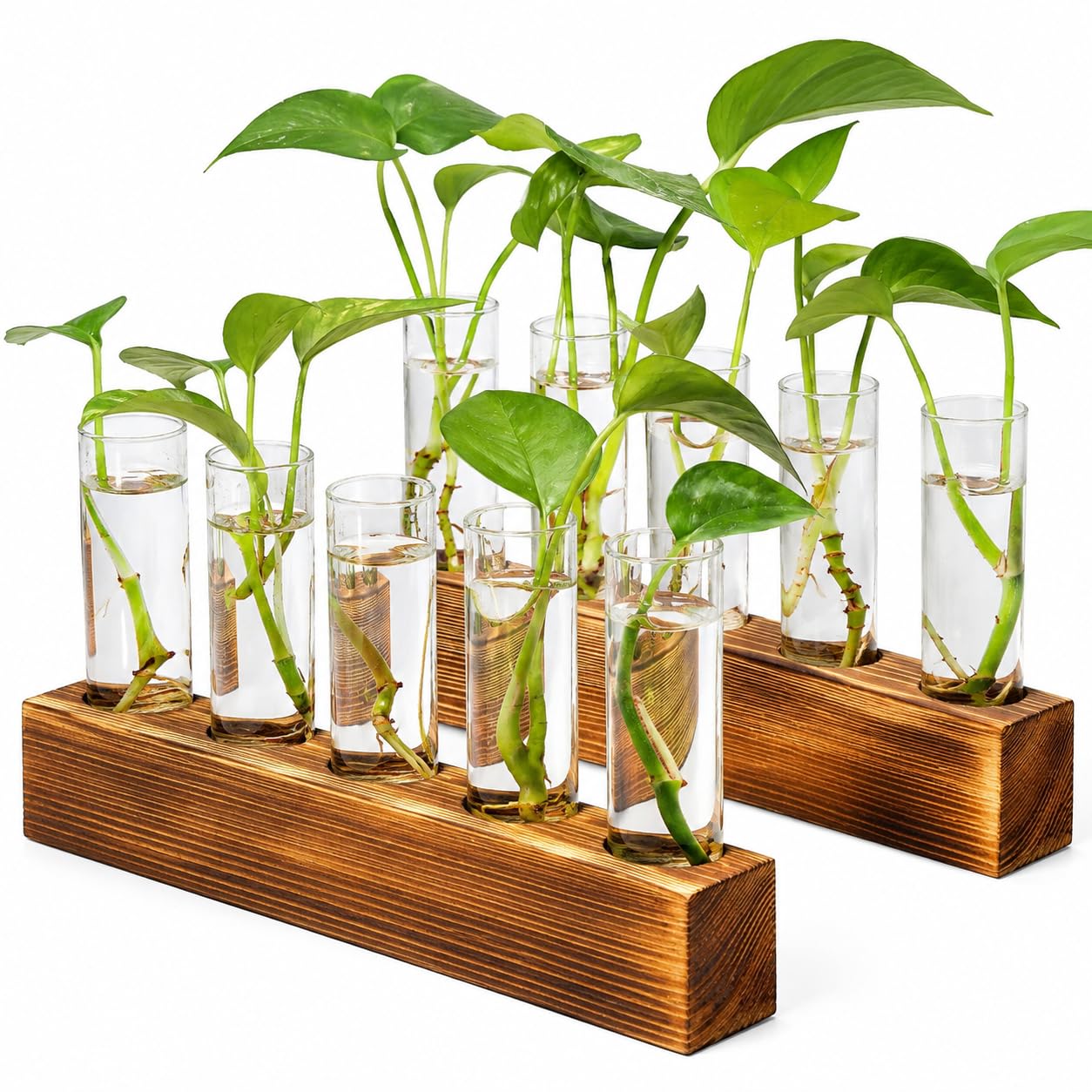
Two separate wooden bases, five tubes each — that is the reason to pick this over a single ten-tube rack, and we like it more than we expected. One base goes on the kitchen sill, one goes on a desk across the house, and there is no argument about which cuttings belong where.

The tubes are 1.2 inches across and 4.4 inches deep, wider than the one-inch tubes on most wall racks, so a stem with a couple of leaves goes in without being stripped. Nothing needs assembling: the bases are 9.9 inches long and low enough to sit under a window without blocking it, and the burnt finish on the wood looks more considered than the price bracket usually manages.

Ten tubes across two bases also means you can stagger batches by age, which is more useful than it sounds over a season of rooting pothos cuttings — the row that is ready for soil is visibly ahead of the row that went in last week. It suits someone propagating on a schedule rather than decorating a wall.

Bottom line: We split these two bases between rooms: ten wide tubes, no assembly, and enough capacity to run a batch of cuttings without crowding.

7

Renmxj 5-Bulb Station

Renmxj 5-Bulb Station

Easy water changes

Our Score 9.2/10
Check Price

Worth Noting

  • Thin bulbs can chip at the rim during cleaning
  • No spare vase in the box
Vases
5
Dimensions
17.2 x 5.83 x 3.36 inches
Holder Style
Open C-shaped cradles
Capacity Per Vase
140 ml
Read the full review

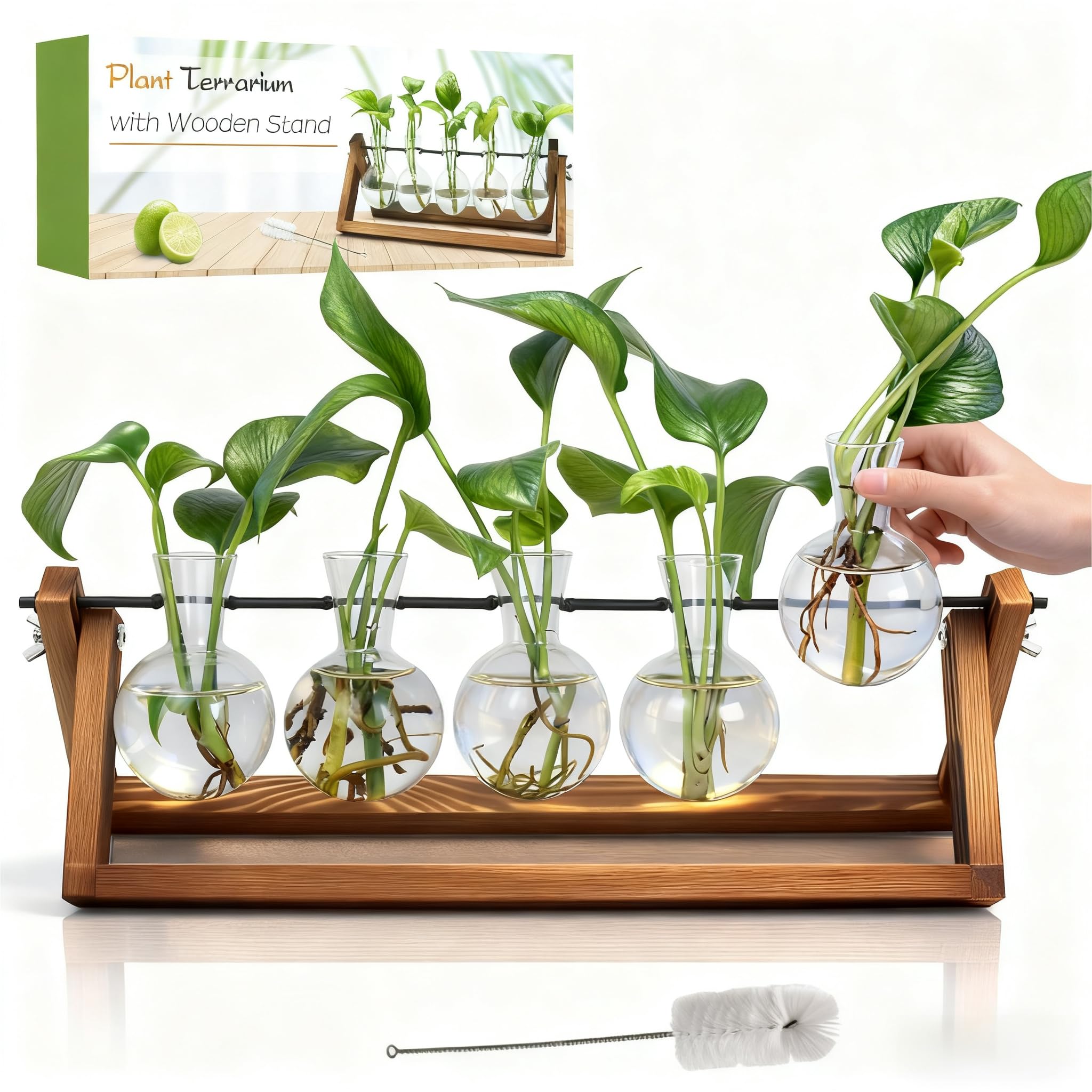
The open C-shaped cradle is the whole idea here, and it works. Each bulb rests in a metal half-ring instead of a closed hole, so you lift one vase out by the glass without nudging the four beside it. Water changes stop being a two-handed operation with a wet bulb balanced against your palm.

The bulbs hold 140 ml, comfortably more than a test tube, and the rounded shoulder gives a five-leaf pothos cutting somewhere to sit rather than a narrow neck to be threaded through. The stand runs 17.2 inches along a windowsill — long enough to want a real sill rather than a shelf — and the anti-slip sleeves under the wood do their job on tile.

It reads as decor rather than lab equipment, which matters if this is going on a dining table or a kitchen counter rather than a plant shelf. Clear glass against the wood means new root tips are visible from the far side of the room, and that is the part of propagation most people actually bought the station for.

Bottom line: We reach for this when water changes annoy us most: the open cradles let you lift one vase out cleanly, and the bulbs show roots from every side.

8

XXXFLOWER 3-Bulb Terrarium

XXXFLOWER 3-Bulb Terrarium

Decorative gifting

Our Score 9.2/10
Check Price

Worth Noting

  • Light stand shifts when you knock a bulb
Vases
3
Opening
1 inch diameter
Vase Size
3.74 inches high x 2.75 inches wide
Stand Size
5.5 x 11 x 4 inches
Read the full review

Three glass bulbs hang from a metal bar that swivels, so you can angle the vases toward the light instead of turning the whole stand on the sill. It is a small thing that turns out to matter on a north-facing window, and it is the reason this one stays on a shelf rather than in a cupboard.

At 11 inches wide and 5.5 inches tall it is the most compact of the tabletop stations here, and the bulbs are 3.74 inches tall with a 2.75-inch belly — enough for a short pothos cutting with two or three leaves. It also arrives in a gift box that needs no wrapping, which is why so many of these leave the house as presents rather than staying in the kitchen.

The opening is one inch, so plan on slim stems: vine cuttings, herb sprigs, a single African violet leaf. Anything with a woody stem or aerial roots is not going in, and that is a limitation of the shape rather than a fault. As a small, good-looking station for a desk or a guest room shelf, it does the job.

Bottom line: A decorative three-bulb station we like for short cuttings on a shelf; the swivel holder earns its keep, but the one-inch openings set the limit.

How We Tested the Best Plant Propagation Stations

To build the shortlist, I read through product pages, customer reviews, and material specs, then narrowed by size, tube count, and whether the stand could be cleaned without disassembly. We ended up with 12 stations and used them for six months in the places they’d actually live: a kitchen windowsill, a bathroom shelf with steamy showers, a living room bookcase, and an office desk. Each one held pothos, philodendron, and basil cuttings through at least two water changes a week.

I timed assembly solo and noted whether parts lined up without force, then checked whether standard cuttings fit the openings and whether the tubes sat level in the stand. We measured each footprint against a narrow sill and a crowded shelf, bumped stands with a hip as we passed, topped off water one-handed, and wiped down bases weekly. Over six months, we watched for wobble, scratches, rust, clouding, and loosening joints.

For propagation, we tracked root visibility, how easy it was to swap water without disturbing cuttings, and whether roots tangled or tubes tipped. We also lived with them on open shelves and asked whether they looked like decor or clutter, then compared what each station demanded in care and space with what it delivered. The ones that held up were the ones where materials, finish, and function justified keeping them over a plain glass jar.

How to Choose Plant Propagation Stations

Match the opening to the cuttings you actually take

A one-inch test tube takes pothos, tradescantia, mint, African violet leaves and most of what gets snipped off a windowsill houseplant. It will not take a monstera node with aerial roots or a thick begonia stem, and forcing one in bruises the stem exactly where roots need to form. Tubes of 1.18 to 1.2 inches buy a little more room; bulb vases and jars let a stem and its leaves sit without being stripped.

So measure the stem before you choose a shape. If your cuttings come from vines and trailers, a tube rack is efficient and looks sharp. If they come from anything woody or chunky, buy the jar station and accept the wider footprint.

Decide where it lives before you choose a shape

Wall racks trade counter space for vertical wall. The three-tier versions here hang 28 to 35 inches tall, and the narrower one is under eight inches wide, which is the sort of strip beside a window that nothing else fits. A tabletop station needs length instead of height — the five-jar trays run about 13 inches — plus enough sill depth that the stand is not hanging over the edge with wet glass on it.

Watch the word compact in a listing: it usually describes the stand, not the footprint once four cuttings are leaning out of their vessels. Measure the sill depth, then add an inch for the stems.

Buy for the water change, not the photograph

The recurring job is emptying and refilling, and the design question is how easily one vessel comes out. Open C-shaped cradles and a separable tray let you lift a single vase without touching its neighbours. A closed ring or a tight wooden hole means pulling wet glass against friction every few days, which is the point where a station quietly stops being used.

Scale cuts the other way too. A fifteen-tube wall rack is fifteen water levels to check, and the top tier is the one people skip. Count the vessels and ask honestly how many you will service.

Glass, spares and the extras worth having

Borosilicate tubes handle warm tap water and the occasional knock better than thin decorative glass, and a spare tube or jar in the box is worth more than it sounds the first time one rolls off a counter. A cleaning brush matters because a cloudy vessel hides the roots you bought the station to see.

Hand-wash anything metal. A coated tray or a black stand that goes through a dishwasher comes out with its finish dulled and, sooner or later, rust at the seams.

Frequently Asked Questions

Final Verdict

The THYGIFTREE five-jar station is where we point most people: nothing to assemble, one handled tray to carry to the sink, and jars big enough for a real cutting rather than a single stripped stem. That is the version of this purchase people keep using after the novelty wears off.

If you have wall space and a dozen slim cuttings to root, the Mkono fifteen-tube rack does that job better than anything that sits on a counter. And if the only sill you have is two and a half inches deep, the Mkono desktop rack is the one that fits at all.