Seeds & Plants

Best Mushroom Grow Kits of 2026

A mushroom grow kit doesn't turn you into a mycologist. The block inside arrives already colonized, white mycelium running through the sawdust, so your only real jobs are humidity, light, and patience. What separates a kit you'll actually harvest from one that goes green and fuzzy by week two is how healthy the block shows up, whether the directions explain what to do in plain language, and whether the species forgives a forgotten misting. Get those three things right and you're eating mushrooms picked minutes earlier, which is the whole reason they taste like something.

The first real fork in the road is ready-to-fruit versus inoculate-it-yourself, and beginners are almost always happier with the former. The second is the instructions: a good kit tells you when to cut the bag, when to mist, and when to soak between flushes, while a lazy one leaves you guessing and blaming yourself when nothing pins. Over five months, my team and I grew out 14 kits, from countertop boxes to a bag hung in a dim closet, and the best performers weren't the fanciest or the most expensive. They were the ones whose directions matched what the block actually needed.

1

Myco Labs 66-Quart Monotub

Top Pick
Myco Labs 66-Quart Monotub

Large indoor grows

Our Score 9.2/10
Check Price

Worth Noting

  • No culture included; the syringe is extra
  • Needs a closet shelf, not a counter
Footprint
22.5 x 15.5 x 12.5 in
Tub Capacity
66 quarts
Grain Included
Two 2.25 lb bags
Substrate Included
10 lb
Read the full review

Sixty-six quarts is the number to start with, because it decides everything else about this kit. The tub measures 22.5 by 15.5 by 12.5 inches and weighs 16 lb before anything goes into it, so it wants a closet shelf, a basement bench or a spare-room floor rather than a kitchen counter. What it grows is proportional to that: this is the kit you buy when one dinner's worth of mushrooms isn't the point.

Inside is the most complete kit here — the tub itself, two sterilized 2.25 lb grain bags with injection ports, 10 lb of manure-loving bulk substrate, a casing layer, filter patches and black plugs for the holes in the lid. Missing is the one thing that makes it alive: a spore syringe or liquid culture. You inoculate the grain, wait for it to colonize, break it up into the substrate, and then the bin does the rest.

We rate it the best of the tubs because the parts people normally improvise are already sorted: the airflow holes, the filters, and a spawn-to-substrate ratio that's been worked out rather than guessed. Building your own monotub is an afternoon of drilling and taping, and the taping is exactly where contamination gets in. This skips that without skipping the growing.

Plan the harvest, too. Ten pounds of substrate tends to fruit in a wave rather than a trickle, so a dehydrator, freezer bags or several willing neighbors are part of the setup. That's a good problem to have, but it's worth knowing before the pins arrive.

Bottom line: The most complete tub kit here for a grower who already has a culture: airflow, filters and a workable spawn-to-substrate ratio, with none of the DIY drilling and taping.
2

NuBlume 4 lb Two-Pack

NuBlume 4 lb Two-Pack

Side-by-side comparison

Our Score 9.0/10
Check Price

Worth Noting

  • No culture included; you supply the syringe
Bags
Two 4 lb all-in-one
Filter
0.2 micron
Includes
2 incubation boxes, gloves, tools
Total Capacity
8 lb
Read the full review

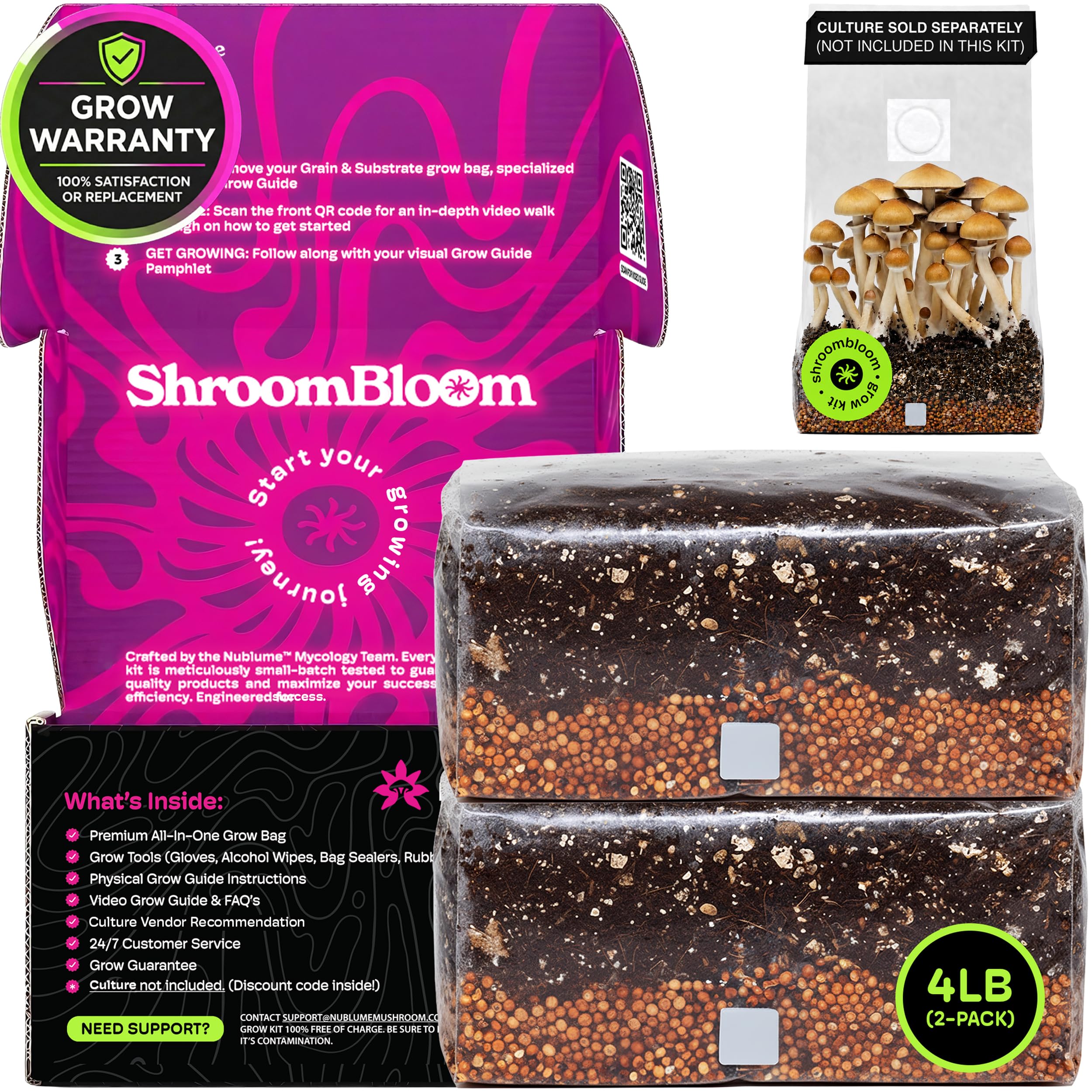
Two 4 lb bags, two incubation boxes, gloves, prep wipes, sealing clips and two liquid transfer tools — this box is packed like someone expected you to be nervous, and that's meant as praise. It's the most completely outfitted bag kit here, and the extras are the things you'd otherwise be ordering separately the night before your culture arrives.

The point of two bags isn't volume, it's comparison. Run a different liquid culture in each and you can watch colonization side by side under identical conditions, which is the fastest way to learn what a healthy bag looks like and what a stalled one looks like. The printed guide is backed by a video walkthrough, and both bags carry 0.2 micron filter patches and self-healing ports.

This is the all-in-one we point people to once they've grown one block kit and want to choose the species themselves. Everything you need once the culture is in hand is in the box, the instructions pitch themselves at a first inoculation without talking down, and two bags take the guesswork out of deciding whether a slow one is normal — you have a control sitting next to it.

The incubation boxes are a better idea than they sound. Colonization wants dark and steady, and a closed box on a shelf does that far more reliably than a bag propped in a cupboard where the door gets opened forty times a day.

Bottom line: The best-outfitted bag kit here: two 4 lb bags with gloves, wipes, clips and transfer tools, so you can run two cultures and compare them side by side.

3

North Spore Lion's Mane

North Spore Lion's Mane

First-time growers

Our Score 8.4/10
Check Price

Worth Noting

  • Pinning can stall if the block sits cool
Arrives
Fully colonized
First Flush
0.5-1.5 lb
Block Weight
4 lb
Refrigerator Storage
Up to 3 months
Read the full review

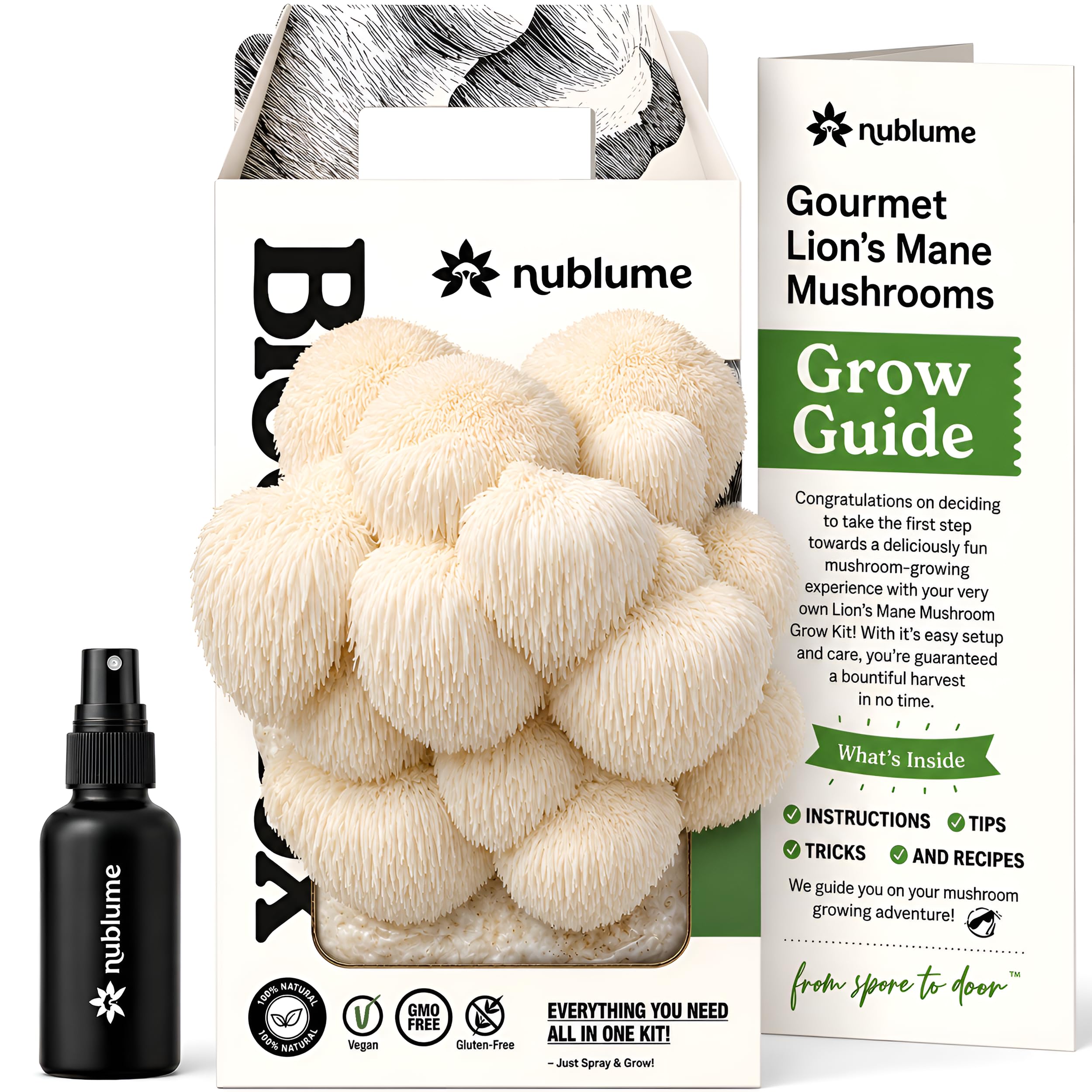
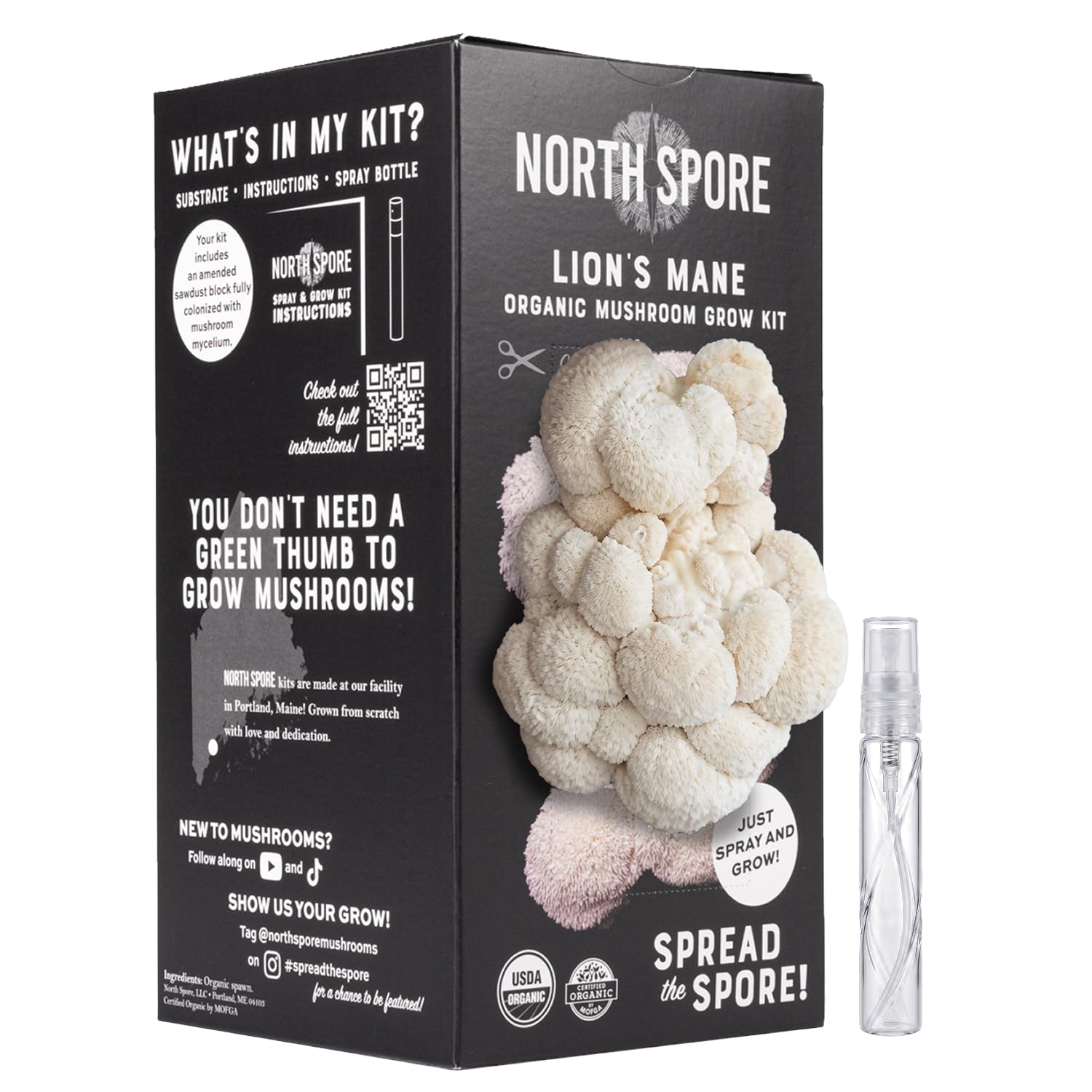
The detail that decided it for us is a storage instruction: this block keeps in the refrigerator for up to three months before you start it. That turns a kit with a countdown on it into something you can buy in October and fruit in January, or hand to someone as a gift without first asking when they plan to clear a shelf. North Spore ships the 4 lb block fully colonized, so day one is cutting away the perforated front panel and misting once or twice with the bottle in the box.

We send first-time growers here because nothing else has to be bought and nothing has to be learned first. There's no syringe, no sterile technique, no two-week colonization wait before anything visible happens — the block is already white and alive when it lands. Lion's mane is also the oddest thing you can grow on a counter, all soft cascading spines instead of caps, and it puts on size quickly once it pins.

The honest part is the range: a first flush runs anywhere from 0.5 to 1.5 lb, and the low end is a real possibility. What does arrive is genuinely good eating — tender, faintly seafood-sweet, at its best in a hot pan with butter and salt rather than buried in a sauce. A second flush usually follows, smaller than the first, and it's a bonus rather than a promise.

It also works as a gift in a way the bag kits don't. There's nothing to inoculate, nothing to look after until the recipient is ready for it, and a satisfaction guarantee behind the whole thing.

Bottom line: The one we recommend first for anyone who wants mushrooms on the counter without buying a culture: organic, fully colonized on arrival, and simple enough that misting twice a day is the whole job.

4

Forest Origins Oyster Trio

Forest Origins Oyster Trio

Trying three varieties

Our Score 8.4/10
Check Price

Worth Noting

  • Plan on two of the three blocks fruiting
Blocks
3 oyster varieties
Made In
California
Watering
3 tbsp per block plus misting
Time To Harvest
About 10 days
Read the full review

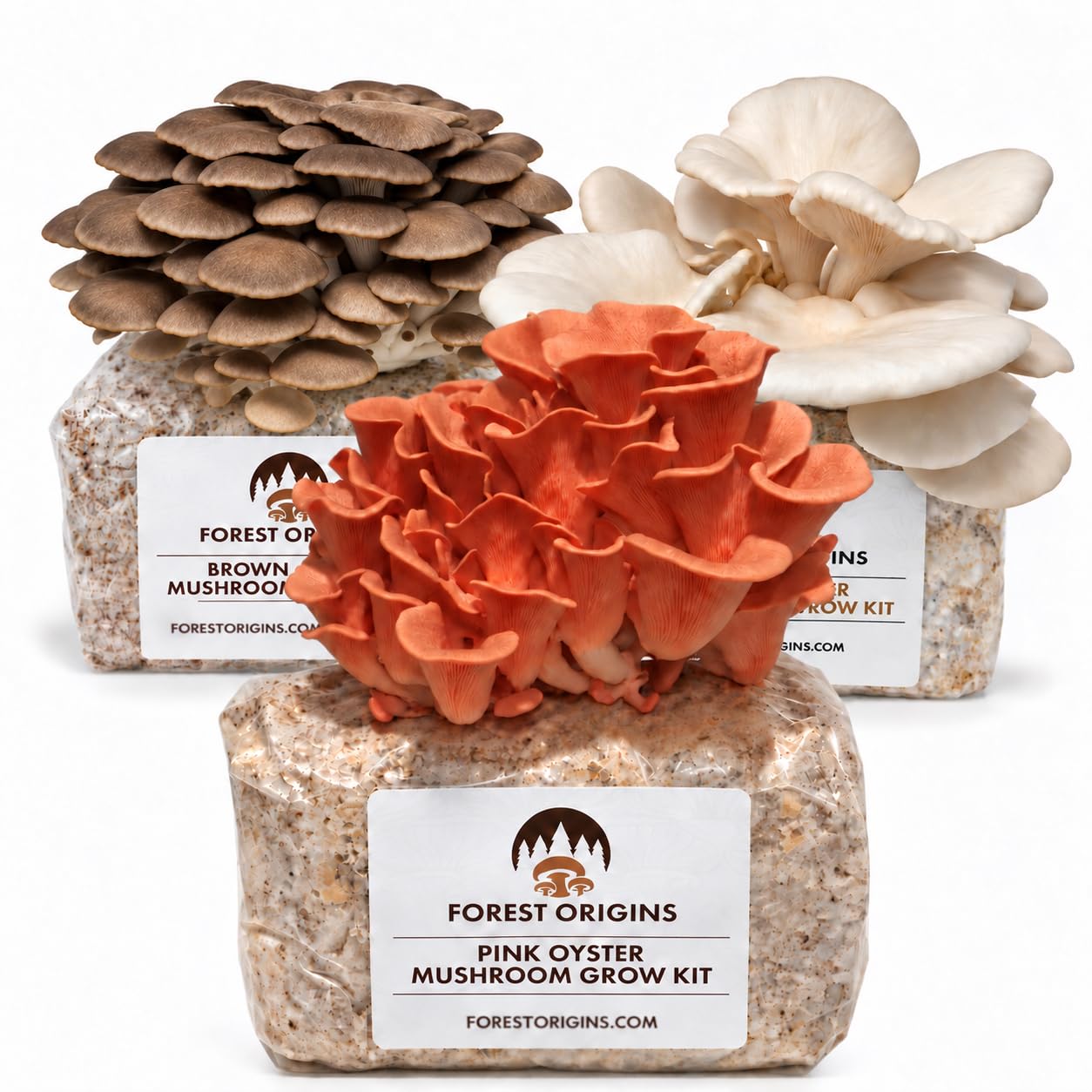
One block tells you whether you enjoy growing mushrooms. Three tells you which ones you'd grow again — and that's the trade this trio makes against every single-block kit here. Pink, brown and white oysters arrive as separate blocks on one shared routine, so you get a comparison instead of a single result. They look different as they develop, too: pink and white layer up in frills, brown comes in denser, earthier-toned caps.

The routine is a step more involved than a single block. Cut an X in each bag, scratch the exposed surface, add three tablespoons of water to each block, then mist 10 to 12 sprays twice a day, with about 10 days to harvest. The variable that actually decides it is warmth. Blocks left in a cool hallway sit there doing nothing; the ones moved somewhere in the high 60s pin and go.

Start all three together and you'll be cooking all three in the same week. Cutting the bags a week apart instead stretches the season out, which is what we suggest if you want oysters more than once. The blocks themselves are modest — this is a tasting flight, not a bulk buy — so plan meals around what three small clusters actually give you.

It costs more than the single blocks, and what you're paying for is variety rather than weight. If you've grown oysters once and know you like them, three at a time is a more interesting purchase than a bigger block of the same thing.

Bottom line: The pick for anyone who wants to taste their way through oyster varieties: three blocks, one routine, and a fair chance of two good crops out of three.

5

Myco Labs All-in-One Bag

Myco Labs All-in-One Bag

Your own culture

Our Score 8.4/10
Check Price

Worth Noting

  • You still buy the spore syringe
  • Formulated for dung-loving species only
Includes
30 ml culture jar
Mix Ratio
1:1:1
Bag Weight
4 lb
Read the full review

A 30 ml jar is why this bag is on the list instead of the other all-in-ones. Myco Labs includes a small culture jar alongside the 4 lb bag, so your spores go into the jar first, turn visibly into mycelium over a couple of weeks, and only then get injected into the grain. We like it because it moves the moment of failure earlier — a bad syringe shows up in something you can throw away instead of in a bag you've already committed to.

The bag is pre-sterilized grain and manure-based compost at about a 1:1:1 mix, with a self-healing injection port, so after the injection you close it and leave it alone. Two weeks is a good colonization run. Slower than that happens, and it isn't automatically a problem — the jar is what tells you whether the culture itself is healthy.

It also makes the process legible. Watching the jar cloud white before the bag is ever touched is the clearest demonstration of what colonization is that you'll get for the money, and it makes the second attempt much less mysterious than the first.

Four pounds is a single-bag project: one culture, one result, nothing to compare it against. That's the reason two-bag kits appeal once you've done this once. For a first inoculation, though, the jar is worth more than the extra bag.

Bottom line: The all-in-one bag we reach for when you're growing from your own culture: the extra jar lets you prove the spores are alive before you commit a bag of grain.

6

NuBlume BloomBox Lion's Mane

NuBlume BloomBox Lion's Mane

Small spaces, gifts

Our Score 8.2/10
Check Price

Worth Noting

  • 6-12 oz first flush is a small haul
Arrives
Fully colonized
Harvests
Up to 3
First Flush
6-12 oz
Block Weight
2 lb
Read the full review

Two pounds of substrate, roughly the size of a hardback, small enough to sit on a windowsill without anyone in the household asking what it is. That's the whole case for the BloomBox: it takes up less room than anything else here, it's the least expensive way to try this, and the block ships fully colonized, so day one is a cut and a spray.

We hand it to two people. The first is the one who wants lion's mane on a counter with no space to spare. The second is the one buying a gift that has to work — NuBlume replaces a failed box free, no forms, which is what makes a first attempt with a small block reasonable rather than a gamble.

The thing that turns a stalling block around is air against the fruit. Lion's mane grows outward from the cut, and if the plastic sags back against it the mass presses flat and stops. Propping the bag off the block with a couple of toothpicks on day one is a small bit of housekeeping that can save two weeks of waiting.

Expect 6 to 12 oz on the first flush, with up to three harvests if you keep misting between them. That's a couple of good dinners, which is the right scale for a 2 lb block — a bigger one would just mean more lion's mane than most kitchens get through.

Bottom line: The smallest and least expensive way into the hobby, and the box we hand first-timers: fully colonized, quick to fruit, and replaced free if it doesn't.

7

North Spore Boomr Bin

North Spore Boomr Bin

Hands-off automation

Our Score 8.2/10
Check Price

Worth Noting

  • No grain, substrate or culture included
  • Lid needs a shove to seat on both sides
Stacking
Recessed base
Footprint
22 x 15 x 11 in
Automation
Fan, humidifier, controller
Substrate Capacity
Up to 25 lb
Read the full review

Misting twice a day is fine until the first weekend you're away. The Boomr Bin is the only kit here that takes the job over: a fan and a humidifier connect to the tub, a controller holds humidity where you set it, and your role drops from caretaker to observer. If you've already lost a flush to forgetting it for three days, that's the entire argument.

The tub is a proper monotub — 22 by 15 by 11 inches, rated for up to 25 lb of substrate, with a recessed base so a second bin stacks on top, and latches that tie the lid to the base so you can lift the whole thing without the top popping off. Of the two tubs here, it's the one designed to be lived with.

What it doesn't include is anything alive or anything to grow in: no grain, no substrate, no culture. Everything that becomes a mushroom is bought separately, so this is a container-and-controls purchase layered on top of a hobby you already have rather than a way into one. That's a different transaction from every other kit on this page.

We place it for the repeat grower. The automation is genuinely useful at the scale where hand-misting stops being realistic, the stacking base is a real space saver if you run two, and the cost buys you not having to think about humidity again. A first-timer should put the money into a block instead.

Bottom line: Buy it for the automation rather than the parts: the only kit here that mists and fans itself, and worth it if a weekend away would otherwise cost you a flush.

How We Tested 14 Mushroom Grow Kits

We began with a running list of about 40 kits sold by specialty growers and garden retailers, then cut anything with vague species labeling, blocks that ship already fruiting and arrive bruised, and instructions shorter than a recipe card. That left 14 kits across oyster, lion's mane, shiitake, and a couple of ready-to-fruit varieties, which we bought at retail price and set up over five months.

Each kit was started by someone who had never grown mushrooms before, following the included directions literally and jotting down every point where they assumed knowledge. Did you need scissors, a clean bowl, room in the fridge, a spot out of direct sun? The kits lived where they'd realistically live: a kitchen counter, a closet shelf, a bathroom windowsill.

We logged the date of the first pins and the first harvest, weighed every flush on a kitchen scale, and kept each block going until it stalled or showed mold, which told us how many solid harvests a box really delivers. Then we ate them, sautéed in butter with no seasoning, side by side, to compare flavor and texture rather than trusting the label. Value came out as cost per ounce of mushrooms actually picked, not cost per box.

A few of the slower blocks are still pushing out a third flush, and we'll update this list if anything changes.

How to Choose Mushroom Grow Kits

Ready-to-Fruit Block or a Bag You Inoculate

A ready-to-fruit block ships fully colonized: you cut a hole, mist, and harvest in roughly one to three weeks. An all-in-one bag ships sterile and inert — you inject a spore syringe or liquid culture, wait for the grain to colonize, then mix it into the substrate and wait again. The block is the shorter, easier road. The bag is the cheaper road to more mushrooms, and the only one that lets you choose the species.

Watch for the word complete in the listing. An all-in-one bag is complete in the sense that the substrate, filter and ports are done for you — not in the sense that you can start the day it lands. Every bag and tub here still needs a culture bought separately. If what you want is a ten-day project with nothing else to order, buy the block.

What a Kit Actually Yields

A 4 lb block gives roughly 0.5 to 1.5 lb on the first flush, and later flushes are smaller and less reliable. That's two or three dinners off a good block, not a supply.

Which is why we think of these as a ten-day experience with dinner attached rather than a grocery substitute. If cost per pound is genuinely the goal, the bags and tubs return more mushroom for the substrate you buy — but only after you've bought a culture and waited out colonization, and only if you're willing to work clean.

Where the Kit Lives Matters More Than Which Kit

Oysters and lion's mane fruit in a warm room. The blocks that sit for two weeks doing nothing are usually the ones in a cool spare bedroom, a garage or a hallway; move them somewhere in the high 60s and they tend to go. Give them indirect light, a steady temperature, and no radiator or air-conditioning vent blowing across the block.

Space is the other half of the decision. A 2 lb block fits a windowsill, a 4 lb block wants a counter corner, and a 66-quart monotub wants a closet shelf or a basement bench and will not be welcome in a kitchen. Measure the spot before you order, not after.

Misting, Humidity and When Automation Earns Its Place

Twice a day is the standard: around 10 to 12 sprays per block on an oyster trio, one or two passes on a lion's mane block. It's a small habit, but it's the habit that decides the result — a block that dries out between mistings stalls and doesn't come back easily.

Automation makes sense in exactly two situations: you travel often, or you're running enough substrate that twice-daily misting has stopped being realistic. A fan, a humidifier and a humidity controller do the work, and you pay for them — the automated monotub here is the most expensive thing on the page by a wide margin. A single block on a counter doesn't need any of it.

Frequently Asked Questions

Final Verdict

We start everyone on the North Spore lion's mane block. It arrives alive, the only daily job is misting, and the three-month refrigerator window means it can be bought now and started when the counter is clear.

Once you want to choose the species, the calculation changes. The NuBlume two-pack is the best-equipped way into growing from your own culture, and the Myco Labs 66-quart tub is the right buy when volume matters more than counter space. Neither is a first kit, and neither pretends to be.