Pest & Weed Control

Best Mouse Traps of 2026

The first mouse I ever saw in my apartment wasn't the problem—it was the scratching inside the wall at 2 a.m. that kept me up. A mouse trap is a small purchase that fixes a big, gross, slightly panic-inducing problem: it removes the animal before it gets into your cereal, chews a wire, or invites friends. But the difference between a trap that works and one that just snaps your finger is mostly about design, ease of use, and where you put it—not the picture on the box.

Over the past three months, I've set and cleared 14 different traps—snap, electronic, live-catch, and glue—in my kitchen, pantry, garage, and basement. Some were reusable and easy to clean; others were one-and-done and felt like a waste of money. I learned that a trap's value isn't just whether it catches mice, but whether you can set it without fear, bait it without sticking to everything, and reset it after a catch. The picks below are the ones that actually earned their place along the wall.

1

Catchmaster Rat & Mouse Glue Traps 12-Pack

Top Pick
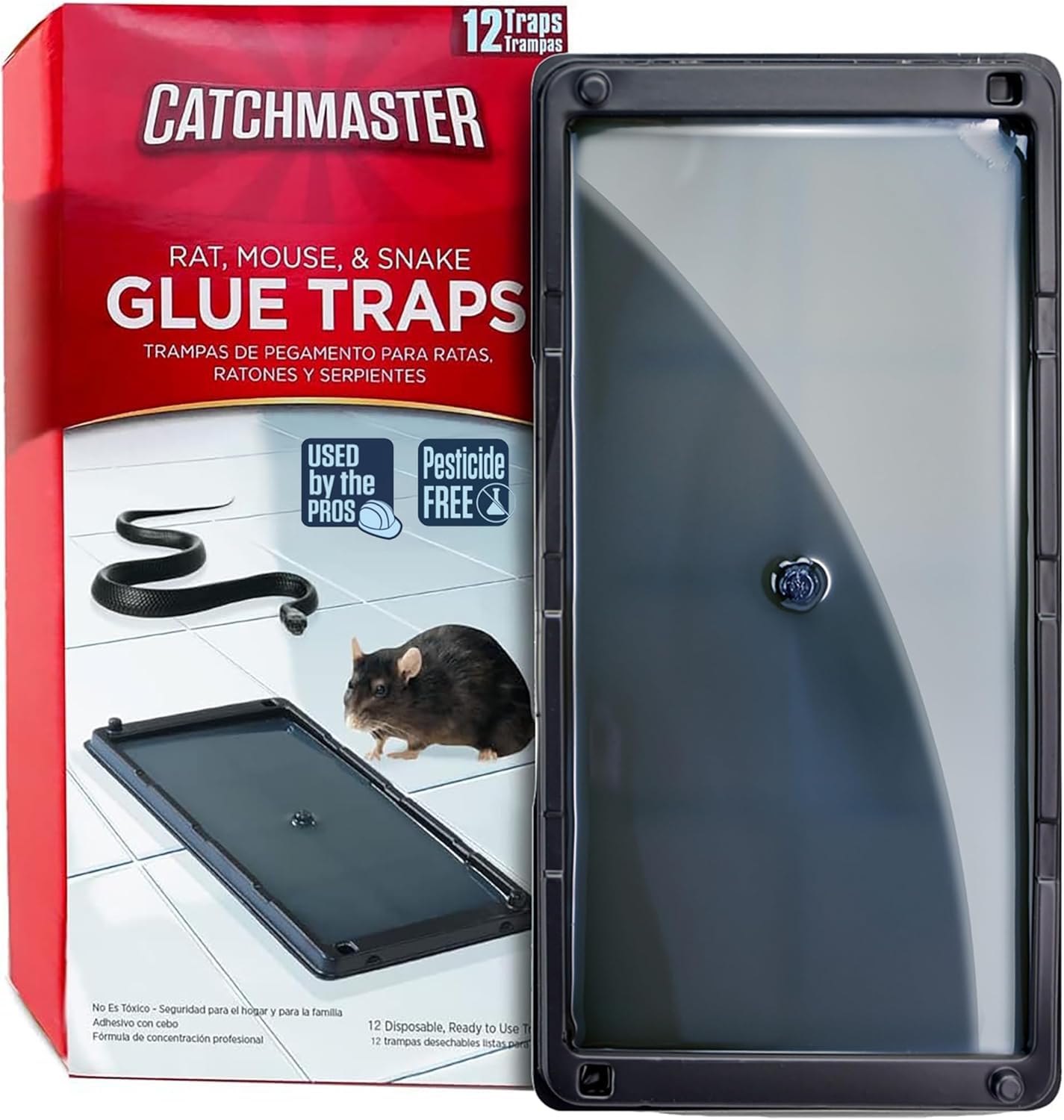
Catchmaster Rat & Mouse Glue Traps 12-Pack

Indoor mice

Our Score 9.0/10
Check Price

Worth Noting

  • Holds a live mouse until you deal with it
  • One use per catch, nothing to reuse
Target
Mice, rats, snakes
Trap Type
Glue board
Board Size
10 x 5 x 0.25 in
Pack Count
12 traps
Read the full review

A 10-by-5-inch pad is a lot of real estate to put under a mouse's feet. The board is a quarter inch thick, so it slides under a door or the kick plate of a cabinet and lies flat instead of rocking, and there is enough glue that a mouse has to commit most of its body before it reaches the far edge.

That combination is why this pack is the one we recommend first. Placement catches mice, and a big flat board lets you put the trap exactly where they run — tight against a baseboard, behind the bin, under the dishwasher — without folding or cutting it down. Twelve in the box is the other half of the argument: enough to line a kitchen and a utility room in one go, and enough spare that you do not ration them. Adhesive decides whether any glue trap works, and this one is generous but not immune to its surroundings. A board that has sat in a hot garage or on a dusty concrete floor is a different board from the one that came out of the wrapper; sweep, press it flat, and touch the surface before you trust it.

Glue does not kill. Whatever walks onto the board is alive when you find it, and dealing with that is the honest cost of choosing glue over a snap trap. It will also take whatever else uses the same route — a pet's paw, a bird in the garage, the wrong rodent. Keep boards behind furniture or inside a shallow box with a hole cut in one end, and check them every morning rather than every few days.

So: the best catch rate we found indoors, and a disposal job you have to be willing to do. If a stuck mouse is more than you want to handle, the Victor box and the Motel Mouse trap below solve the same problem with a different ending.

Bottom line: We recommend the Catchmaster 12-pack as the default for indoor mice: the big pads and flat profile do the work where small boards fail.

2

Tomcat Glue Traps with Eugenol 6-Pack

Tomcat Glue Traps with Eugenol 6-Pack

First-line check

Our Score 8.8/10
Check Price

Worth Noting

  • Six boards go fast in a big room
  • Mouse-size only, no use against rats
Scent
Eugenol
Target
Mice and household insects
Trap Type
Glue board
Pack Count
6 traps
Read the full review

Six small glue boards is a modest package, and that is the point: cheap enough to put down in four or five likely spots and find out where the mice are actually traveling before you spend more.

The boards are mouse-sized, so they slide behind a fridge or into the gap beside a cupboard, and there is nothing to set or bait — peel the paper and lay one against the baseboard. The eugenol in the glue is a clove-derived additive used to keep the surface supple, and it gives the board a faintly medicinal smell out of the wrapper.

The adhesive is the variable. On a clean kitchen floor these hold well. On concrete, or after a couple of weeks down, they collect grit and lose their grip, and a mouse can walk the length of a spent board and off the end. Replace them rather than hoping, and do not put them where a broom or a boot will slide them across the floor.

As a first purchase we think it earns its place. It answers the question every mouse problem starts with — where are they going? — for very little, and the boards you do not use keep until you need them.

Bottom line: The cheap first step: six mouse-size glue boards that show you where the traffic runs before you commit to a bigger trap.

3

LULUCATCH Small Mouse and Insect Traps 12-Pack

LULUCATCH Small Mouse and Insect Traps 12-Pack

Tight gaps

Our Score 8.8/10
Check Price

Worth Noting

  • Small surface lets a mouse pull free
  • Scent is strong in a small room
Scent
Peanut butter
Target
Mice, roaches, ants
Trap Type
Glue tray
Pack Count
12 traps
Read the full review

The first thing you notice is the peanut butter. It is built into the glue rather than added on top, and it is strong enough that you notice it across a room when the pack is open.

The trays are the other half of the appeal. Each pair folds out into two shallow plastic trays, which keeps the glue where you put it instead of letting a flat board slide and smear, and the low lip means one will sit under a washing machine or behind a bin without being pushed aside. Twelve of them in a pack makes this the value option in this group.

What it gives up is surface area. These are small trays, and a mouse that only gets a paw on the edge can pull back and take the glue with it. Set them tight against a wall, where a mouse has to run the length of the tray rather than clip the corner, and the odds improve. The scent does not compensate for a trap placed in the open — it attracts attention, it does not steer the mouse onto the glue.

Best for a light problem: one mouse in a flat, a couple in a garage, or a kitchen where you want something tidy under the units. For anything that feels like an infestation, buy a bigger board.

Bottom line: It earns its place on tidiness: plastic trays that keep the glue where you put them, for a light problem in a small space.

4

Victor M156 Wooden Snap Traps 20-Pack

Victor M156 Wooden Snap Traps 20-Pack

Sheds and lofts

Our Score 8.6/10
Check Price

Worth Noting

  • Stiff springs make some traps hard to set
  • Wood suffers in a damp shed
Material
FSC wood, metal pedal
Reusable
Yes, or disposable
Trap Type
Wooden snap
Pack Count
20 traps
Read the full review

Twenty traps in one box is the argument, and it is the box we keep in the shed. A mouse problem is rarely one mouse, and having a couple of dozen wooden traps means you can set a line along a shed wall and a couple behind the feed bin without doing arithmetic. The pattern is the old one — FSC-certified wood, a metal pedal, a wire bar — and it still works: bait the pedal, pull the bar back, and set it across the run with the trigger end against the wall.

Setting them is where people divide. The springs are stiff, and one or two traps in a box of twenty take real thumb pressure to arm; on those the bar can slip while you are still positioning it. Set, they are light enough that a mouse nosing at the pedal sets them off, which is the behavior you want.

Wood is the trade-off. It is light and cheap and does not care about being dropped, but it does care about damp — a shed floor that takes on water is a better home for a plastic trap. Indoors, along a dry pantry wall, that is a non-issue, and you get a trap you can bin after a catch or clean and reuse.

This is the cheapest way in this set to put a lot of traps down at once, and the only one that gives you spares instead of a fixed number of chances. Buy it when the job is bigger than one room.

Bottom line: This is the box we keep in the shed: twenty wooden snap traps that kill cleanly and cost the least per trap of anything here.

5

Motel Mouse Humane Live Catch Traps 4-Pack

Motel Mouse Humane Live Catch Traps 4-Pack

No-kill homes

Our Score 8.6/10
Check Price

Worth Noting

  • Door tab wears and stops holding the trap open
  • Chamber suits mice, not rats
Includes
Brush and guide
Trap Size
6.69 x 2.56 x 2.44 in
Trap Type
Live catch
Pack Count
4 traps
Read the full review

A live trap has three jobs: catch the mouse without hurting it, let you carry it outside without touching it, and survive enough uses to be worth keeping. This one is built around the second job. The chamber is ventilated, the door drops behind the mouse rather than pinning it, and the release door at the far end opens over a hedge or a field without your fingers going anywhere near the animal.

Bait goes at the far end — a smear of peanut butter is enough — and the trap sits along a wall like any other. Setting it takes a second: hold the door open on its little tab, put the trap down, walk away. Releasing is one movement, and the brush that comes in the box is for the corner a frightened mouse will have used.

We rate it as the humane pick here, with one reservation. The door tab that holds the trap open is the weak point: it wears, and once it stops holding, the trap is a plastic box with a lid. Treat the four-pack as a few-use tool and it holds up; treat it as a permanent fixture and you will be disappointed. The other limit is size. This is a mouse trap, and a big rat will not fit comfortably, which rather defeats a catch-and-release design.

Check it morning and evening. A mouse left in a trap all day in a warm shed is not a humane outcome, whatever the box calls it, and two traps in rotation is easier than one trap you have to reset the moment you get home.

Bottom line: Our humane pick: it catches mice unharmed and lets you carry them out without touching anything, which is the whole job.

6

Hdama Reusable Snap Traps 6-Pack

Hdama Reusable Snap Traps 6-Pack

Small field mice

Our Score 8.6/10
Check Price

Worth Noting

  • Jaws suit small mice only
  • Light springs; some units arrive that will not set
Bait Cup
Removable
Trap Size
4.3 x 1.8 x 2.2 in
Trap Type
Plastic snap
Pack Count
6 traps
Read the full review

Small is the whole review. At about four inches long this trap suits field mice and young house mice; an adult mouse has its head and shoulders between the jaws before the bar lands, and a rat is out of the question. That is a limitation, but it is also why the trap fits in places a wooden one will not.

Where it fits, it works. The bait cup pulls out for loading and cleaning, the jaws close on a spring that is strong for the size of the trap, and the body is narrow enough to tuck into the corner of a cupboard or the back of a drawer. Setting it is a thumb press with nothing in the way of your fingers.

Durability is where expectations need setting. The springs are light, some units arrive that will not hold open, and rust shows on the inner springs if the trap lives in a damp shed. You are buying a handful of cheap traps rather than a tool for life, so order the six-pack expecting to lose one or two.

Use them as a scatter of traps in sheltered indoor spots — a pantry, a garage shelf, a feed shed — and keep the bigger boards or a Victor box for the main runs.

Bottom line: Six cheap, small snap traps for field mice and tight corners — the ones that fit where a wooden trap will not.

7

USKICH Reusable Mouse Traps 20-Pack

USKICH Reusable Mouse Traps 20-Pack

Big infestations

Our Score 8.4/10
Check Price

Worth Noting

  • Deep bait cup needs a firm trigger pull
  • Light springs and plastic bodies can break
Bait Cup
Removable
Reusable
Yes
Trap Type
Plastic snap
Pack Count
20 traps
Read the full review

The reason to choose plastic over wood is the set. Your fingers stay behind the jaw while your thumb presses the catch, and emptying it is a matter of tipping the jaws open over a bin instead of picking a mouse out by the tail.

Twenty of them in a box makes this the pack we hand to anyone with a garage, a loft and a feed shed to cover. The bait cup lifts out for filling and washing, and there is a nail hole in the base so you can fix one to a beam at mouse height rather than hoping it stays put on a shelf. That is a lot of traps for the kind of job where you want to stop thinking about traps.

It is not the sharpest trigger in this group. The cup sits deep in the body, so a mouse has to get its head and shoulders in before the bar drops, and a light, wary visitor can take the bait and leave. Press the bait down into the cup so it has to be tugged at, rather than smeared on top where it can be licked off, and expect a misfire or two while you learn where to set it.

Reuse is where the money comes back: rinse, dry, rebait. The springs are not heavy-duty, and a trap that has been kicked around a concrete floor may never sit square again, so buy the twenty knowing a few will retire early.

Bottom line: For garages, lofts and anyone who wants twenty reusable traps without fingers near a live bar, this box does the job.

How We Tested the Best Mouse Traps

We started by researching the most widely sold and highly reviewed traps—snap, electronic, live-catch, and glue—then filtered that list by price, safety features, and how easy each was to set and clean. From that shortlist, we tested 14 traps over three months. Each one was placed in the same rotation: along the wall in a kitchen, behind the stove, in a pantry corner, on a garage sill, and beside a basement water heater where droppings had appeared.

Every morning and evening, we checked each trap and recorded what happened: whether it fired, what it caught, and how much bait was left. We noted whether arming a snap trap felt safe or required a pencil and a prayer, whether a glue trap held a mouse or let it drag the pad, and whether a live trap was easy to release without touching the animal. For reusable traps, we cleaned and reset them after every catch to see how the mechanism held up.

We also weighed the practical stuff: how many catches each trap delivered before it failed, whether the bait stayed put or got stolen, and what the cost worked out to per catch. A trap that caught one mouse but snapped in half on the second try didn't score well, and neither did a glue pad that stuck to the floor better than to a mouse. The traps that made the list were the ones we'd buy again—and the ones we'd actually reach for at 2 a.m.

How to Choose Mouse Traps

Glue, Snap, or Live Catch

These are three different jobs, not three grades of the same one. A glue board holds a mouse alive, a snap trap kills it, and a live trap holds it alive and lets you carry it outside. Decide which of those endings you can handle before you look at anything else, because every other feature — size, trigger, bait, reuse — follows from that decision.

Glue suits anyone who wants a passive trap that needs no setting, snap suits anyone who wants the job finished in one motion, and live catch is for households that will not kill a mouse at all. Nothing in the hardware is subtle; the difference is what you are willing to do at the end.

Placement Is the Whole Skill

Mice run along edges, not across open floor, so a trap in the middle of a room is decoration. Put boards and traps tight against a baseboard, behind appliances, and in the corner where a wall meets a cupboard; set a snap trap across the run with the trigger plate against the wall so the mouse meets it nose-first.

Check that whatever you set sits flat, because a rocking board gets avoided, and give it a few nights before you move it somewhere else. A listing's compact figure describes the trap, not the gap you want to slide it into, so measure the gap first.

Match the Trap to the Rodent and the Room

Everything on this page is mouse-scale. Droppings the size of a grain of rice mean mice; bigger, blunt-ended droppings mean rats, and a mouse trap will not solve that. Match the trap to the space as well: small trays and narrow jaws for the gap beside a cupboard, big boards for an open run along a wall, and plastic rather than wood or glue in a shed where damp and grit work against you.

Then buy enough. One trap is a bet; five along the same run is a plan.

Pets, Children, and the Wrong Catch

Every trap here can catch something that is not a mouse. Glue is the worst offender — a cat's paw or a bird in the garage will stick, and freeing it is a job for a vet or a wildlife rescue. Snap traps belong behind furniture, inside a box with a hole cut in the end, or in a station that pets and toddlers cannot open.

Live traps are the safest thing to have around a household and the least forgiving of neglect. Check them twice a day, and handle the trap, not the mouse.

Frequently Asked Questions

Final Verdict

The Catchmaster 12-pack is what we put down first in a house. Big boards, a flat profile that slides under an appliance, and twelve of them in the box so you can cover a kitchen properly instead of rationing traps. The trade-off is the method itself: glue holds a live mouse, and the morning after is your job.

If that is not a trade you want to make, the Victor box gives you twenty snap traps at the lowest cost per trap here, the Motel Mouse carries the mouse outside alive, and the Tomcat six-pack is the cheapest way to learn where the traffic runs before you commit to more.