Garden Tools

Best Manual Lawn Edgers of 2026

A lawn can be freshly mowed and still look unfinished if the line where the grass meets the driveway has gone ragged. String trimmers blur that edge into a fuzzy fringe, and a shovel leaves you with a trench and a pile of torn sod. A manual edger does one job: it slices a clean vertical cut along walks, beds, and curb, either with a half-moon blade you step on or a star-wheel that cuts as you push. The catch is that the difference between a good one and a bad one shows up in the first ten feet — a blade that tears instead of slices, or a handle that twists in your grip on every pass.

I spent the past seven months cutting edges with 11 different manual edgers, along sidewalks, a driveway, and flower beds that get overgrown every June. What separated them had little to do with the features printed on the box. Sharpness mattered more than anything, and so did sturdiness: an edger that won't stay upright when you lean into it turns a quick Saturday job into a wrestling match. A few of the cheapest models embarrassed tools that cost twice as much, which is worth remembering before you assume price equals quality here.

1

Radius Garden Pro-Lite

Top Pick
Radius Garden Pro-Lite

Comfortable long runs

Our Score 9.4/10
Check Price

Worth Noting

  • Carbon steel blade needs drying after each use
Blade
Heat-treated carbon steel
Shaft
Fiberglass
Weight
4 lb
Handle Length
45 inches
Read the full review

The handle is the whole argument, and for us it is a convincing one. Instead of a T-bar you grip in one place, the Radius has a closed loop you can hold anywhere around its circumference, so your wrist angle changes as you work rather than locking into the same position for the length of a driveway. It is the most comfortable edger in this group to hold for more than a few minutes.

At 45 inches it has the longest handle of the step edgers here, and the fiberglass shaft is why it does not feel like a fence post: stiff enough to drive the blade, light enough that four pounds does not turn into ten by the time you reach the corner. The blade is heat-treated carbon steel and it arrives with a working edge rather than a keen one; ten minutes with a file makes a noticeable difference on the first pass.

The upkeep is the trade. Carbon steel wants wiping dry after every session, and the loop, comfortable as it is, gives you less to lean on than a wide T-bar when you are driving hard. Neither bothers us along a walk or a bed line; both would show up if you were recutting a quarter mile of curb in one go.

Bottom line: If comfort decides it, this is our pick: the circular grip and stiff fiberglass shaft make long borders easier on your hands, wrists and back.
2

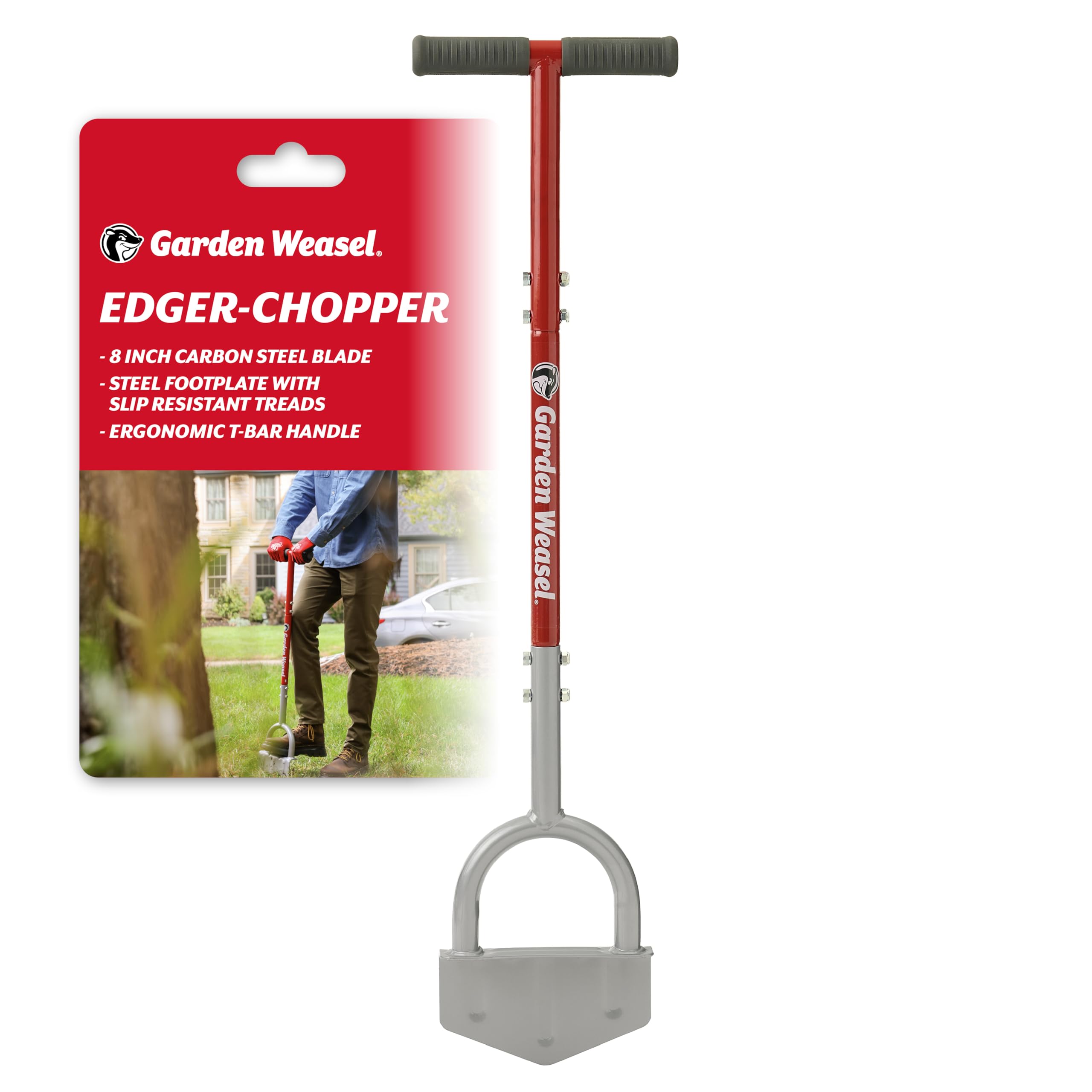
Garden Weasel Edger Chopper

Garden Weasel Edger Chopper

Small yards

Our Score 9.0/10
Check Price

Worth Noting

  • Blade edge could be keener out of the box
Blade
8-inch tempered carbon steel
Handle
T-grip
Pieces
3
Footplate
Extra-wide, slip-resistant
Read the full review

If your edging is one bed, one walk and an afternoon, this is the tool that ends the job with the least fuss. The Garden Weasel is a step-and-press design with an extra-wide, slip-resistant footplate, and it is the one we hand to someone who has never edged a lawn before.

The blade is eight inches of tempered carbon steel with a step set into the middle of it, and that is the detail we like most. Instead of driving the tool down from the handle, you put a foot on the blade itself and push it straight into the sod; the T-handle then gives you the lever to work around a curve.

It arrives in three pieces and goes together without drama, which matters if you plan to break it down for storage over winter. What it will not do is eat a long driveway edge in one pass — the shorter blade and lighter build suit a defined border, not a marathon.

Bottom line: For a couple of beds and a short walk, the Garden Weasel is the simplest tool here and the one we hand over without instructions.

3

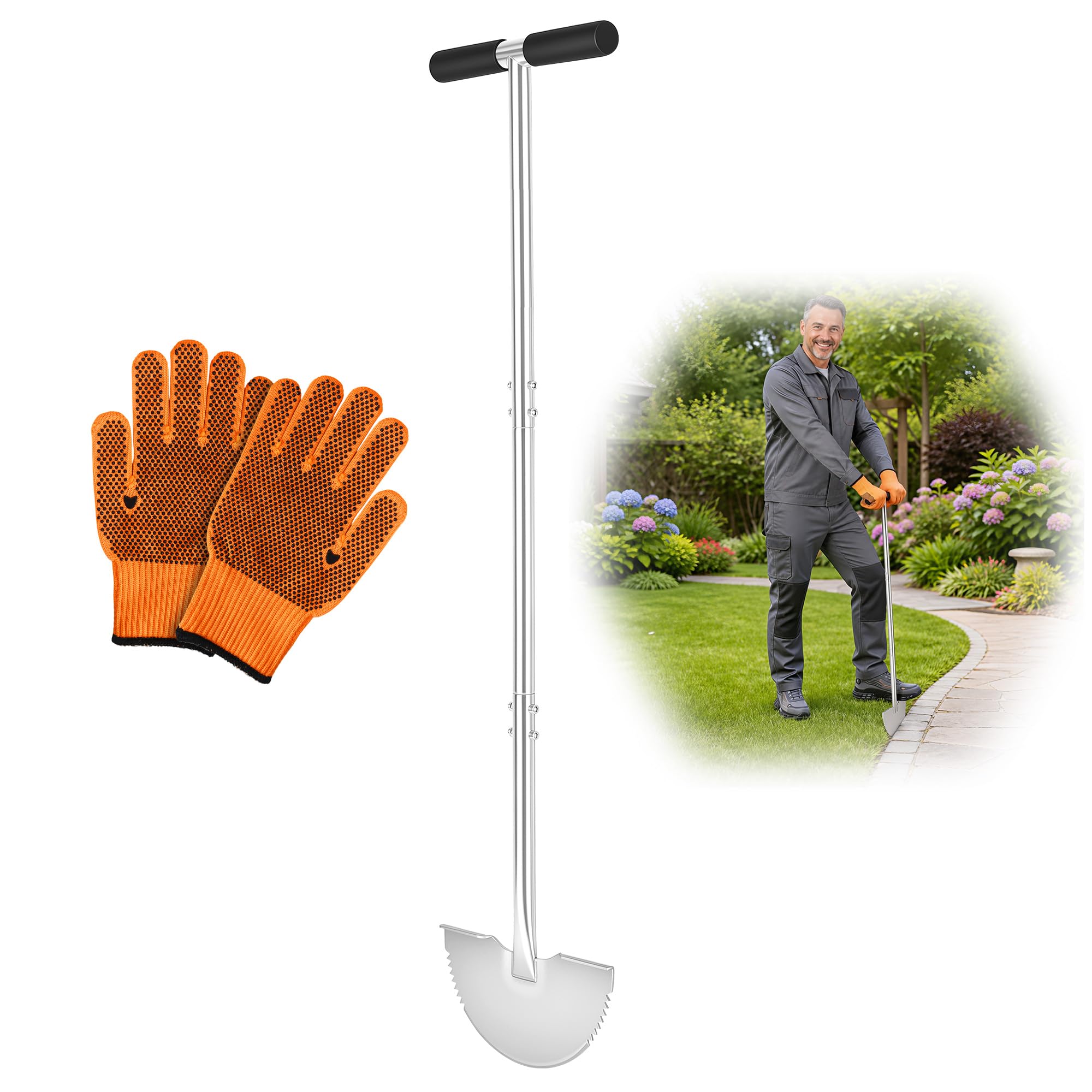
KYEEN Serrated Edger

KYEEN Serrated Edger

All-round edging

Our Score 8.8/10
Check Price

Worth Noting

  • Thick blade needs extra passes in hard, dry soil
Blade
Serrated rust-proof steel
Weight
2.75 lb
Footrest
Wide
Handle Length
38 inches
Read the full review

A serrated steel plate does the cutting here rather than a smooth half-moon, and that single choice is why this one took the top spot. Teeth give the edge somewhere to start: on turf that has knitted over a sidewalk, the blade catches and slices instead of skating along the surface. The steel is rust-proofed, too, so a damp morning does not turn into a rust patch by the weekend.

What sold us was how little the rest of the tool gets in the way. The handle runs 38 inches, long enough to work standing up; the footrest is wide enough for a full boot; and at 2.75 pounds it carries one-handed to the far corner of the yard. The hardware comes in the box, and so do a pair of gloves, which sounds like a throwaway extra until you have spent an afternoon pushing a steel plate around.

Assembly is a four-bolt job anyone can finish at the kitchen table, and the blade is the only part that will ever ask for attention — a few strokes with a file at the start of the season keep the teeth biting. Nothing about the tool feels fussy, which is exactly what you want from something that lives in a shed and comes out when the line starts to blur.

Bottom line: We recommend the KYEEN to anyone who wants a clean edge without a cord: it cuts confidently, stays tight, and asks less money than most of this group.

4

Colwelt Saw-Tooth Edger

Colwelt Saw-Tooth Edger

Overgrown borders

Our Score 8.6/10
Check Price

Worth Noting

  • Assembly takes patience to get tight
Blade
Saw-tooth carbon steel
Teeth
6
Foot Platform
Extra-wide
Handle Length
38 inches
Read the full review

Where our top pick cuts with a fine serrated edge, the Colwelt attacks the line with six big saw teeth on an arched blade. That is a rougher, more aggressive tool, and it is the one we reach for when a bed has been left alone for a season and the grass has run over the concrete.

The rest of it is built for leverage. An extra-wide foot platform takes a full boot, the powder-coated carbon steel blade is 8.7 inches across, and the 38-inch handle ends in a cushioned T-grip that keeps your hands off cold metal in November. At 3.7 pounds it is light for something this willing to be stood on.

Second place rather than first comes down to the edge you get out of the box: the teeth are not uniformly sharp, and the difference between a good session and a frustrating one is ten minutes with a file before you start. Once it is keen, it saws through roots and packed soil that stop a spade, and it keeps cutting after the easy ground is gone.

Bottom line: Our choice for matted, neglected borders: the six saw teeth bite where a smooth blade skids, and the 38-inch handle keeps you off your knees.

5

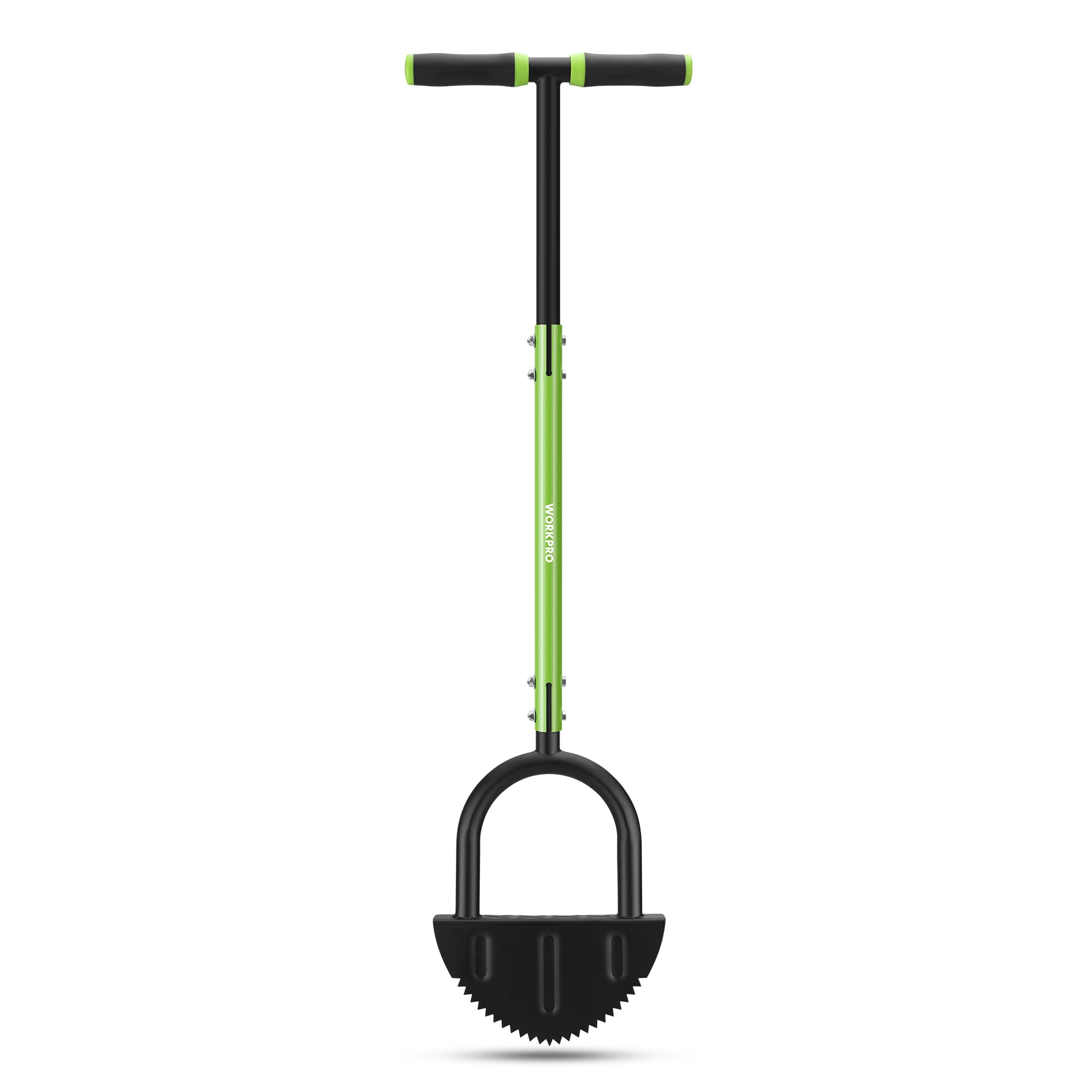
WORKPRO 40-Inch Edger

WORKPRO 40-Inch Edger

Tidy bed edges

Our Score 8.4/10
Check Price

Worth Noting

  • Blade needs a file before it cuts cleanly
Blade
23-tooth alloy steel
Handle
Soft TPE grip
Footrest
Wide
Handle Length
40 inches
Read the full review

Twenty-three teeth is the finest saw pattern in this group, roughly four times the count on the Colwelt's blade. That changes how the tool behaves in practice: the blade enters turf gradually and takes small bites rather than levering out a chunk.

The 40-inch T-handle wears a soft TPE grip that is the most forgiving of the T-grips here, and the footrest is wide enough to find with a boot without looking. There is enough heft behind the blade to drive it without the tool behaving like a digging bar.

Assembly is the usual bolt-together job, and the washers and two spanners come in the box, so nothing is missing when it lands. The blade is alloy steel, and the grip is a genuine upgrade if you have ever finished a border on a bare metal T-bar.

We rank it as an also-consider because a fine tooth count is a specialist taste: it tidies an edge that is already under control beautifully and struggles in matted growth where fewer, bigger teeth win. Buy it as a second edger, or for a rental where the line only needs keeping rather than reclaiming.

Bottom line: The WORKPRO makes sense when you want a fine-toothed blade at a modest price, though it trails our top pick on sharpness straight out of the box.

6

CKLT 41-Inch Edger

CKLT 41-Inch Edger

Clay and heavy soil

Our Score 8.2/10
Check Price

Worth Noting

  • Heavy enough to tire you over a long border
Blade
Serrated manganese steel
Weight
5.9 lb
Footplate
8 inches wide
Handle Length
41 inches
Read the full review

At just under six pounds, the CKLT is the heaviest edger in this group, and the weight is the point rather than the flaw. A heavy head behind a wide blade is what drives through clay that bounces a lighter tool straight back at you.

We rate it near the top of this set for ground-breaking power. The eight-inch footplate gives you somewhere to stand, so your body weight does the cutting instead of your arms, and the serrated manganese steel blade keeps a working edge through roots. On a bed that has never been cut, this is the tool that finishes the argument.

The join between handle and blade is bolted, and that is the part to watch: when the bolts back off, the head rocks side to side instead of driving straight. Keep a wrench with the tool and check them before a session rather than after the line has gone crooked.

Bottom line: The CKLT is the tool we hand to anyone facing clay: a wide footplate and real weight drive it through ground that stops lighter edgers.

7

BlumeTrec Adjustable Edger

BlumeTrec Adjustable Edger

Shared households

Our Score 8.2/10
Check Price

Worth Noting

  • Blade arrives duller than the best cutters here
Blade
Manganese steel saw-tooth
Blade Guard
Included
Handle Length
38 to 42 inches
Height Settings
3
Read the full review

Three preset heights between 38 and 42 inches, changed by moving a single screw, is not a glamorous feature. It is, however, the answer to a real household problem: one edger that a tall gardener and a shorter one can both use without either of them working bent over.

The business end is a thickened manganese steel half-moon with saw teeth and an extra-wide footplate, so the cutting motion is the familiar step-and-lever rather than anything clever. It ships with a rubber cover for the teeth, and that is the detail we appreciated most — a toothed blade rattling around a shed is worth covering.

Assembly is straightforward and the tools come with it, though the screws want a firm hand at the end so the head does not feel vague on the first outing. Nothing about the build feels fragile; nothing about it feels premium either, and that is the right trade for the money.

We place it in the also-consider tier on value rather than function. Underneath the adjustment it is a conventional half-moon that cuts about as well as the mid-priced group, and what the money buys is the fit and the guard; if one person does all the edging, a fixed-length tool here cuts at least as well for the same or less.

Bottom line: The adjustable BlumeTrec is the one to buy if two people of different heights share the edging, and the blade guard makes it easier to store.

8

BARAYSTUS Wheel Rotary Edger

BARAYSTUS Wheel Rotary Edger

Straight sidewalk edges

Our Score 8.0/10
Check Price

Worth Noting

  • Wheel axle collects grass and needs clearing
Blade
Serrated steel
Design
Wheeled rotary
Weight
16 oz
Height Settings
30.7, 44.5, 58.3 inches
Read the full review

This one does not step and lever; it rolls. A serrated wheel runs along the pavement and the blade follows it, so the tool tracks the line for you instead of you holding it steady through every stroke. On a long straight sidewalk that is less work than a half-moon, and far harder to make wavy.

The three-section stainless handle sets at 30.7, 44.5 or 58.3 inches, which covers a shorter adult and a tall one without buying twice. At 16 ounces it is the lightest long-handled tool here, so trying a different height costs nothing but a minute with the sections.

We keep it for maintenance along straight runs and for anyone who finds stepping on a blade hard on the knees. Where it stops working is thick, overgrown turf, because the wheel rides up over matted grass instead of cutting it and you are back to a step edger.

Bottom line: Pick the BARAYSTUS if your edge is a long straight run; the wheel holds the line for you and the handle adjusts to whoever is pushing.

How We Tested the Best Manual Lawn Edgers

We started by rounding up every manual edger we could find that was actually in stock — half-moon step models, star-wheel push models, and a couple of convertible designs — then narrowed the field by blade material, handle construction, weight, and price. Anything with a plastic collar where the handle meets the blade got cut early, since that joint is where inexpensive edgers tend to fail first.

For seven months, 11 edgers lived in my garage and came out on Saturday mornings before the mower did. Each one got the same 20-foot run along a sidewalk edge and a driveway edge, plus a pass around two beds that grow over by mid-June. I timed the run, noted how much body weight it took to drive the blade into the soil, and looked at the cut face of the turf afterward — a clean slice versus a frayed tear tells you nearly everything about blade sharpness and cutting performance.

Stability got its own check: I stood each edger against the walk and pushed without steadying it, watching whether it tracked a straight line or keeled sideways into the grass. For durability, I inspected welds, rivets, and handle joints for wobble after every session, and I deliberately left two of them outside through a rainy week to see which blades spotted or seized. Functionality came down to small things — whether the handle sat at a comfortable height, whether the grip held up in gloves, and whether an overgrown edge needed one pass or four.

How to Choose Manual Lawn Edgers

Step Edger or Wheeled Rotary?

Two designs do this job and they suit different yards. A step edger drives a half-moon blade straight down and levers a clean shoulder of turf away, which redefines a line and saws through roots. A wheeled rotary runs a serrated wheel along the pavement and slices a strip as it rolls, which is faster and steadier over a long straight run.

The trap is buying a roller to rescue an edge that has disappeared. Wheels ride up over matted grass instead of cutting it, so reclaim the line with a step edger first and keep it with a rotary afterwards.

Read the Tooth Pattern, Not the Word Sharp

Smooth blade, six big saw teeth, twenty-three fine teeth: the pattern decides how the tool behaves far more than any claim on the box. Fewer, larger teeth bite aggressively and clear roots and packed soil at the cost of a rougher line. A fine saw edge takes smaller bites and leaves a tidier finish in turf you already control.

Whatever you choose, expect to sharpen it. Most of these arrive with a working edge rather than a keen one, and ten minutes with a file before the first session is the difference between slicing and sawing.

Handle, Grip and Footplate

You want to work standing up: 38 inches is the practical minimum for most adults, and 40 to 45 inches suits taller users or anyone who wants a straighter back. A T-grip is simple and gives you something to lean on; a closed loop lets your wrist change angle over a long run, which is why our comfort pick uses one.

The footplate matters as much as the handle, because a wide platform is what puts your body weight behind the blade. The trade is maneuverability: a wide plate wants room and will not follow a tight curve around a shrub, so cut those with a spade.

Weight, Upkeep and Storage

Heavier tools drive harder and tire you sooner, so match the weight to the job: six pounds is an advantage in clay and a burden along a quarter mile of border. Upkeep is modest but real. Carbon steel blades want wiping dry after use, bolted handles want checking before a session, and a wheeled edger's axle collects grass that turns into drag.

If the tool lives in a shed with children around, a blade guard is worth having, and one of our picks ships with one.

Frequently Asked Questions

Final Verdict

For most yards the KYEEN is the edger to buy: a serrated blade that bites, a handle long enough to keep you upright, and a build that stays tight. Spend more only when you have a specific reason.

The Radius if comfort over long runs decides it, the CKLT if your soil is clay, the BARAYSTUS if your edge is one long straight sidewalk. And if you edge a single small bed twice a year, the Garden Weasel is already enough tool.