Garden Tools

Best Hori Hori Knives of 2026

A hori hori knife looks like a trowel that got ambitious: a narrow, concave blade with one serrated edge, built to dig, pry, cut roots, and slice stems without swapping tools. That range is the point—and the problem, because a soft blade folds against clay, a slick handle twists in wet gloves, and a weak tang can feel loose by midsummer. The right garden tool turns a dozen small chores into one motion; the wrong one sends you back to the trowel and pruners you meant to replace.

I keep a hori hori within reach from the first spring planting through the last fall harvest, and over one full growing season my team and I worked through 15 of them in raised beds, clay-heavy borders, and container pots. We looked for quality you can feel in the hand, sharpness that survives real soil, cutting performance on roots and stems, and durability that lasts past a wet weekend. Versatility mattered too: the best ones really did dig, weed, divide, and harvest. The picks below earned a permanent spot by the shed door.

1

Nisaku NJP650 Hori Hori

Top Pick
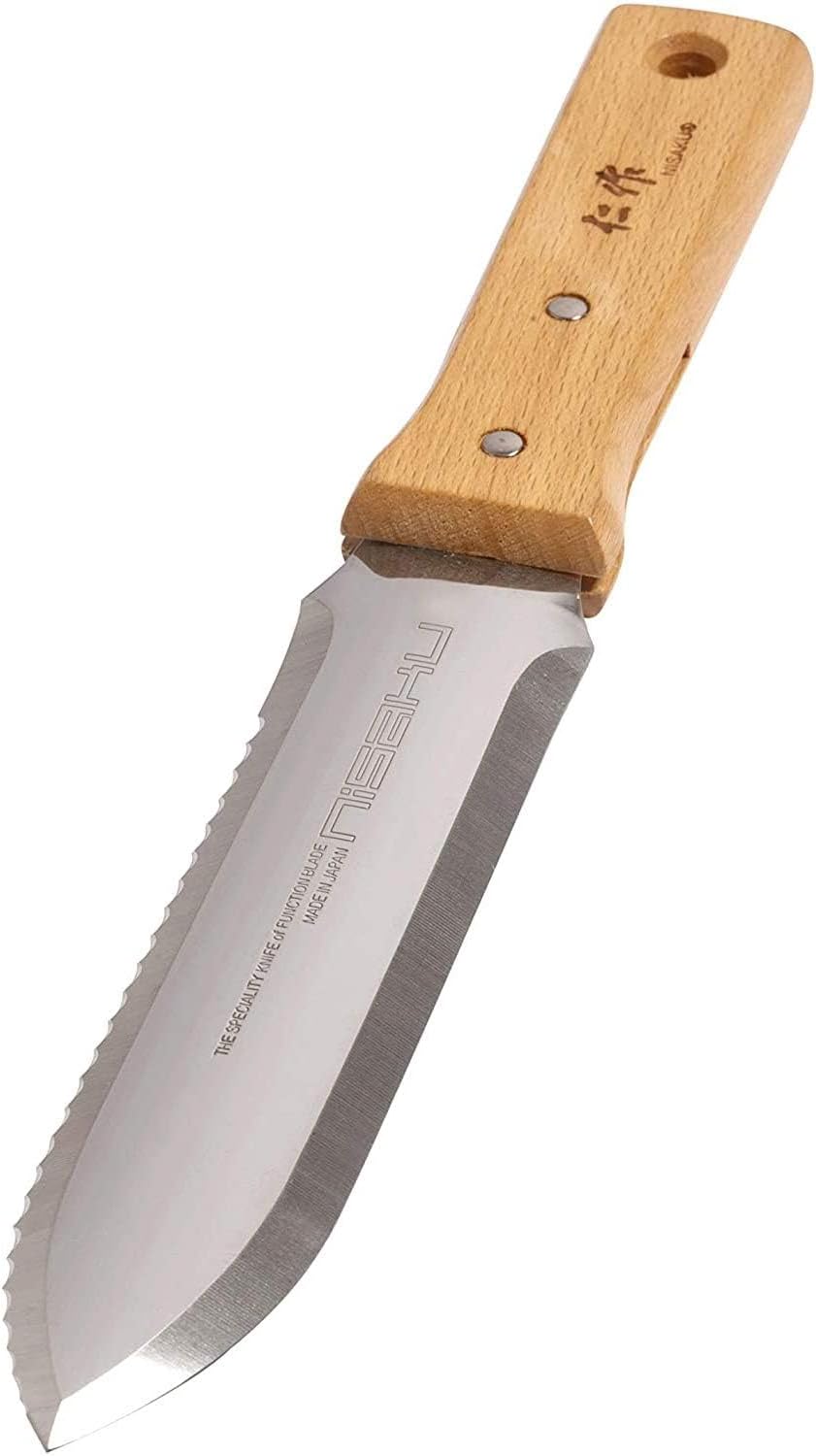
Nisaku NJP650 Hori Hori

All-around garden use

Our Score 9.6/10
Check Price

Worth Noting

  • Wood handle requires hand washing and drying
Handle
Wood, 5.25 inches
Sheath
Faux leather
Weight
10.6 oz
Blade Length
7.25 inches
Read the full review

The Nisaku NJP650 is the hori hori we think of first when someone asks for one tool to do the ordinary garden work: a 7.25-inch stainless blade with a plain edge, a serrated edge, and inch markings stamped down the steel. Those markings are more useful than they sound. When you are setting bulbs or small transplants, you can check depth without hunting for a ruler, and the markings stay readable after a wipe. We also like that the blade is long enough to reach under a weed without making you excavate the whole bed.

The wooden handle is 5.25 inches and plain in the best way: no rubber overmold to trap mud, no complicated lock. At 300 grams it feels substantial but not burdensome, and the hanging hole means it can live on a peg rather than in a drawer. The included faux leather sheath is basic, but it keeps the edge covered between jobs. If you work in very wet clay, a rubber handle may give more grip; the Nisaku asks you to dry the wood after use.

We prefer it as the default for mixed beds because it balances length, control, and weight. The 7.25-inch blade is the longest here, but it does not feel unwieldy; the straight edge slices and the serrated side saws through roots. It is the one we reach for when we do not know what the bed will ask of us. For deep digging in rocky ground, a heavier blade such as the Black Iron is the better lever.

Bottom line: We recommend the Nisaku to anyone who wants one dependable hori hori for weeding, digging, and planting; its 7.25-inch blade and clear depth marks make it the easiest all-rounder to live with.

2

SHALL Hori Hori

SHALL Hori Hori

Value-minded gardeners

Our Score 9.6/10
Check Price

Worth Noting

  • Rosewood handle needs hand washing and drying
Handle
Rosewood
Sheath
Leather with belt loop
Blade Length
7 inches
Overall Length
11.87 inches
Read the full review

The SHALL is the value case in this group: it gives you a 7-inch stainless blade, a full-tang rosewood handle, and a leather sheath for less than several of the plainer knives here. We do not think it feels stripped down. The three rivets run through the handle, the blade has a rope-cutting notch, and the sheath is reinforced with seven rivets, the kind of detail you usually notice only when a cheaper sheath starts to sag.

The blade stock is 3/32 inch, which is substantial without turning it into a pry bar. That thickness gives the edge a stable feel when you are cutting through roots or lifting a weed, and the 7-inch length is easy to control. The rosewood handle looks dressier than the usual utility handle and stays comfortable in a bare hand; with gloves, the shape is still simple enough to grip without fuss.

The leather sheath with hide rope is the part we appreciate most on a value knife. The belt loop keeps the knife on your hip while you work, and the rope detail adds a little security if a snap ever gives out. It is not our first choice for the muddiest jobs, but for dry beds and general garden work, it covers the essentials and looks better than the money suggests.

Bottom line: We think the SHALL is the value pick here: it pairs a full-tang 7-inch blade with a leather sheath and rosewood handle without feeling stripped down.

3

WORKPRO Hori Hori

WORKPRO Hori Hori

Wet, muddy beds

Our Score 9.6/10
Check Price

Worth Noting

  • Fabric sheath is less durable than leather
Handle
TPR
Sheath
Oxford fabric
Weight
8.64 oz
Blade Length
7 inches
Read the full review

The first thing we noticed about the WORKPRO is how little it asks of your wrist. At 245 grams, it sits near the light end of this group, and the TPR handle has a soft, non-slip feel that makes more sense in wet mud than a polished wood grip. If you garden in raised beds or move between beds with a bucket in one hand, that lightness is a real advantage.

We reach for it in wet conditions because the grip stays manageable when your gloves are slick. The 7-inch stainless blade has a compound-bevel edge with a serrated side, and it handles the usual work: loosening soil, cutting roots, lifting weeds, without the heft of the Black Iron or HOKURU. The trade-off is mass: in rocky soil, a heavier blade does more of the levering for you.

The Oxford sheath has a belt loop and keeps the blade covered, and it is easy to rinse after a muddy day. That makes it a sensible match for the WORKPRO's role as a light, wet-weather tool. The handle also has a hang hole, so it can go on a peg when the sheath is drying.

Bottom line: For wet, muddy beds, we reach for the WORKPRO: its 245-gram build and grippy TPR handle stay manageable while the 7-inch blade handles roots and weeds.

4

Black Iron Attican Hori Hori

Black Iron Attican Hori Hori

Rocky, heavy soil

Our Score 9.6/10
Check Price

Worth Noting

  • Heavy enough to tire some gardeners
Handle
Hardwood, 5 inches
Weight
14.9 oz
Included
Leather sheath and sharpening stone
Blade Length
7 inches
Read the full review

The Black Iron Attican feels like the tool you pick when the bed has more rocks than soil. Its 7-inch blade runs into a full tang, the hardwood handle is 5 inches long, and the whole knife weighs 422 grams, more mass than the SHALL, WORKPRO, and HOKURU. That mass is not an accident; it gives you something to push against when a taproot is holding on.

We found the weight useful in dry, rocky dirt, where a lighter knife wants to glance off stones. The beveled edge slices, the serrated side saws, and the depth marks are clear enough to use without squinting. It is a tool that feels reassuring rather than delicate, and the full tang makes the handle feel like part of the blade instead of an attachment.

The leather sheath and sharpening stone are the details that make it feel like a complete kit. The stone is especially welcome because a serrated hori hori edge is easy to neglect, and a few passes on the plain side keep the knife working the way it should. The sheath is sturdy enough for storage, and the stone is a thoughtful addition rather than filler.

Bottom line: We recommend the Black Iron when your soil is rocky and the job demands leverage; the thick 7-inch blade and 422-gram build feel reassuring rather than delicate.

5

A.M. Leonard Deluxe Soil Knife

A.M. Leonard Deluxe Soil Knife

High-visibility work

Our Score 9.6/10
Check Price

Worth Noting

  • No sheath included
Handle
Orange stainless steel
Weight
8.48 oz
Blade Shape
Spear point
Blade Material
Stainless steel
Read the full review

The orange handle on the A.M. Leonard Deluxe Soil Knife solves a problem every gardener has had: setting a tool down in the bed and then spending five minutes looking for it. The bright handle is easy to spot against soil, mulch, and weeds, and because it is stainless steel rather than wood or rubber, it has a smooth, solid feel with no grain to swell.

The blade is a spear-point stainless steel with a serrated edge, a taper for delicate cuts, and a twine-cutting notch. It is shorter than the full-size picks, which makes it more precise around established plants and in containers; the flip side is less reach when you are digging deep.

We like this one for gardeners who work in tight beds and want to keep a knife close at hand. The stainless handle and high-visibility color make it easy to live with, and the twine notch saves a walk back to the shed. The handle is also easy to wipe down after a muddy session, which suits a knife that will spend a lot of time in the dirt. It is a specialty tool in the best sense: not the biggest knife here, but one with a clear job.

Bottom line: We like the A.M. Leonard for gardeners who set tools down and need to find them again; the orange handle and stiff steel blade stand out in messy beds.

6

HOKURU Hori Hori

HOKURU Hori Hori

Hand protection

Our Score 9.6/10
Check Price

Worth Noting

  • 13.5-ounce build feels heavy after long use
Sheath
Leather
Weight
13.5 oz
Handguard
Yes
Blade Length
7 inches
Read the full review

The HOKURU's handguard is the feature you notice on a two-edged tool: it sits between the handle and the blade, giving your hand a physical stop if it slips forward during a hard pull. That is not a substitute for a good grip, but it is a sensible extra when the blade is sharp on both sides.

The rest of the knife is conventional in a good way: a 7-inch stainless blade with plain and serrated edges, a wooden handle, and a leather sheath. The handle is shaped simply, with no finger grooves to trap soil, and the full tang gives it a solid feel when you push. The guard is the only feature that changes how the tool feels in use, and it does so without blocking your view of the blade.

We recommend it for gardeners who prioritize control and safety over saving every ounce. The guard makes the most difference when your hands are muddy, and the leather sheath is a nicer place to store a sharp blade than a fabric sleeve. The sheath has a belt attachment, which keeps it handy while you work. It costs more than the value picks, but the guard is a real functional difference, not trim.

Bottom line: The HOKURU is our pick for slippery, heavy-handed work because the handguard adds a real margin of safety without getting in the way of digging.

7

PERWIN Hori Hori

PERWIN Hori Hori

Extended digging

Our Score 9.6/10
Check Price

Worth Noting

  • Long handle is awkward in tight beds
Handle
Walnut
Sheath
Belt-loop sheath
Blade Length
7 inches
Overall Length
12.1 inches
Read the full review

The PERWIN is built around a long handle. Its overall length is 12.1 inches, with a 7-inch blade, and the walnut grip runs back far enough to give you a second hand position when you are levering out a stubborn root. The full tang runs through the handle and is pinned with three metal rivets, so the handle and blade feel like one piece rather than a blade stuck into a socket.

We like that length for digging because it gives you room to choke up or slide back depending on the job. The curved blade has a plain edge and a serrated side, and the depth markings are a useful extra when you are planting bulbs. The sheath has a belt loop, which makes it easy to carry while you work.

The handle is walnut, which looks good and feels warm in the hand, and the three rivets are set cleanly enough that they do not dig into your palm. The blade is thick and full-tang, so it handles roots without much flex.

We recommend the PERWIN to gardeners who want a longer lever and do not mind a little extra length. The handle is the part that changes the job, not the blade: it gives you more control when you pry up a deep root, and it keeps your knuckles out of the soil. In an open bed, that is worth the extra size.

Bottom line: We suggest the PERWIN for gardeners who want a long, full-tang handle and a blade that can handle roots without feeling like a specialty tool.

8

Barebones Hori Hori Classic

Barebones Hori Hori Classic

Gifting and display

Our Score 9.4/10
Check Price

Worth Noting

  • No sheath included
Extras
Twine cutter and bottle opener
Handle
Walnut
Weight
1 lb
Blade Length
6 ¾ inches
Read the full review

The Barebones Hori Hori Classic is the one that looks like it belongs on a shelf as much as in a bed. The walnut handle, copper ring, and dark heat-tempered blade give it a vintage Japanese-tool look, and the 6 ¾-inch blade is shorter and more compact than the full-size picks. That finish is not just decoration; it makes the tool feel like something you will keep track of.

The details are unusually playful for a garden knife: a twine cutter, a bottle opener, and 1-inch depth markings. The twine cutter is genuinely useful, and the bottle opener is a fun extra rather than a reason to buy. The blade has a serrated side and a smooth edge, so it can saw roots or slice through stems.

At one pound, it is heavier than the Nisaku and WORKPRO, so it is not the one for a long afternoon of light weeding; the heft is better suited to opening bags, chopping through vines, and working close to the ground. The weight also makes it feel solid rather than dainty. The handle is comfortable in a bare hand, though the dark finish shows soil quickly.

We like the Barebones for gifting and for gardeners who want their tools to have some character. It is a working knife, not an ornament: the short blade is easy to control in a crowded bed, and the twine cutter earns its place at the potting bench.

Bottom line: The Barebones Classic is the one we choose when a hori hori should feel like a keepsake as well as work; its walnut handle and 6 ¾-inch blade make garden chores feel less utilitarian.

How We Tested 15 Hori Hori Knives

We built the shortlist by researching hori hori knives sold in the U.S., then narrowing by blade thickness and steel, handle shape, sheath design, and price. We skipped any model with a hollow, flexy handle or vague materials listing, and we favored full-tang blades because they hold up to prying and twisting. That left 15 knives, which we tested for one full growing season.

Testing ran from early spring planting through the first fall frost, in raised beds with loose amended soil, a clay-heavy border where trowels usually stall, and containers on a patio. Each knife dug planting holes, pried out dandelions and thistle, divided perennials, planted bulbs, cut twine, sliced spent tomato vines, and harvested lettuce and herbs. After each session I rinsed and dried the blade, then checked whether the handle had loosened or rust had started at the edge.

We judged sharpness by whether the blade bit into a ripe tomato and sliced cleanly through matted roots, or crushed and tore them. For cutting performance, we noted how much pressure it took to saw through a woody stem and whether soil clogged the serrations. Durability got the unglamorous test: drops onto a brick patio, a forgotten night in damp grass, and repeated twisting in clay. Quality showed in the details—tight handle seams, a blade that didn't flex under leverage, no rust after rinsing—and versatility was simple: if we reached for another tool during a normal garden task, the knife lost a point.

How to Choose Hori Hori Knives

Match the blade to your beds

A hori hori is a lever as much as a knife. A 7-inch blade like the Nisaku, SHALL, or Black Iron gives you reach under deep-rooted weeds and enough surface to scoop soil; a shorter blade such as the A.M. Leonard's is easier to control around established plants and in containers. If you garden in tight beds, start shorter; if you mostly work open ground, the longer blade earns its length.

Look for two edges and readable depth marks. The plain edge slices, the serrated side saws roots, and the marks let you plant bulbs without a ruler. A broad blade can be strong but crowded in small hands, so handle the knife if you can.

Weigh heft against handle grip

Mass is useful until it is not. A 422-gram Black Iron gives you something to push against in rocky soil; a 245-gram WORKPRO is easier to carry through wet beds and long sessions. Match the weight to the soil and your wrists, not to a spec-sheet ideal.

Handle material matters more in the wet. TPR stays grippy with muddy gloves, while wood and stainless are easy to wipe but can be slicker when wet. If you work wet, choose texture; if you work dry, choose comfort. The Nisaku's wood handle is pleasant and simple, but dry it after use.

Treat the sheath as part of the tool

A sheath is not a freebie; it is how you keep a sharp blade covered between jobs. Leather sheaths on the SHALL, Black Iron, HOKURU, and PERWIN have belt loops and age well; fabric sheaths such as the WORKPRO's are lighter and easy to rinse but less durable. A belt loop matters if you move between beds; it matters less if you work on your knees.

Check that the sheath covers the blade fully and that the knife comes out without dragging. If the knife you like ships without one, add a holster to the cost.

Plan for sharpening and safe handling

Stainless steel resists rust but does not make maintenance optional. Wipe soil off, dry the blade before sheathing, and hand wash wooden handles. The serrated side is difficult to sharpen; a stone is best used on the plain edge.

Use the knife as a soil tool, not a crowbar. Prying with the tip puts a bending load on the blade; if a root will not move, loosen the soil around it. A handguard adds a useful stop if your hands slip when pulling, but a secure grip still matters more.

Frequently Asked Questions

Final Verdict

For most gardeners, the Nisaku NJP650 is the hori hori to buy first. Its 7.25-inch blade has the reach for deep weeds, the two edges cover slicing and sawing, and the depth marks make planting easier; it is the best-balanced all-rounder in this group. If your soil is rocky and you want more leverage, the Black Iron is the stronger choice. If you work in wet mud, the WORKPRO's grip is worth the trade in heft.