Beekeeping

Best Hive Tools of 2026

The first time a frame comes out glued down with propolis, you stop thinking of a hive tool as a small pry bar and start thinking of it as your third hand. A good one separates supers without cracking them, scrapes wax off a queen excluder, and lifts a frame cleanly without rolling the bees. A cheap one that bends on the first sticky super is no bargain, and a fancy one that slices through a glove or feels too heavy by the last box isn't much better. That balance is what this list is about.

I've kept hives long enough to have a drawer of bent, rusted, and mysteriously dull tools, so I had opinions before we started. This past season my team and I put 16 hive tools through weekly inspections and honey pulls, from cheap stamped models to heavier forged ones, and the differences showed up fast. The best tool isn't the sharpest or the heaviest; it's the one that holds an edge without turning into a razor in your pocket and has enough weight to pry without wearing out your wrist. The picks below reflect that balance, and each one earned its place for a different kind of beekeeper.

1

KINGLAKE Steel J-Hook Hive Tool

Top Pick
KINGLAKE Steel J-Hook Hive Tool

Most beekeepers

Our Score 9.6/10
Check Price

Worth Noting

  • Painted finish rather than bare stainless
Length
10.5 in
Weight
3.68 oz
Hook Style
J-hook
Tools Included
1
Read the full review

The detail that earns this tool its place is small enough to miss in the product photo. Above the J-hook on this 10.5-inch bar there is a step: drop the hook under a frame lug and that step rests on the frame next door, so a straight pull becomes a lever. A frame glued down with propolis since spring comes up with a squeeze instead of a wrench, and that is the difference between a calm inspection and a box full of rolling bees.

That hook is why we point almost everyone here first. The rest of the tool holds up as well: 3.68 ounces disappears into a jacket pocket, the flat end is ground sharp enough to slice bur comb off a top bar, and the whole thing cleans up with a scrape. On our own inspections it is the tool we have carried when we carry only one.

There is no handle, no grip, no moving parts — just steel with a hook at one end and a chisel at the other, which is exactly what you want sliding into a bee suit pocket. The flat end also works as a small pry bar when a super needs persuading, and the square corner gets under a stuck frame where a round hook will not.

What it will not do is bully a box that has been sealed for a season in cold weather. The stock here is thinner than the 3 mm tool below, so on a hard bonded stack, clear the seam with the scraper and let the hook lift rather than leaning on the blade. For a weekly inspection and a scrape of the inner cover, the light tool in your pocket beats the heavy one in the truck.

Bottom line: The hive tool we hand to new beekeepers: at 10.5 inches and under four ounces, the J-hook frees a stuck frame and the flat edge scrapes it clean.

2

AukBeeFun 7-in-1 Hive Tool

AukBeeFun 7-in-1 Hive Tool

One-tool kit

Our Score 9.6/10
Check Price

Worth Noting

  • Heavy at 10.4 ounces
  • Wide head and wood handle crowd a pocket
Handle
Wood
Length
10.6 in
Weight
10.4 oz
Functions
7-in-1
Read the full review

The first thing you notice is the handle. It is a solid piece of wood with steel heads riveted on each end, and at 10.4 ounces the whole tool weighs close to three times what the KINGLAKE does. In a gloved hand it feels like a tool rather than a strip of steel, and on a cold morning that bulk is something to hold on to.

The seven functions are mostly real: a scraper, a J-hook, a frame lifter and a pry on one end, three more jobs on the other. That comes down to one tool covering what two or three separate ones would. The J-hook lifts a frame, the wide blade scrapes a rim, the pry end opens a super, and we did all three without swapping anything out of a pocket.

Carrying is where it gives ground. At 10.6 inches long and more than 3 inches across the head, it does not drop into a bee suit pocket the way a plain bar does, and the wooden handle eats space in a tool bag. Ours lives in the truck and comes out for full inspections; the tool that goes into the apiary in a pocket is still a plain J-hook.

Bottom line: The one-tool answer for a bench or truck box: seven jobs on a single handle, as long as you do not mind the weight out in the yard.

3

Sunshane 2-Pack J-Hook Hive Tool

Sunshane 2-Pack J-Hook Hive Tool

Two hives

Our Score 9.6/10
Check Price

Worth Noting

  • Identical tools, so no second hook shape
Pack
2 tools
Length
10.5 in
Material
Stainless steel
Thickness
0.08 in
Read the full review

The second tool is the reason to buy this pack. You get two identical 10.5-inch stainless J-hooks, each 0.08 inch thick with a hole drilled through the flat end for hanging, and together they solve the oldest problem in beekeeping: the tool you set down on the inner cover and then walked away from.

We put one in the bee jacket and one in the truck box and stopped ferrying a hive tool between two yards. Taken on its own, it is a good plain J-hook: the curve catches a lug, the flat end takes wax off a frame top, and the thin blade slips into a seam without wedging the boxes wider than they need to go.

The hanging hole earns its keep if you keep a hook on a nail in the shed. What you do not get is a second shape: both tools are identical, so if you are still deciding between a J-hook and an L-hook, the Kasteco pair is the better buy.

Bottom line: Buy it for the spare, not the steel: two 10.5-inch stainless J-hooks mean one lives in your jacket and one stays in the truck.

4

Kasteco J-Hook and L-Hook 2-Pack

Kasteco J-Hook and L-Hook 2-Pack

Trying both hooks

Our Score 9.6/10
Check Price

Worth Noting

  • Die-cut edges can arrive with a burr
Pack
2 tools
Lengths
10.5 in and 9 in
Material
Steel
Hook Styles
J-hook and L-hook
Read the full review

The appeal here is choice. You get a 10.5-inch J-hook and a 9-inch L-hook in the same pack, both steel, so you can find out which shape your hives actually want instead of guessing from a photo and buying twice.

We ended up with the J-hook on frame duty — the curve catches a lug and holds it while you lift — and the L-hook in the box as a flat scraper and pry for rims and corners. The steel is sturdy, the flat edges scrape a rim clean, and neither tool feels like a freebie thrown in with the other.

What to watch is the finish on the die-cut sides: a burr along the grip side is worth a minute with a fine file before the pack goes into your bee bag. After that, the L-hook is the one that sits unused if you take to the J, which makes this a learning pair rather than the last hive tool you buy.

Bottom line: A good way to find out which hook suits your hives: both shapes in one pack, both sturdy enough to keep using afterwards.

5

Acostop J-Hook with Bee Brush

Acostop J-Hook with Bee Brush

Brush included

Our Score 9.6/10
Check Price

Worth Noting

  • The hook alone does not beat cheaper tools
Brush
Horsehair, 13.8 in
Bristles
2.7 in
Material
Stainless steel
Tool Length
10.5 in
Read the full review

Most people click this listing for the brush, and that is the right way to read the set. It is a 13.8-inch horsehair brush with 2.7-inch bristles, bundled with a 10.5-inch stainless J-hook scraper.

The brush is the part we were glad to have. Soft bristles let you sweep bees off the edge of a frame and back into the box instead of shaking them, and the long wooden handle keeps your knuckles a little further from the cluster.

The hook is a plain stainless J-hook with a flat scraper edge. It goes under a lug, lifts a frame, and takes wax off a rim; there is nothing wrong with it and nothing memorable about it either.

Buy the set if a bee brush is already on your list — you get a decent brush and a competent hook in one order. If you own a brush, the KINGLAKE does the same hook work with less in the box.

Bottom line: Buy this set if you need a soft bee brush anyway; the stainless J-hook is competent, but the brush is what earns the spot.

6

EZ Find Pro Hive Tool

EZ Find Pro Hive Tool

Tight seams

Our Score 9.4/10
Check Price

Worth Noting

  • Shorter 9.5-inch reach than the standard bar
  • Most expensive tool in this group
Extras
Notched hook and nail puller
Length
9.5 in
Weight
7 oz
Material
3 mm heat-treated stainless steel
Read the full review

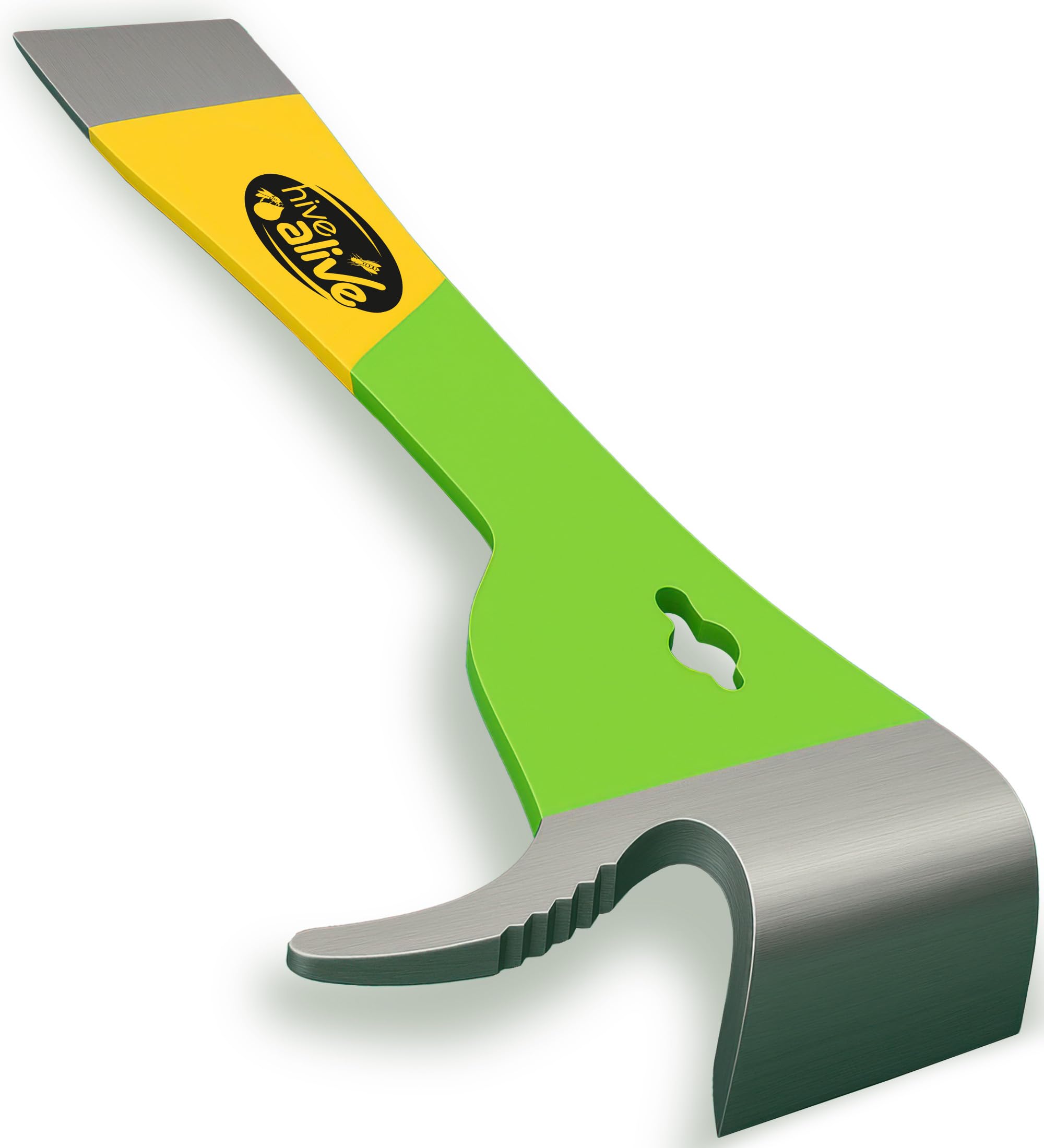
This is the priciest tool in the group, and the first time you slide the long, low-angle bevel into a seam that has been shut since spring, the price stops mattering. The blade is 3 mm heat-treated stainless and it does not flex when you lean on it to part two supers. That stiffness is the whole pitch: thin tools bend, bent tools stop sliding into gaps, and then you are back to a screwdriver.

The hook end has a pointed tip and notches ground above the curve that catch the frame next door and stop the hook skating off while you lever. There is a nail puller in the mix too, which sounds like filler until a frame nail works loose. At 7 ounces it has real weight in the hand — still about two-thirds of what the wood-handled AukBeeFun weighs.

The two-tone yellow and green finish looks like a gimmick and is not. This is the tool we found again fastest after setting it down in grass, and that happens more often than anyone admits. At 9.5 inches it is an inch shorter than the standard bar, and we noticed the shorter reach in deep boxes, though the stiffness makes up for part of it.

Bottom line: Worth the premium if you crack a lot of cold, propolized boxes: the 3 mm steel and long bevel make short work of seams where thinner tools stall.

7

WEICHUAN Stainless Hive Scraper 2-Pack

WEICHUAN Stainless Hive Scraper 2-Pack

Scraping and cleanup

Our Score 9.4/10
Check Price

Worth Noting

Ends
Open hook and flat scraper
Pack
2 tools
Profile
Thin blade
Material
Stainless steel
Read the full review

This is not a J-hook-first tool, and that is fine as long as you buy it for what it is: two thin stainless scrapers, each with a large open hook at one end and a wide flat blade at the other.

Scraping is where the pair earns its place. The blade is thin enough to slide into the joint where a box meets its rim and wide enough to take a run of wax and propolis off in one pass. We used them on bottom boards and inner covers, where a frame hook is the wrong shape and a paint scraper is too clumsy.

The profile is close enough to a glazier's bar that plenty of these get bought for trim work instead of hives, which tells you how they handle: flat, controlled, and good at getting behind something without gouging the surface underneath.

In the apiary that makes them a cleanup pair rather than the tool you carry every week. Thin stock is the trade: the same blade that scrapes a rim clean is not what you want to lean on when a super is cold and bonded, so keep a J-hook for the frame work and these for the mess.

Bottom line: A cleanup pair rather than an everyday hive tool: thin stainless scraper blades that clear box rims and bottom boards fast.

8

KINGLAKE Garden Hive Tool Set

KINGLAKE Garden Hive Tool Set

Hook plus scraper

Our Score 9.4/10
Check Price

Worth Noting

  • Two handles for a job one tool covers
Pack
2 tools
Sizes
10.6 in and 9.2 in
Storage
Hanging holes
Material
Steel
Read the full review

Two tools, two jobs: a 10.6-inch J-hook for lifting frames and a 9.2-inch scraper with a wider, flatter blade for rims, ledges, and bottom boards. Both are steel, both have a hanging hole at the end, and both are light enough to carry together.

The scraper is the more interesting half. Its blade is wider and stiffer than the flat end of a J-hook, so it takes wax off a box rim in fewer passes and reaches the corner where the rim meets the side. The J-hook is a standard one and does standard J-hook work: under the lug, lift, lever.

Where it loses to the single KINGLAKE is overlap. You are carrying two handles to do work one bar does, and the hook is the tool you reach for first. It makes sense if you want a dedicated scraper that stays out of the wax, or a second tool for a helper without buying the same shape twice.

Bottom line: A sensible pair for a beekeeper who wants a separate scraper for cleanup duty and a hook for the frames.

How We Tested Hive Tools

We started by rounding up the hive tools that show up in beekeeping supply catalogs and forums, then narrowed the list to 16 across a range of shapes, weights, and steel types. We left out novelty bottle openers and tools with no clear beekeeping use. Over a full season of weekly inspections and honey pulls, we used each tool for the same jobs: prying apart supers, scraping propolis off frames and excluders, lifting frames, and cutting burr comb. We rotated them among three beekeepers so the results weren't one person's grip or one hive's temperament.

At each inspection we noted whether the tip flexed or held when we pried a stuck frame, and whether the edge still bit into wax after several scrapes. We weighed every tool on a kitchen scale and used the heavier ones through a full box-by-box inspection to see where fatigue set in. We also checked the edges by running a gloved finger along them and by carrying each tool in a bee suit pocket; a blade that was too sharp for safe handling got marked down even if it cut beautifully. Durability came down to repeated exposure to propolis, honey, and washing, with a close look for rust, nicks, and loosening handles.

Value was judged against how often we reached for a tool and how well it held up, not just the sticker price. Versatility mattered too: the best tools could pry, scrape, and cut without needing a second gadget, though we noted when a narrower or wider blade suited a specific job. By the end of the season, the tools that stayed in our buckets were the ones that did the unglamorous work without flexing, slicing a glove, or tiring out a wrist.

How to Choose Hive Tools

The Hook Does the Lifting

The first frame is the hard one. It is glued to the box with propolis, and it is the frame you have nothing to grip. A J-hook solves that by sliding under the frame lug and giving you something to pull against, and the better ones add a step or a notch above the curve that rests on the neighbouring frame, turning a straight pull into a lever. A flat pry bar or an L-hook will crack boxes apart, but both are poor at freeing a frame that has set in place.

So if your frames come out with a fight, make the hook the first thing you compare and the steel behind it the second. The step is the part worth looking for in photos; it is small, and it is the difference between lifting a frame and dragging the whole box with it.

Stiff Steel in a Tight Seam

You do not need a thick blade to scrape wax; you need one to separate boxes that have bonded. Thin stainless flexes under load, and a bent tool stops sliding into the gap it was bought for. A long, low-angle bevel starts in a seam that a blunt wedge cannot enter, and 3 mm heat-treated stock keeps it there while you lean on it.

If you run more than a few hives, or you open boxes on cold mornings when propolis sets hard, that stiffness is worth paying for. For two hives in a garden and a weekly look, a light bar with a good hook does everything you need.

Edges, Gloves, and the Wood Behind Them

Every tool here arrives sharp enough to cut wax, and some arrive sharp enough to cut you. That is the working edge, not a fault, but it sets the rule: gloves on, and the blade pointed away from the hand holding the frame.

Grinding varies more than the specs suggest. An uneven bevel scrapes in one direction and skates in the other, so check the flat by eye before the first inspection and run a fine file over any burr left along the die-cut sides. A tool that will not take an edge after a few strokes has earned a place in the scrap bucket.

Weight, Length, and Where It Rides

A hive tool spends most of its life in a pocket, so the numbers that matter are the ones you notice when you put it away. Standard length runs around 10.5 inches, which reaches past a frame lug in a deep box; shorter tools are handier, and you give up reach to get them.

Weight runs from under 4 ounces for a plain bar to over 10 for a wood-handled multi-tool, and the gap shows up at the end of a long inspection. If your suit has chest pockets, a plain bar disappears into one. If your tool lives in a bucket by the gate, weight matters far less than the grip.

Singles, Pairs, and Extras

Buy one good hook before you buy a set. A second identical tool is genuinely useful — one in the jacket, one in the truck — but a second shape is a better use of the money if you are still deciding between a J and an L. Bundles that add a bee brush make sense when the brush is on your list anyway; otherwise you are paying for something that sits in the shed.

Hive tools get set down on inner covers and left behind, which is the honest argument for owning two. It is also the argument for a finish you can spot in grass.

Frequently Asked Questions

Final Verdict

If you want one hive tool and no fuss, the KINGLAKE is the one we point to. It is light enough to forget in a jacket pocket, the step above the J-hook gets the first frame out of a propolized box, and the flat end scrapes off the wax you just loosened.

Spend more only if your boxes are heavy and your mornings are cold: the EZ Find Pro's 3 mm steel and long bevel earn their keep there. Keep hives in two yards and the Sunshane pair means you stop carrying one tool between them.