Garden Tools

Best Garden Twine for Tying Plants of 2026

The first heavy tomato cluster is a small test of faith: one weak length of twine and the vine ends up on the ground. Garden twine looks trivial until you're halfway up a trellis with slipping knots, so I spent the past growing season, early spring through late summer, using 14 different twines in my beds. I wanted a line that holds a plant without cutting the stem, survives rain and sun, and pulls easily from the ball. The right one disappears into the job; the wrong one turns every tie into a negotiation.

The differences show up fast. Thickness changes how a tie bites into a soft stem, material decides whether a knot holds through a wet week, and a smelly or badly wound ball can make close work unpleasant. I also noted how much twine I actually got for the money, whether the ball tangled as it emptied, and how it looked against leaves and stakes. The picks below are the ones I'd reach for again, whether you're tying tomatoes, training peas, or bundling prunings.

1

ACE Supply Nylon Twine #18

Top Pick
ACE Supply Nylon Twine #18

Weatherproof trellises

Our Score 9.6/10
Check Price

Worth Noting

  • Bright white line stands out against foliage
Material
Braided nylon
Line Size
#18
Spool Length
500 feet
Tensile Strength
170 lb max
Read the full review

Jute is designed to break down; that's the point of it, and also its weakness once the weather turns. If you want a tie still doing its job in November, you want the braided nylon. At 170 pounds of tensile strength this line holds a laden branch, and the braided construction means a cut end doesn't unravel into a brush the way twisted nylon does.

We keep this for the structures — trellis runs, a line between two posts for a Florida weave, anything that stays outdoors through the worst of it. It doesn't sag, it doesn't go fuzzy, and you wind it back onto the spool in October and use it again next year. That's why the outlay is easier to justify than it looks: it's the one spool here you can reasonably expect to buy once.

The catch is slickness. Nylon doesn't grip itself the way jute does, and a single knot under load will slide; tie a double half hitch, or use it where tension comes from the run rather than from the knot itself. Stretched between two posts, it holds a taut line better than anything else here. It's also the brightest thing in the bed — fine on a fence line, conspicuous on a trellis you look at from the kitchen window.

Bottom line: The tie we leave out over winter: braided nylon that holds a taut line through storms and can be wound up and used again next spring.

2

PerkHomy Cotton Butcher Twine

PerkHomy Cotton Butcher Twine

Tender stems

Our Score 9.6/10
Check Price

Worth Noting

  • Not reliably all cotton despite the label
Material
Cotton
Spool Length
500 feet
Strand Diameter
2 millimeters
Read the full review

The stems that suffer most from a tie are the ones still growing. Cotton is the softest cord here, and around seedlings, peppers, and anything with a stem you can pinch between two fingers, it holds without bruising the tissue. We used it where jute felt like overkill — young transplants, a leaning delphinium, the first stake on a pepper plant that had no business being staked yet.

It's also the most kitchen-friendly spool in the guide. The same 500 feet that ties up beans is food-grade cotton you can truss a chicken with, and it holds a knot without slipping, which is more than the nylon can say. Two millimeters is fine cord, so it goes around a stem twice where a jute strand goes once, and it disappears against green foliage.

Where it doesn't belong is on anything heavy. A branch with real weight behind it needs the thicker jute; this is a delicate-work cord that will hold a seedling all season and look neat doing it. Between a kitchen drawer and a garden bag, that's two jobs from one small spool, and we like it more for that than for any strength claim.

Bottom line: Our pick for seedlings, peppers, and any stem you'd rather not scar: soft cotton cord that holds its knot and costs very little.

3

Joyberg 3-Roll Twine Set

Joyberg 3-Roll Twine Set

Labeling varieties

Our Score 9.6/10
Check Price

Worth Noting

  • Cotton rolls are thin for outdoor ties
Materials
Jute and cotton
Set Contents
3 color-coded rolls
Total Length
984 feet
Strand Diameter
2 millimeters
Read the full review

Three rolls sounds like a craft-box gimmick until you're standing over twelve tomato plants trying to remember which one is the San Marzano. A colored tie answers that in a second: black on the cherries, white on the slicers, jute on everything else.

The set is 984 feet across three 328-foot rolls — one jute, one black cotton, one white cotton, all 2 mm. The jute roll does the actual garden work. The cotton rolls are ten-strand, soft and fine, better for tags, plant labels, and wrapping than for holding up a branch.

Where it's weaker is strength. Two-millimeter cotton is thin, and outdoors it's a light-duty cord; use it for labeling and light support and it behaves. The color coding is what you're really buying, and it's worth it once you grow more than a couple of varieties.

For a household that ties plants and wraps presents from the same drawer, this is the tidy buy: one box, three colors, no scrambling for a marker at transplanting time. Keep all three rolls on a single peg so the code stays obvious, and you'll use them down to the last yard.

Bottom line: Ideal if you label as much as you tie: three color-coded rolls that separate the jute for plants from the cotton for tags and wrapping.

4

Leecogo Heavy Duty Jute Twine

Leecogo Heavy Duty Jute Twine

Heavy plant support

Our Score 9.4/10
Check Price

Worth Noting

  • Petroleum smell when the coil is new
  • 328 feet runs out fast in a big garden
Construction
4-ply twisted
Spool Length
328 feet
Strand Diameter
2.5 millimeters
Read the full review

Two and a half millimeters is the whole argument. Every other jute spool in this guide is 2 mm, and that half millimeter is the difference between a tie that holds a loaded tomato branch and one that slowly works its way into the stem. The Leecogo is the thickest strand we tested, four plies twisted tight, and it's the coil we kept reaching for whenever something had weight behind it — a fruiting branch, a shrub bent by wind, a stake that had to stay upright until harvest.

Four plies is why it survives the job. Thin jute frays at a cut end and shreds when you pull a knot down hard; this one keeps its twist, so a short tie still has body to it. We used it to tie back shrubs at the end of the season, and the knots were still holding when we took them off. Nothing had slid down a stake.

The trade is length. At 328 feet it's the shortest single jute coil here, so a garden with a couple of dozen plants will finish it in a season. Buy two at once, or keep a bulk coil for netting and rows and save this one for the ties that matter.

What the extra thickness buys isn't brute strength so much as contact: a wider strand spreads the load across the stem instead of concentrating it in one thin line, which is exactly what you want on a plant you've spent four months growing. That's why it's the first spool we hand anyone staking tomatoes.

Bottom line: For staking and tying anything with weight, we reach for this spool: thick four-ply jute that grips a stake, holds its knot, and doesn't saw into stems.

5

PerkHomy Jute Twine 1,100 ft

PerkHomy Jute Twine 1,100 ft

Big gardens

Our Score 9.4/10
Check Price

Worth Noting

  • Chemical smell straight off the coil
Construction
3-ply twisted
Spool Length
1,100 feet
Strand Diameter
2 millimeters
Read the full review

Eleven hundred feet is the number that makes this coil worth owning. Tying a garden eats twine faster than anyone expects, and a coil this long means you stop rationing: cut a generous length, pocket the offcut, and get on with the row. Nothing else here covers as many ties from one spool.

It handles well for bulk twine. The coil is wound so the strand pulls from the center, which sounds trivial until you've fought a ball of twine that keeps collapsing on itself. Three plies at 2 mm, soft enough to tie against a stem without chafing. Run it double around anything with weight behind it and it behaves like a much heavier cord.

Where it falls short of the Leecogo is bite: 2 mm doesn't spread load the way 2.5 does, and on a loaded tomato branch you'll feel the difference. But as the coil by the gate for netting, bundles, and the hundred small ties a week a vegetable garden demands, it's the sensible purchase. Store it dry — a jute coil left on wet soil takes up the damp and sours.

Bottom line: For a garden that eats twine — rows of tomatoes, beans, netting — this is the coil we buy: 1,100 feet that feed out without tangling.

6

KINGLAKE Natural Jute Twine

KINGLAKE Natural Jute Twine

Everyday shed spool

Our Score 9.4/10
Check Price

Worth Noting

  • Bare coil with no dispenser or cutter
Wind
Twisted coil
Material
Jute
Spool Length
656 feet
Strand Diameter
2 millimeters
Read the full review

There's nothing to the KINGLAKE but the twine. A bare coil, 2 mm, 656 feet, no dispenser, no cutter, no claims beyond tying things up — and at the lowest price tier here it makes half the rest of this guide look fussy.

We keep it for the jobs that don't deserve the good twine: a quick loop on a cucumber vine, a bundle of spent stalks, a row cover pegged down for a windy night. Cut a length, tie it off, and don't think about it again, which is exactly what you want from a shed spool. It's light twine, so leave it off anything with real weight — this is a 2 mm strand for annuals, vining crops, and light staking. For everything else, it's the coil that lets you cut generously instead of hoarding the last few feet.

Bottom line: The spool to keep in the shed: plain 2 mm jute in a long coil, cheap enough to cut a generous length without thinking twice.

7

Vanhench Jute Twine 805 ft

Vanhench Jute Twine 805 ft

Light staking

Our Score 9.4/10
Check Price

Worth Noting

  • Some coils run thinner than the stated 2 mm
Material
Jute
Construction
3-ply twisted
Spool Length
805 feet
Strand Diameter
2 millimeters
Read the full review

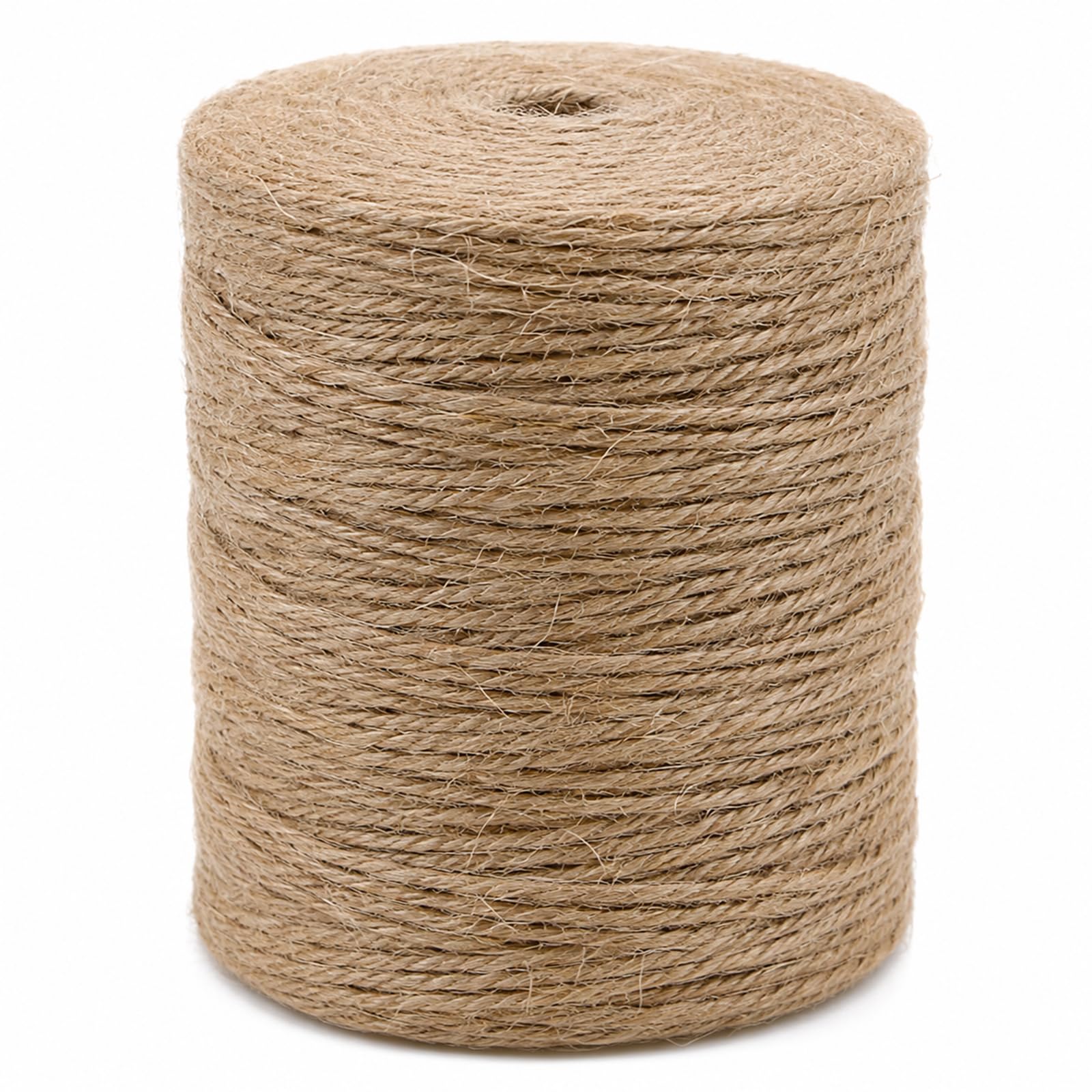
This is the same 2 mm strand as most of the group, with more than twice the length of the top pick on the coil. The Vanhench is what a lot of people actually need: enough workable jute for trellis vines, netting, and light staking without buying a coil the size of a melon.

Three plies, twisted, brown, 200 grams on the coil — light enough to hang on a hook by the door. It ties vining crops up a trellis neatly, and the natural color disappears against stems and soil, which is more than the white nylon manages. Knots grip, and the strand is soft enough that it doesn't chafe a bean vine.

What keeps it out of the top tier is consistency. At 2 mm it's a light tie, and a coil that feels sturdy on a vine is not what you trust on a branch with fruit on it — buy the thicker strand for the heavy row. For a first vegetable garden, or a season of light staking, it's a sensible buy that leaves you plenty of twine to waste.

Bottom line: The coil we hand a first vegetable garden: 805 feet of workable jute for trellis vines and light staking, with room to be generous.

How We Tested Garden Twine

We started by narrowing a long list of twines sold at garden centers and online to 14 that felt suited to outdoor garden use, setting aside anything mostly decorative, too thin for a tomato vine, or sold in a ball so small it seemed likely to run out mid-season. We compared listed materials, thickness, ball size, and approximate length before buying, then used each one from early spring through late summer in the same beds. The main jobs were tying tomatoes and cucumbers to stakes, training peas up a trellis, and bundling prunings for yard waste; we also used the leftovers for tying back shrubs and wrapping a few packages.

We measured strand thickness with calipers and noted how each material felt, whether soft jute, waxed cotton, or a synthetic blend, and whether it shed fibers or had an off-odor straight from the package and again after a wet week outside. We tied knots at plant stems, pulled them snug, and checked after rain whether they slipped, stretched, or cut into soft growth. To judge strength, we hung a 5-pound weight from a knotted loop and watched for fraying, elongation, and how cleanly the knot released.

Because a tangled ball wastes more twine than a weak one, we pulled from both the center and the outside, dropped the ball, and timed how long it took to get a clean arm's length without knots. We also watched how each twine looked through the season, whether the color faded, the surface fuzzed, or the line stood out awkwardly against leaves and stakes, and compared the usable length of each ball with how many ties and bundles it covered. The ones that stayed tidy, held their knots, and still looked good by late summer earned a place on the list.

How to Choose the Right Garden Twine for Tying Plants

Start with thickness, not length

Two millimeters is the standard garden twine, and it's fine for annuals, vining crops, netting, and anything you tie and forget. It is not fine for a fruiting branch. Where a stem carries real weight, a 2 mm strand concentrates the load in a narrow line that can rub or girdle the plant, and it snaps when you cinch it hard. A 2.5 mm four-ply like the Leecogo spreads that load over more fiber and takes a firm pull.

The trap is trusting the label. Diameters run thin on some coils in this group, and a spool sold as 2 mm can feel like thread in the hand. If you're tying anything you'd be sorry to lose, buy the thicker strand or run a thin one double.

Jute, cotton, or nylon

Jute is the default for good reasons: it grips its own knots, it's cheap, and it composts with the season's debris. It also breaks down in weather, which is exactly why it isn't what you leave around a fence post for three years. Nylon is the opposite — the braided line from ACE holds a taut run through storms and winds back onto the spool for reuse, at the cost of slick knots and a brightness that stands out in a bed.

Cotton sits between them, softer than both, which makes it the right cord for seedlings and tender stems and the wrong one for anything structural. Match the fiber to how long the tie has to last, not to how it looks in the drawer.

Work out how much twine a season takes

A 328-foot coil sounds enormous until you're tying a row of tomatoes every week and cutting a fresh length each time. Short coils make you ration, and rationing is how people end up reusing a frayed tie. If you garden in more than a couple of beds, an 800-to-1,100-foot coil costs little more per foot and removes the calculation entirely.

The reverse holds on a balcony or with a few pots: a big coil is one more thing to store, and a small spool will last years. Buy length to match the size of the garden, not the size of the shelf.

Knots and coils: the handling details

Jute and cotton hold a knot; nylon slides, so plan on a double half hitch wherever a nylon tie carries tension. On the plant side, tie off on the stake rather than the stem and leave a finger's width of slack so the stem can thicken without strangling.

A center-pull coil feeds cleanly; a loose ball ends up in knots on the shed floor. Store natural fiber dry, because a jute coil left sitting on wet soil takes up the damp.

Frequently Asked Questions

Final Verdict

Start with the Leecogo. At 2.5 mm and four plies it holds a staked tomato or a bent shrub without cutting in, and it grips its own knot in a way nylon never will — that combination is what most gardens actually need.

If your ties have to survive winter and be used again, take the braided nylon and tie a double half hitch. If you're tying seedlings or trussing a roast, the cotton coil is the softer answer. One jute spool and one nylon spool cover a full season between them.