Pest & Weed Control

Best Electric Fly Swatters of 2026

An electric fly swatter is a tennis racket with a battery in the handle: two grids of metal mesh, a charge between them, and a fly that never sees it coming. The differences between models show up fast — grid spacing, handle weight, whether the head pivots, how satisfying the zap is when you connect. What you're buying is fewer flies circling the fruit bowl and fewer evenings swatting at thin air. My team and I spent a full summer with 14 of these; the ones worth keeping shared a few traits.

What nobody tells you first is that reach matters more than power. Flies land on the ceiling and the top of a window screen, which is why a rotating head does more for you than a bigger battery. I also check the mesh before the price tag — flimsy grids bend on the first hard swing and stop zapping, and a swatter that quits in July is a bad deal at any cost. Somewhere below is the one that fits your kitchen, your patio, and your noise tolerance.

1

Nymrix Electric Fly Swatter 4100V

Top Pick
Nymrix Electric Fly Swatter 4100V

All-around use

Our Score 8.8/10
Check Price

Worth Noting

  • Premium price for a two-pack
  • Loud zap can startle pets
Battery
1800mAh rechargeable
Voltage
4100V
Charging
Dual Type-C ports
Pack Size
2-pack
Read the full review

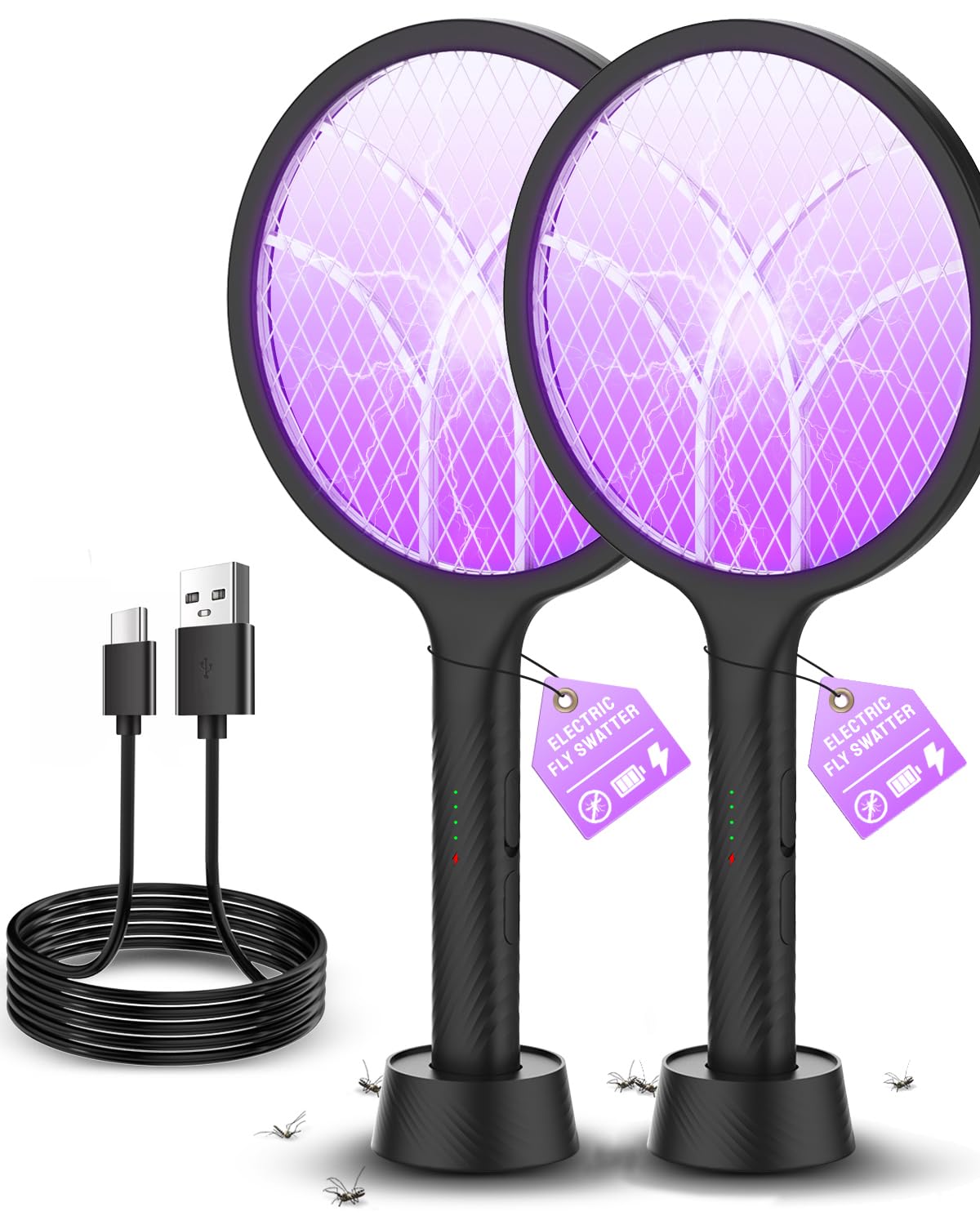
The charging dock is the feature that makes the Nymrix the first racket we reach for: it doubles as a stand, so the swatter can sit ready in standby mode instead of disappearing into a drawer. Add the 4,100V grid, 1,800mAh battery, and handle display that shows the charge level, and this is the most complete package here for a household that wants one by the kitchen and one in the garage.

Two rackets are the obvious convenience, but the two Type-C charging paths matter more than they sound. If the base ever stops charging, the port on the handle gives you a second way in rather than turning the racket into a paperweight. We appreciate that redundancy because a charging base is one more thing to fail.

On contact, the three-layer mesh and 4,100V grid make quick work of gnats, flies, and mosquitoes. The two-pack is most useful when you have two trouble spots, not one. It is a lot of racket for a studio apartment, but a sensible setup for a house with a kitchen door and a garage.

The battery-level display is the small detail that keeps it from becoming another gadget you forget to charge. That, more than the voltage number, is why it stays within reach.

Bottom line: We think the Nymrix is the easiest high-voltage swatter here to live with for a two-racket household, thanks to its dual-mode stand, two Type-C charging paths, and battery display.
2

Mosiller Electric Fly Swatter 4000V

Mosiller Electric Fly Swatter 4000V

UV standby

Our Score 8.8/10
Check Price

Worth Noting

  • Premium price for a two-pack
Modes
Dual mode with UV lamp
Battery
1800mAh rechargeable
Voltage
4000V
Pack Size
2-pack
Read the full review

Two rackets solve a problem a single swatter cannot: one can live by the back door and one in the kitchen, so a fly circling the fruit bowl does not send you hunting through the house. The Mosiller pair adds a 4,000V grid, a 1,800mAh USB-C battery, and a stand with a UV lamp for hands-free standby.

The UV lamp is a bonus, not a promise. It gives the racket something to do between swings, and the stand makes that mode easy to leave out, but the manual swing is still the reason to buy. Treat the lamp as a way to keep the racket ready, not as a substitute for a plug-in trap.

The 4,000V grid is powerful for its size, and the pair is a sensible fit for a household that wants coverage in two places. The two-pack also means you are buying a spare whether you need one or not, which is the main thing to weigh.

The UV lamp is the detail you notice at dusk, when a mosquito circles the porch light and you want a visible target.

Bottom line: The Mosiller earns our recommendation for a porch or kitchen two-racket setup, provided you treat the UV lamp as a bonus and the manual swing as the main event.

3

Faicuk Bug Zapper Racket 2-Pack

Faicuk Bug Zapper Racket 2-Pack

Simple two-pack

Our Score 8.4/10
Check Price

Worth Noting

  • Batteries not included
  • Lower voltage than the top picks
Power
2 AA batteries (not included)
Voltage
3000V
Pack Size
2-pack
Safety Mesh
3-layer mesh
Read the full review

No charging cable, no dock, no battery-level screen: the Faicuk pair is the keep-it-in-the-shed option. That simplicity is why it earns a place as the backup racket you do not have to think about, especially if your swatter lives outdoors and only comes out when the flies do.

The 3,000V grid has enough punch for gnats, mosquitoes, and fruit flies. The double trigger plus three-layer mesh make it feel safer to hand to a guest. The two-pack is the real value: one for the porch, one for the garage.

AA batteries are the trade-off. You do not have to remember a charger, but a racket that lives outside will eat through them. We appreciate the no-frills design for a shed or camper; we do not recommend it as the only swatter for a big house.

The double trigger is the safety detail that matters if the racket lives where kids or guests can grab it.

Bottom line: We keep the Faicuk pair for the shed, porch, or guest space where AA batteries and a simple double trigger make more sense than a charging dock.

4

GeckoMan Electric Fly Swatter

GeckoMan Electric Fly Swatter

High, angled spots

Our Score 8.2/10
Check Price

Worth Noting

  • Not the most powerful grid here
  • Single racket, not a two-pack
Head
Rotating head
Battery
1200mAh rechargeable
Voltage
3500V
Handle Reach
17 to 28 inches
Read the full review

A fly on the ceiling is the test that separates a racket from a stool and a rolled-up magazine. The GeckoMan is built for that angle: its head rotates, and the handle extends from 17 to 28 inches, so you can meet a fly on the wall or overhead without climbing.

We think the rotating head is the feature that earns it a place. Tilt the face flat against a wall or ceiling and the 3,500V grid does the rest; the reach is what makes it worth carrying. The USB-C battery is a convenient bonus, and the wall mount keeps it off the counter.

The trade-off is complexity. An extending handle and a rotating head add parts, and this is not the racket to toss in a truck bed. What you get for that is the reach to handle a stairwell or vaulted room.

For vaulted ceilings and upstairs windows, that reach is the difference between a clean hit and a fly that gets away.

Bottom line: We reach for the GeckoMan when the fly is on the ceiling or high wall; its rotating head and extending handle solve a reach problem the fixed rackets here cannot.

How We Tested: One Summer, 14 Swatters

We started from a list of about 40 swatters sold by retailers and brands we trust, then narrowed it by battery type, whether the head genuinely pivots, replacement mesh availability, and price spread, so the final 14 ran from the cheap drugstore racket to the sturdier rechargeable kind. Testing ran from June through August — three months, 14 units, one long fly season. Most of the work happened in the kitchen at dinnertime and on a screen porch in the evening, with weekend cookouts and a hot garage filling in the rest.

Every swatter got the same run: a full pass through the kitchen, porch, and garage, swinging until we either killed the fly or it left the room. We counted swings per kill in a shared note, including the fast, jittery flies that dodge a lazy swing, since a swatter that needs five tries on a counter is the same as no swatter at all. We also chased ceiling and window-screen flies one-handed with a plate or a drink in the other hand, to see whether the rotating head solved the problem it promises to solve.

Between sessions we logged battery life by dating every charge or battery swap and counting how many days of use it covered, and we listened from a few feet away to judge whether a zap was satisfying or loud enough to wake a sleeping dog. Durability and build quality got checked honestly: we felt how each grid held up after a hard swing, weighed how the handle sat in the hand during a long evening, and asked whether the higher-priced models gave us anything we could actually feel. The picks below are the ones we kept reaching for even when there wasn't a fly in the room.

How to Choose Electric Fly Swatters

Voltage and Grid Design

A 3,000V racket is enough for houseflies, gnats, and mosquitoes; the 4,000V and 4,100V models here add headroom for larger insects and faster contact. What matters just as much is the three-layer mesh: the outer layers keep fingers off the live grid, and the inner grid needs to stay straight to make contact. A bent or dirty grid can turn a powerful racket into a noisy paperweight.

Choose a higher voltage if you deal with wasps or large flies, but do not pay for it if the racket is too heavy to swing. The Nymrix and Mosiller sit at the top of this group on voltage; the Faicuk's 3,000V is the simple backup end of the scale.

Rechargeable or AA Power

Rechargeable rackets with a dock or USB-C port are the easier choice for a kitchen or porch, where the swatter lives within reach and you want it ready. A battery-level display helps, and two charging paths are worth having because a charging base can fail while the handle port keeps working. AA models are better for a shed, camper, or backup racket: no charger to lose, but you pay for batteries and the output is usually lower.

If you use a racket weekly, rechargeable wins on convenience; if it comes out a few times a season, AA is fine. The Nymrix's dual Type-C setup and the GeckoMan's USB-C battery are the low-fuss end; the Faicuk pair is the AA end.

Reach and Head Angle

A fixed racket is fine for waist-height flies, but ceilings, upper walls, and window corners call for a head that tilts or a handle that extends. A rotating head lets you keep the grid flat against a wall instead of approaching at an awkward angle, and a telescoping handle adds reach on the GeckoMan. Both features add joints, so they are worth it only if you actually have high or angled spots.

For a normal room, a fixed racket is lighter and simpler. For a vaulted ceiling or two-story entry, choose the reach.

Standby Mode and UV Light

Dual-mode rackets can sit on a stand with the grid live, sometimes with a UV lamp to draw insects in. That is a useful between-swings convenience, not a replacement for a plug-in bug zapper or a patio trap. The lamp has to bring the insect to the racket, and contact still does the killing; a stand works best on a counter, porch table, or garage shelf where you pass by often.

Choose standby mode if you want the racket to keep working while you are doing something else. Skip it if you need area coverage; a handheld racket is still a contact tool.

Safety and Household Handling

Three-layer mesh and a double trigger are the features to look for if children, guests, or pets share the space. The mesh keeps fingers off the live grid, and the trigger means the racket is not live until you press it. Keep the racket dry, store it out of reach when energized, and never touch the inner grid to check whether it is working.

A safety mesh is not a license to hand the racket to a child; treat it as a tool, not a toy. The Faicuk's double trigger is the simplest example here, while the rechargeable models add a charging base or cable that needs its own safe spot.

Frequently Asked Questions

Final Verdict

Start with the Nymrix if you want a two-racket household setup that can stand by the door and still reach across a room. Its dual charging paths and battery display make it the easiest of these to live with. For a fly on a vaulted ceiling, choose the GeckoMan's rotating head and extending handle; for a shed or guest porch where charging is a hassle, the Faicuk pair runs on AA batteries and asks for nothing else.