Poultry & Livestock

Best Egg Skelters of 2026

An egg skelter is a spiral ramp for eggs: load new ones at the top, take the oldest from the bottom, and gravity keeps the rotation going. It solves a small, specific annoyance — the half-carton shuffle, where you own 18 eggs and can't tell which four are the oldest. My own counter sat under a stack of lopsided cartons for two years before one of these replaced them in about six inches of space.

The catch is that a spiral only earns its counter space if the eggs actually travel. Pull one from the bottom and the next should ease down a notch — not jam sideways, not drop and crack against the one below. Over four months we've loaded and unloaded 16 of these, from six-egg countertop arcs to 18-egg towers, and the differences in capacity, stability, and how willingly an egg rolls come down to details you can't see in a product photo. The ones below are the ones we kept refilling.

1

Toplife Spiral Egg Skelter

Top Pick
Toplife Spiral Egg Skelter

Full flocks

Our Score 9.6/10
Check Price

Worth Noting

  • 16.1 inches tall: check under-cabinet clearance
Base
Non-slip felt pad
Capacity
3 dozen eggs
Rotation
360-degree spinning base
Dimensions
16.1"L x 6.9"W x 16.1"H
Read the full review

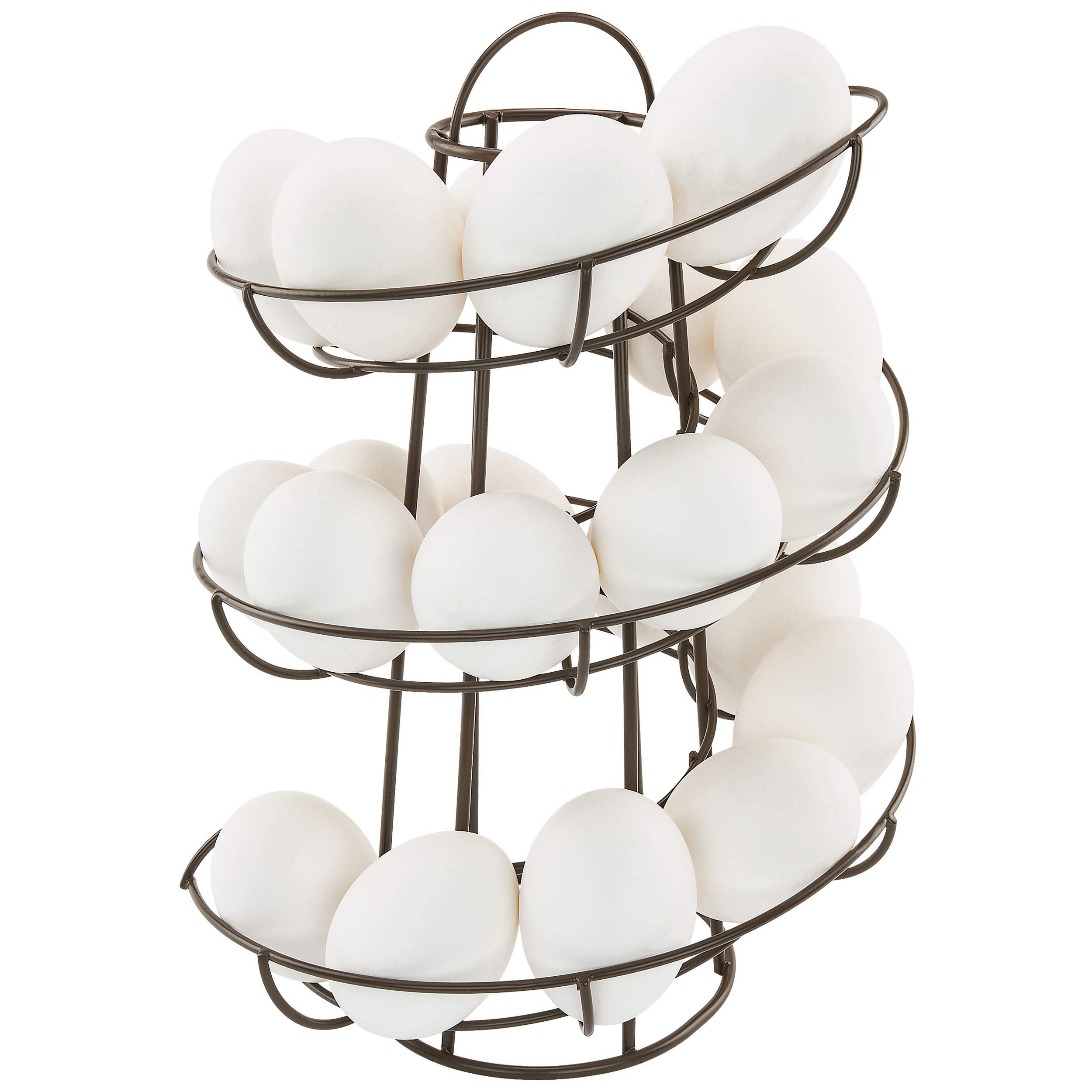
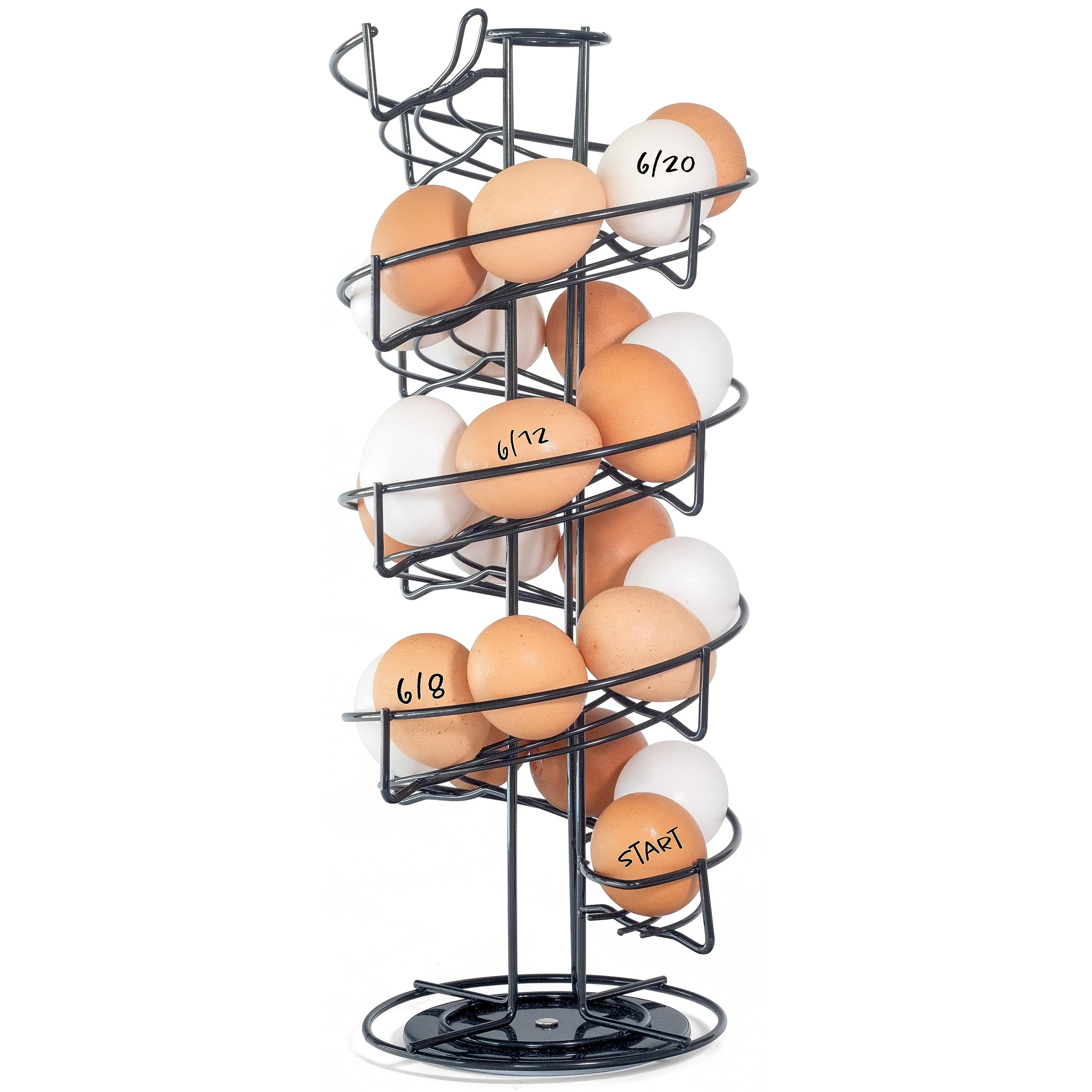
Sixteen inches of black iron spiral, 6.9 inches across the base, and room for three dozen eggs — that trade, a lot of eggs in very little counter, is the whole argument for a skelter over a stack of cartons. The Toplife makes it more confidently than anything else in our set, and the iron wire with its black finish looks like it was chosen for the kitchen rather than inherited from the coop.

We recommend it first because the capacity and the spin work together. Three dozen is the stated figure, and with eggs on the larger side you will get a little less than that; the spiral still swallows a full morning's collection. Eggs are oblong, so any spiral track will let one hang up rather than rolling down on its own. The 360-degree base makes that a non-issue — instead of waiting for the next egg to drop into place, you turn the tower and take the one you want. We used that constantly.

The felt pad underneath is a detail we appreciated more than we expected: it keeps the iron off the counter and stops the whole thing skidding while you are feeding eggs in at the top. Loading is a one-hand job, and the stop at the bottom holds the next egg ready, so the oldest one is always the one in front of you.

A full tower is heavy at the top. It sits steady on a level counter, but filling the last few turns you can feel the weight shift, which is worth knowing before you park it somewhere it can be knocked. On the felt pad ours has stayed exactly where we put it.

Bottom line: We recommend it first to anyone with a full flock: three dozen eggs on a small footprint, with a spin that reaches any egg without fishing.
2

Southern Homewares Egg Skelter Deluxe

Southern Homewares Egg Skelter Deluxe

Small flocks

Our Score 9.4/10
Check Price

Worth Noting

  • Bantam and pullet eggs drop through the spiral
  • Large eggs hang up instead of settling
Capacity
Up to 24 eggs
Material
Alloy steel, brown finish
Dimensions
10.63"D x 8"W x 10.63"H
Read the full review

Twenty-four eggs rather than thirty-six, and for a lot of households that is the right number: four or five hens, a couple of eggs at breakfast, no need for a tower that takes over the counter. This is the rack we point to when the flock is small. At 10.63 inches it is the shortest of our picks, so it slides under a wall cabinet that the 16-inch racks cannot clear.

It is steel rather than iron, and the brown finish reads as kitchen-ware rather than farm equipment — the one here that looks chosen instead of repurposed. The base sits flat and the tower stays put while you load it from the top, which is more than we can say for some of the taller racks.

In daily use it is the simplest of the five to live with. Eggs go in at the top, the oldest waits at the bottom stop, and two dozen is roughly a week for a small flock, so the tower empties and refills instead of becoming a display. Nothing to adjust, nothing to line up.

Bottom line: Buy this one if you keep a few hens and want two dozen eggs in the shortest, steadiest tower here.

3

Shop Square Spiral Egg Holder

Shop Square Spiral Egg Holder

Polished counters

Our Score 9.4/10
Check Price

Worth Noting

  • Published footprint figures contradict each other
Base
Non-slip base
Capacity
3 dozen eggs
Material
Black metal wire
Rotation
360-degree spin
Read the full review

Same three-dozen spiral as our top pick, with one swap that matters on a polished counter: a non-slip ring under the wire instead of felt. That ring is the reason we keep it on the shortlist for stone and quartz — a full tower stays put while you turn it with one hand and feed eggs in with the other.

The wire is plain black, the curves are simple, and the spiral takes medium and large eggs without ceremony. Loading from the top, pulling from the bottom: the tower spins freely enough that you can fill it from whichever side you happen to be standing on, which sounds trivial until you have tried to reach over a 3-dozen rack that does not turn.

What it does best is keep order without fuss — new eggs in at the top, the oldest out at the bottom, the whole inventory visible in a single turn. Three dozen eggs and no carton lid to open is the entire argument for a skelter, and this one makes it without drama.

Bottom line: Our pick for a polished counter: the non-slip base holds a full three dozen while the spiral turns.

4

QUTREY Egg Skelter with Basket

QUTREY Egg Skelter with Basket

Extra storage

Our Score 9.2/10
Check Price

Worth Noting

  • Extra-large eggs jam in the tight spiral
  • Three-dozen claim counts the bottom basket
Handle
Metal carry handle
Capacity
About 3 dozen, with basket
Dimensions
7.08"D x 7.08"W x 13.97"H
Extra Storage
Bottom basket
Read the full review

A wire basket sits at the base of this spiral, under the last turn, and it is the reason to pick this one over the plainer towers. That bowl is where the eggs go that do not fit the run — the pullet egg, the cracked one you will use for breakfast, the two you carried in after the rack was already full.

Above the basket it is a plain spiral: load at the top, take from the bottom, oldest first. There is a metal handle at the top of the frame, which sounds like a small thing until you are carrying a loaded rack to the sink to wipe under it — the plainer towers here need both hands and a clear path.

In use it is the most forgiving of the five, because the basket absorbs whatever the spiral will not. A tiny egg, a double-yolker that will not seat, one you fumbled at the nesting box: they all have somewhere to go that is not a carton on the counter. On a mixed flock that is worth more than a slightly wider track.

Just under 14 inches tall, it clears a wall cabinet comfortably, and the black coated finish wipes down without drama. The basket does make the base the widest of our picks, so give it a little elbow room on the counter.

Bottom line: Choose it when your eggs come in every size: the spiral takes the standard ones and the basket catches the rest.

5

OBVIS Spiral Egg Skelter

OBVIS Spiral Egg Skelter

Tight budgets

Our Score 8.8/10
Check Price

Worth Noting

  • Extra-large eggs will not seat in the track
Capacity
Up to 22 eggs
Material
Coated iron
Dimensions
8.25"D x 8.25"W x 12.5"H
Read the full review

Twenty-two eggs, a 12.5-inch tower, and less money than anything else here. If you keep three or four hens and mainly want the eggs off the counter and in eating order, the extra spend buys capacity and a smoother track rather than a different job — and the OBVIS does the job.

The groove is narrow, so eggs sit in it instead of travelling down to the bottom stop, and you push each one along as you take the egg below it. On a rack this short that is a few seconds and we did not mind it; on a three-dozen tower the same habit would be a daily irritation. That is the honest shape of this pick: it trades the roll for the price, and on a small flock the trade works.

The black iron looks better than the rest of the rack suggests — the spiral reads as a deliberate kitchen object rather than storage — and the base is a simple wire ring that sits flat on a level counter. Run a finger around that ring when it arrives: it is welded down there, and a rough weld can both rock the tower and mark a quartz countertop.

Twenty-two eggs is about what three or four hens give you in a week, so the rack turns over and stays useful instead of becoming a display piece you dust.

Bottom line: For three or four hens and a tight budget, this is the rack we point to: small, simple, and priced to match.

How We Tested Egg Skelters

We started by gathering every skelter we could find, about 30 in all, and cut the list by capacity claims, footprint, wire gauge, and what you got for the money. Sixteen made it into two home kitchens, where they sat next to the stove for four months, the way one would in real life.

Each was loaded to its stated capacity with a mix of medium, large, and jumbo eggs plus a few small backyard ones, then we did what you actually do: pulled from the bottom with one hand while the coffee brewed. We counted how far the next egg traveled — one cradle, two, or nowhere until we nudged it — and whether a jumbo wedged in the curve while a small egg slipped past two slots at once. Resistance mattered too: an egg should sit still until you take it, not creep forward on its own overnight.

Stability got its own round of abuse. We pulled eggs with a wet hand, set each skelter on a bare counter to see whether the base walked, and spun every rotating model while fully loaded to check that eggs stayed in their cradles rather than sliding outward. Capacity was verified by counting eggs, not by trusting the box, and we measured each footprint against a closed dozen carton to see what it genuinely saved. A few bent under a full load of large eggs; the picks below held their shape.

How to Choose Egg Skelters

Capacity Is Measured in Medium Eggs

Every rack here quotes a capacity, and every one of those numbers shrinks as the eggs get bigger. Southern Homewares says so outright — up to 24, depending on egg size — and the same holds for the three-dozen towers. Count what your flock gives you in a day and buy for a little more than that, so a full rack still leaves room to load without rearranging.

The other end of the scale bites harder. Bantam and pullet eggs are small enough to drop through a wire spiral onto the counter, which is why a basket at the base earns its place on a mixed flock. If you keep bantams, look at the gauge of the spiral before anything else.

The Roll-Down Question

Eggs are oblong. They do not roll like marbles, and no wire spiral feeds them like a vending machine — expect to nudge one down now and then whatever you buy. What separates the racks is how easily you can reach the egg yourself: a 360-degree base, as on the Toplife and the Shop Square, lets you turn the tower to the egg you want instead of fishing over the top, while a short rack like the OBVIS leaves most eggs within reach of a hand.

If a daily nudge would irritate you, that spin is the feature worth paying for.

Height, Footprint, and the Counter You Have

These are vertical racks, so height is the dimension that catches people out. Standard wall cabinets sit 18 inches above the counter; our tallest pick is 16.1 inches and clears by less than two, while the shortest is 10.63 and slots under almost anything. Measure the gap above the spot you have in mind, not the counter itself.

The footprint is smaller than most people expect — typically 7 to 8 inches across — so the real cost is headroom, not width. A felt or non-slip base earns its keep on stone and quartz: it protects the surface and keeps a top-heavy tower where you put it.

Loading Order and the Odd Egg

Every rack here works first in, first out: new eggs at the top, the oldest out of the bottom, with a stop that holds the next one ready. That ordering is the reason to own a skelter at all — you stop guessing at the age of an egg, and you stop finding a forgotten one at the back of a carton.

Where they differ is what happens to an egg that does not fit the run: an oversize one, a cracked one for today, a tiny one. A bottom basket gives those a home; without one they end up back in a carton on the counter, which is the clutter the rack was meant to replace.

Frequently Asked Questions

Final Verdict

With a full flock, buy the Toplife. Three dozen eggs on a narrow footprint, a felt base that keeps iron off your counter, and a 360-degree spin that turns the one real weakness of a wire spiral — eggs that sit instead of rolling — into a flick of the wrist. It holds the most eggs of our picks with the least fuss.

If your counter is tight or your flock is small, the Southern Homewares does two dozen in a shorter, steadier tower; just do not keep bantams. And where the counter is polished stone, the Shop Square's non-slip ring grips better for the same three-dozen load.