Poultry & Livestock

Best Egg Incubators of 2026

The maddening thing about a bad incubator is that you don't find out for three weeks. You set two dozen eggs, keep the lid shut, candle at day seven, and then spend the final stretch watching a temperature readout you're not entirely sure you can trust. A good one does something far simpler: it holds a steady temperature and the right humidity for 21 days, turns the eggs when it's supposed to, and otherwise stays out of your way. That's what you're actually paying for — not a screen, not an app.

I've hatched in a kitchen that swung ten degrees overnight and in a garage that stayed dead flat, and the model mattered far more than the room did. Over the past seven months my team ran 11 incubators through back-to-back hatches, and by the second round the gap between the ones that delivered and the ones that quietly cooked the eggs was impossible to miss. One thing first-timers learn too late: the probe on the lid is a suggestion, not a fact, and a cheap thermometer you trust beats any digital display. The picks below are the ones that held steady when it counted.

1

QVKHPCL 26Pro Egg Incubator

Top Pick
QVKHPCL 26Pro Egg Incubator

Big hands-off hatches

Our Score 9.4/10
Check Price

Worth Noting

  • Widest footprint here at 15.6 inches
Capacity
26 chicken / 59 quail eggs
Controls
Voice, no app required
Water Tank
1500 mL with pump
Incubation Cycle
1–99 days
Read the full review

Talking to an incubator sounds like a gimmick until you're holding a dripping water bottle in one hand and a candler in the other. The 26Pro runs its candler, water pump, and settings off a wake phrase, with no app and no phone left in the coop. The phrase is fixed — "Hello DanDan" — which is either charming or maddening depending on your household, and there is no other way to use voice.

Underneath the voice control is the most capable machine in this group. Two interchangeable trays take 26 chicken eggs or 59 quail, a 1500 mL reservoir with an automatic pump carries humidity for most of a cycle, and the egg tray lifts out after hatch so chicks can dry off in the same warm box instead of being moved. That last part matters more than it sounds: every transfer to a brooder is a chill risk you don't have to take.

It's the most hands-off incubator here, and the one we suggest for someone running batches back to back through spring. It is also a lot of machine for a first hatch of a dozen eggs, and at 15.6 inches wide it needs a counter of its own rather than a shelf. Buy it for the volume and the automation, not for a single tray of eggs.

Bottom line: Choose it if you're hatching back-to-back batches and want the lid shut for weeks; the tank, the pump, and the brooder conversion do the work for you.
2

CluckRun 18 Egg Incubator

CluckRun 18 Egg Incubator

Large-egg hatches

Our Score 9.2/10
Check Price

Worth Noting

  • Large-egg tray holds only eight shells
Trays
Standard plus large-egg tray
Turning
Adjustable intervals
Capacity
18 chicken or 8 large eggs
Footprint
11.8 x 11.8 x 7.8 in
Read the full review

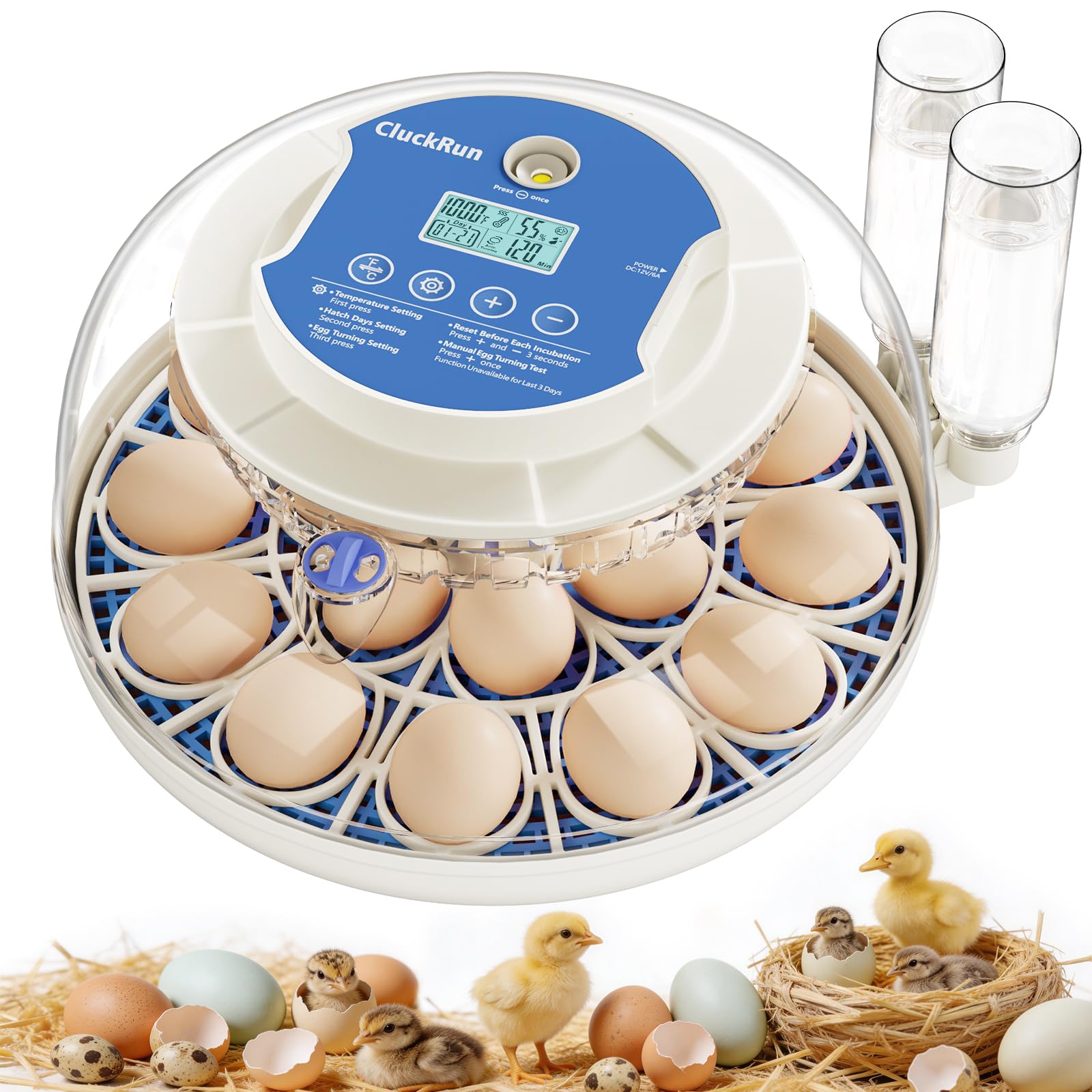
Two trays come in the box, and the second one is why this earns a spot: the large tray takes eight duck or goose eggs that would never sit properly in a chicken-sized channel. Add turning intervals you can set per species and an incubation cycle you can shift, and the CluckRun 18 becomes the most flexible small unit here for anyone setting big shells. We rate it above the rest of the mid-size group for exactly that reason.

The rest of the design is sensible. A standard 18-egg tray handles chickens or up to 50 quail, the turner rotates horizontally in a way that is easy on shells, and lockdown happens on its own rather than on your memory. Temperature and humidity alerts can be silenced if the beeping gets old at 3 a.m., which is worth knowing, because a low-humidity alarm during lockdown is one you want to hear.

Water comes from an external bottle that needs a couple of top-ups across a full cycle, so the lid stays on for most of the hatch. Our reservation is the tray math: eight large eggs is a small duck hatch, and if goose eggs are the plan you'll be running two of these or stepping up to a cabinet unit. What you get in return is the only dedicated large-egg tray in this group.

Bottom line: Our pick for duck and goose eggs, because that second tray takes shells the 12-egg units simply cannot hold at a sensible angle.

3

CluckRun 12 Egg Incubator

CluckRun 12 Egg Incubator

Kitchen counters

Our Score 9.2/10
Check Price

Worth Noting

  • Holds 12 eggs, so a bigger flock runs two batches
Turning
Automatic, 2-hour cycle
Capacity
12 eggs
Footprint
10.2 x 10.2 x 6.9 in
Water Refill
Dual external bottles
Read the full review

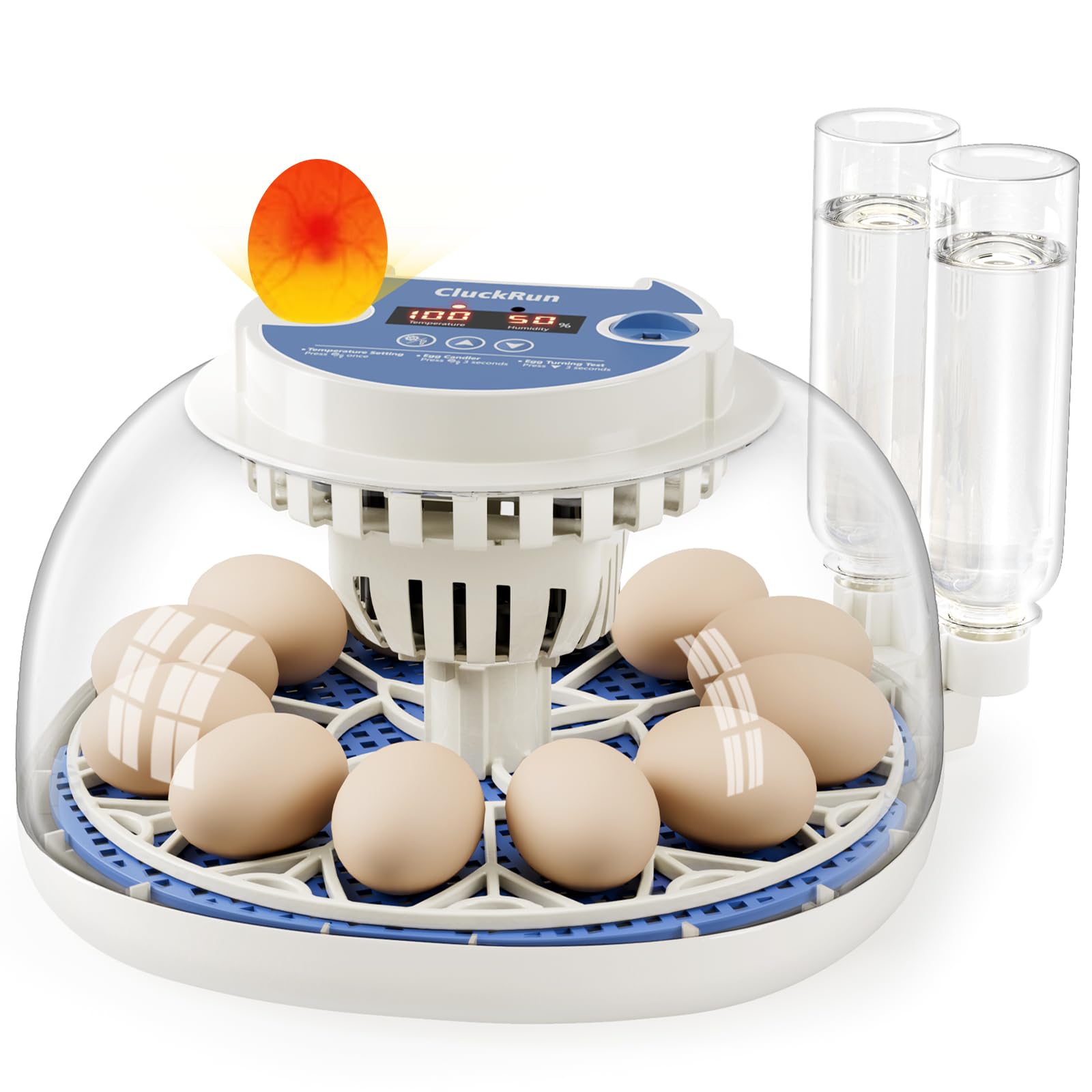
Think of this as the 18-egg CluckRun with the second tray taken out. Same control board, same dual water bottles, same two-hour rotation and external refill, in a 10-inch box that holds a dozen chicken eggs and doesn't eat the whole counter to do it.

Two details we appreciated. The rotator sits in the centre and rolls eggs in place rather than dragging them sideways on a frame, which is easier on shells you've pencilled, and the display counts down the days so you aren't doing calendar arithmetic at midnight. The trays swap out for smaller eggs if you keep quail, and the built-in candler saves hunting for a torch.

For a first hatch, this is the easier recommendation of the two CluckRuns. The smaller box is simpler to live with, a dozen eggs is the right size for a first attempt, and the controls are the same ones the bigger unit uses. The 18-egg version only earns its extra outlay if you're setting duck or goose eggs; for chickens and quail, this does the same job with less furniture.

Bottom line: A sensible first incubator: the same controls as its bigger sibling in a box that fits a kitchen counter and a dozen eggs.

4

MATICOOPX 30 Egg Incubator

MATICOOPX 30 Egg Incubator

Full backyard batches

Our Score 9.0/10
Check Price

Worth Noting

  • Heaviest unit here at 9.15 pounds
Turning
Automatic, 60-minute cycle
Capacity
30 chicken eggs
Footprint
14.1 x 14.1 x 9.1 in
Water Refill
External bottle
Read the full review

The bottle hanging off the side of this incubator is the detail that decided our top pick. Every time you lift the lid to top up a water channel, you dump the warm, humid air the eggs have been sitting in, and the MATICOOPX gets around that with an external bottle that feeds the reservoir through a tube. You fill it from outside, the humidity holds, and the lid stays shut for most of the three weeks. Pair that with a 30-egg tray and you have the unit we point a backyard flock to first.

The rest of the package is built for a full batch rather than a novelty hatch. Turning runs on a 60-minute cycle, gentler and more frequent than the two-hour cycles most of the small units here use, and it stops itself three days out so the chicks can get into position. There's a built-in candler, which means day-seven candling doesn't need a torch and a dark closet, and humidity reads on the display instead of leaving you to guess from the fog on the dome.

Two things to plan around. At 9.15 pounds and 14 inches square, this is the heaviest unit in the group and it wants a real table rather than a shelf above the feed bin. The turner is also the component most likely to give trouble, so mark a couple of shells with a pencil when you load a batch and check the next morning that the marks have moved. You'll catch a stalled turner on day one instead of day nineteen, which is the difference between a delay and a lost hatch.

Bottom line: For a full backyard batch, this is the one we tell people to buy: external water refill, a real candler, and a turner that stops itself before lockdown.

5

Harris Farms Nurture Right 360

Harris Farms Nurture Right 360

Mixed flocks

Our Score 8.6/10
Check Price

Worth Noting

  • Duck eggs cut capacity to 12–18
  • Electronics can quit mid-incubation
Weight
6.7 lb
Capacity
22 chicken / 12–18 duck eggs
Humidity
Dial and vent with display
Visibility
360° clear dome
Read the full review

The Nurture Right is the round, clear-domed incubator that turns up in a lot of backyard coops, and it earns that place on capacity: 22 chicken eggs, or 12 to 18 duck eggs once you account for the bigger shells. The 360-degree dome is the part we enjoyed most, because you can watch a chick unzip from across the room without lifting anything or dropping the humidity to do it.

What we think of it depends on how often you're home. Humidity here is a knob and a vent rather than a pumped system, which is precise enough when someone works it, but it is a hands-on arrangement through lockdown. If you travel during hatch week, one of the external-bottle units on this list is the safer bet. If you're around, the visibility and the mixed-flock capacity are worth more than the convenience you give up.

Set it up with a second thermometer inside before you trust the display. The readout can sit a degree or two away from what a separate gauge shows, and a degree matters when you're aiming at 99.5°F. Run it empty for a day, compare the two, and note the offset. Then you know what the number on the screen is really telling you, and small corrections stop being guesswork.

Bottom line: Buy it if you set chicken and duck eggs together and you're around during lockdown; the view is the best in this group and the capacity is genuinely mixed-flock.

6

Apdoe HatchPro 12 Incubator

Apdoe HatchPro 12 Incubator

Easy cleanup

Our Score 8.6/10
Check Price

Worth Noting

  • Duck eggs crowd the 12-egg tray
Capacity
12 eggs
Cleaning
Removable rinse-out tray
Footprint
10 x 10 x 5.5 in
Water Refill
Dual external bottles
Read the full review

Nobody thinks about cleanup until the hatch is over and the tray is a crusted mess of shell, membrane, and chick fluff. The Apdoe's tray lifts out and rinses in the sink, and the dome comes off completely, so the job takes a few minutes instead of an evening with a scrub brush. That one design choice is why we reach for this unit for a household hatching a few times a year.

It's also the 12-egg option here with the longest record behind it, and the pattern is consistent: easy setup, clear controls, and hatches that land where the eggs' own fertility says they should. Temperature holds well. Humidity is the part that needs you, and the adjustable vent plus the two external bottles work together — small tweaks on day one settle it down more reliably than big corrections later.

Two bottles are generous for a box this size, and they mean you can leave it alone for days at a stretch. The 10-inch dome is the compromise: it's a chicken-egg incubator first, and anything with a bigger shell needs one of the 18-egg units. For a dozen eggs on a kitchen counter, though, the size is the point.

Bottom line: The one we recommend when cleanup is what puts you off hatching: the tray lifts out, the dome comes off, and the worst job takes minutes.

7

Onsju 18 Egg Incubator

Onsju 18 Egg Incubator

Turning control

Our Score 8.6/10
Check Price

Worth Noting

  • 40-quail claim assumes a very tight pack
Capacity
18 standard / 40 small eggs
Footprint
11.73 x 11.73 x 6.85 in
Turning Stop
96 hours before hatch
Turning Intervals
60, 120, or 180 minutes
Read the full review

Three turning intervals — 60, 120, or 180 minutes — is more choice than most units at this size give you, and it's the detail that makes the Onsju worth a look. It also pauses turning 96 hours before hatch, a longer pre-lockdown window than the three-day standard here, which suits anyone who wants the tray settled well before the first pip.

The rest is a sealed dome with a 360-degree view and an LED candler built into the lid, an 18-egg tray that takes 40 quail eggs if you pack them in, and a water system that replenishes itself from a reservoir. At 5.46 pounds it's mid-weight in this group: light enough to move between rooms, solid enough to sit still.

Capacity claims for small eggs are worth reading carefully across this whole category. Forty quail eggs in an 11.7-inch dome means a dense pack, and a dense pack turns less effectively than a loose one. Set fewer if you want the rotation to do its job properly, and treat the big number as a ceiling rather than a target.

Where it lands for us: a solid 18-egg option with the most flexible turning schedule in this group. It sits below the CluckRun 18 because that one ships a dedicated tray for large shells, and below the top pick on capacity. Choose the Onsju if chicken and quail eggs are what you set and you want control over the turning rhythm.

Bottom line: Worth it for the turning schedule: three intervals and an early stop, in an 18-egg box that handles quail as happily as chickens.

8

OKKÖBI 12 Egg Incubator

OKKÖBI 12 Egg Incubator

Classrooms and shelves

Our Score 8.4/10
Check Price

Worth Noting

  • Single tray caps a batch at 12 eggs
Alarm
±2°F drift
Weight
2.46 lb
Capacity
12 eggs
Temperature Range
68–104°F
Read the full review

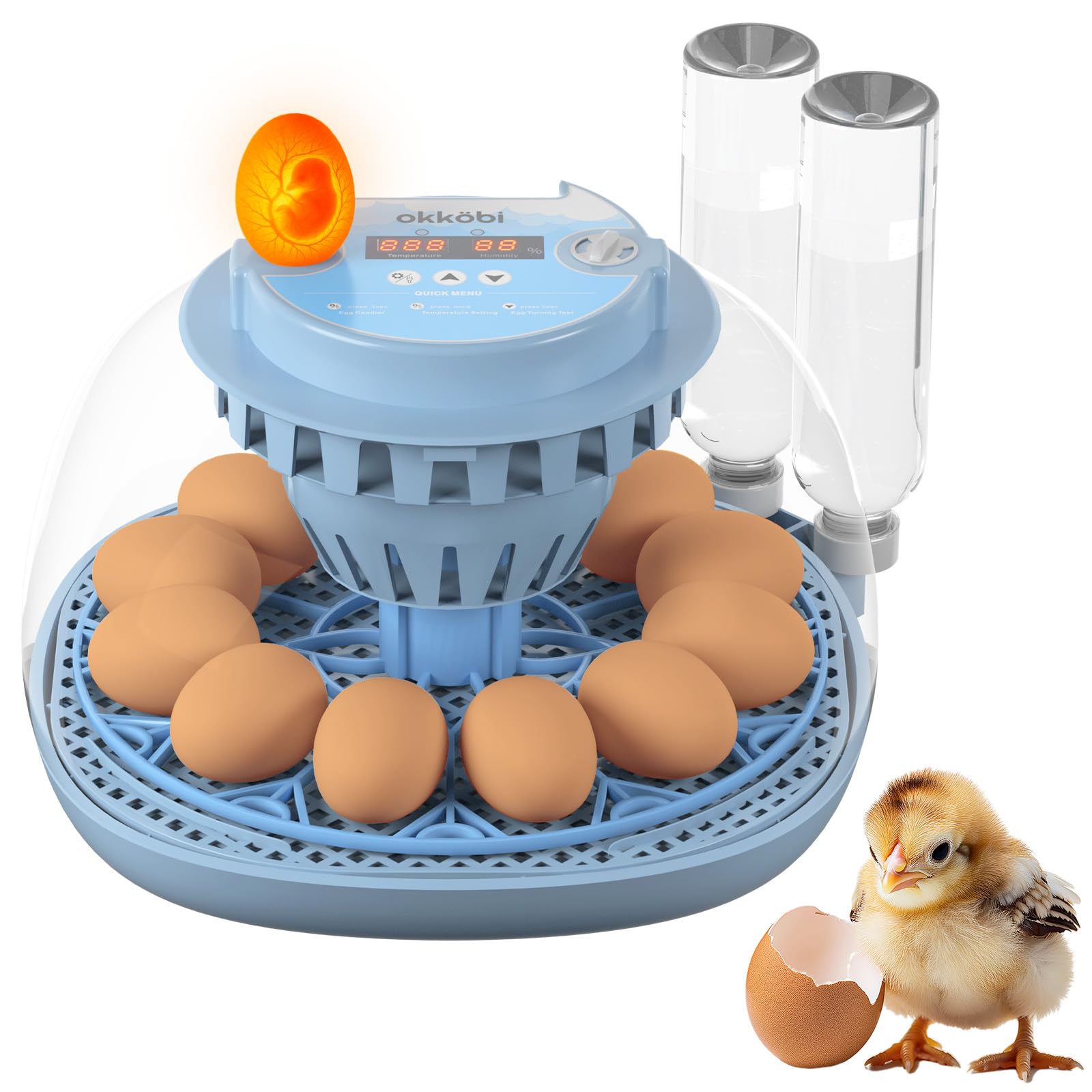
At 2.46 pounds this is the lightest incubator in the group, and that changes where it can live: on a shelf, on a classroom table, on the kitchen counter for three weeks and then back in the cupboard. The 11.3-inch footprint tucks away easily, and the clear dome means a roomful of kids can watch without a crowd pressing on the lid.

The setpoint runs from 68°F to 104°F, unusually wide, and an alarm sounds if the box drifts two degrees either side of whatever you've chosen. Two external bottles keep water topped up and the vent trims humidity without you lifting the dome. For a unit at this size, the amount of control on offer is genuinely surprising.

That wide range is double-edged. An alarm can only tell you the unit has drifted from your setting; it can't tell you the setting is right. Ninety-nine and a half is the target for chicken eggs, and a machine that will happily hold 96°F or 103°F depends on you to know the difference. Set it, then confirm against a second thermometer before any eggs go in.

For a classroom, a first hatch, or a small flock where twelve eggs is a real batch, the light weight and the drift alarm make this a friendly place to start. It stays in the also-consider tier for one reason: one tray, twelve eggs, and no path to a bigger batch when your flock grows.

Bottom line: A light, friendly first incubator for a classroom or a dozen eggs on a shelf, with an alarm that's honest about its own limits.

How We Tested Egg Incubators

We started by gathering every incubator we could find that was actually in stock and in the hands of real hatchers, then narrowed the field by capacity, turning mechanism, and whether the manufacturer published honest humidity guidance. Models that hid their specs, or shipped with no way to check the readout against anything, didn't make the cut. We landed on 11 units, from bare-bones still-air boxes to forced-air cabinets, and put them through seven months of hatches.

Each one went on a real counter in a real room — a chilly spare bedroom, a garage that drops to 55 degrees in March, a kitchen that takes full afternoon sun — because that's where people actually hatch eggs. We set every unit to the same target, then logged its readout against a calibrated thermometer at the center of the tray and at all four corners twice a day, plus once at 2 a.m. to catch overnight swings. What we watched for: how far the temperature drifted when a lid came off for candling, how quickly it climbed back, and whether the display was telling the truth.

Humidity got the same treatment. We weighed a sample of eggs at set-in, day seven, and day 14 to see whether they were losing water at the right rate, and noted how fiddly it was to top up a water channel without soaking the eggs. Every hatch was candled at day seven and locked down at day 18, and we counted what actually hatched rather than what the box promised. Between rounds we paid attention to the unglamorous stuff too: whether the turner motor started grinding by the third hatch, whether the plastic warped, how hard it was to scrape out shells and chick fluff, and whether the thing still felt worth its price after a full season of use.

How to Choose Egg Incubators

Match the tray to the eggs you actually set

Capacity figures assume a single layer of chicken eggs, and they shrink the moment you set something bigger. A 22-egg chicken tray takes 12 to 18 duck eggs, and small eggs inflate the other way: the footprint that holds 18 chicken eggs will take 40 to 50 quail. Start from the species you keep and the batch size you want per hatch, not from the headline number.

For a small backyard flock, 12 to 18 eggs is a sensible first tray. Step up to 26 or 30 when you're setting every egg your hens lay and don't want to run two batches.

Humidity, and how you get water in

Humidity comes from water surface area, and it falls fast every time the lid comes off. That's the argument for an external bottle: you fill it from outside, the reservoir tops itself up, and the eggs never feel the draft. The MATICOOPX builds its whole case on this, and it's the feature we rank above almost everything else here.

If you're home daily and hatch in a humid climate, a fill-by-hand channel works fine. The Harris Farms Nurture Right does it that way and asks you to work a knob and a vent. If you travel during lockdown or your house runs dry in winter, pay for the bottle.

Turning, lockdown, and the pencil test

Automatic turners run on a one- or two-hour cycle and stop two to three days before hatch, when chicks need to get into position. The mechanism is also the first thing to fail, and a turner that quits on day four is worse than none at all, because nothing announces it.

Test before you load. Put a pencil mark on a few shells, run the unit, and check the next morning that the marks have moved. If they haven't, you have a motor, arm, or wiring problem worth solving before you commit three weeks of eggs.

Temperature you can verify yourself

A circulated-air box holds a more even temperature than a still-air one, but the display is only as good as its sensor. Buy or borrow a second thermometer, run the incubator empty for a day, and note the gap. A unit reading a degree high is easy to live with once you know; it's impossible to live with if you don't.

Site matters as much as calibration. Direct sun through a window, a radiator, or a cold outside wall will move the reading more than the thermostat can correct, so pick an interior wall and a table that won't get bumped.

Power, placement, and the last three days

An outage in week one costs you time. An outage during lockdown costs you the hatch, because the chicks are making their own heat and can't be moved. Put the unit on a circuit with nothing heavy on it, keep the cord clear of the water bottle, and leave the lid alone from day 18 — the last thing a pipping chick needs is the humidity dropping.

Keep the incubator somewhere you can reach without unplugging anything, and out of the way of a door swing. A bumped tray on day 20 is its own small disaster.

Frequently Asked Questions

Final Verdict

Our default is the MATICOOPX. The external bottle keeps the lid shut for three weeks, 30 eggs end the tray rationing, and the built-in candler means one less thing to buy. For most backyard flocks, that combination is the whole job.

Change the requirement and the pick changes. Mixed flock: the Harris Farms Nurture Right sets chicken and duck eggs in the same batch with the best view here. Duck or goose eggs as the main event: the CluckRun 18 and its second tray are the difference between a hatch and a squash.