Outdoor Power Equipment

Best Backpack Leaf Blowers of 2026

Backpack leaf blowers are a trade: you carry the weight and the noise so your arms don't have to. A handheld will clear a walkway, but it will not clear a yard's worth of wet oak leaves before the light goes, and that's the afternoon the backpack stops looking like a splurge and starts looking like the tool the job needed all along. The catch is that the extra power has to be worth a strap pressing into your shoulders — and not every model earns that.

For the past ten months, my team and I have run seven of these through a full fall cleanup and a messy spring, and the gap between them showed up fast: how quickly they fire from cold, and how they feel on your back at minute forty. Here's something first-time buyers don't expect — the widest nozzle isn't the fastest way to move a pile. A tighter, faster airstream beats raw volume on wet leaves, and it throws less gravel onto the grass. The picks below were chosen for the cleanup you actually have, not the spec sheet.

1

Echo PB-9010T

Top Pick
Echo PB-9010T

Large properties

Our Score 9.4/10
Check Price

Worth Noting

  • Extension tube can work loose mid-job
  • Loud
Engine
79.9 cc, 2-cycle
Airflow
1,110 CFM
Controls
Tube-mounted throttle with lock
Air Speed
220 MPH
Read the full review

There is a kind of fall cleanup where the leaves are wet, the ground is uneven and raking was never a plan: a long driveway under hardwoods, a wooded lot, a crew working against a deadline. The Echo PB-9010T is built for that. Its 79.9cc two-stroke pushes 1,110 CFM at 220 MPH, the most airflow in this group, matched only by a budget machine claiming the same figure.

We reach for the Echo when the work is measured in hours rather than minutes. It walks three-quarter-inch crushed gravel, wet leaves and pine needles out of a yard without the second pass the smaller blowers need, and the tube-mounted throttle with a lock lets you set a speed and forget your hand. What that costs you is noise: this is loud the way a two-stroke dirt bike is loud, so hearing protection belongs in your kit before the first tank, not after.

It is also a big machine to hoist onto your back and to store, so give it a corner of its own. Two practical notes. The extension collar on the tube can work loose mid-job, so seat it firmly and check it whenever you refuel. And the premium price only makes sense on a genuinely large property; on a quarter acre the 360BT does the same work with less machine to wrestle.

Bottom line: Buy the Echo if your cleanup is measured in acres and hours; nothing else here moves wet debris and gravel with this much authority.

2

Husqvarna 350BT

Husqvarna 350BT

All-round home use

Our Score 9.2/10
Check Price

Worth Noting

  • Durability record is uneven
Engine
50.2 cc, 2-cycle
Airflow
692 CFM
Air Speed
180 MPH
Carried Weight
22 lb
Read the full review

The number that sells a backpack blower is air speed; the number that clears a yard is air volume. The Husqvarna 350BT makes 692 CFM at 180 MPH, which is slower on paper than most of this group, and it is still the one we hand most people. Volume is what pushes a wide band of wet leaves down a driveway in one pass instead of scattering them ahead of the tube, and 692 CFM is more than enough for a suburban lot under mature trees.

It is also the easiest gas machine here to live with. The pack sits at 22 pounds on an ergonomic harness with an adjustable offset handle that keeps the blow force from twisting your forearm, and the throttle rides on the tube with a cruise control so you are not gripping a trigger for twenty minutes. An air purge primes the carburetor before a cold pull, and the two-year warranty is longer than anything else here except the PRORUN.

Two details to sort out before you commit. The offset handle puts the grip a long way forward, so shorter users may find the reach stretched; set the tube length before your first session rather than after your first hour. And the primer bulb is tucked under the housing where you will hunt for it on the first cold morning of the season.

What settles it is the combination: 692 CFM, 22 pounds and two years of coverage for mid-range money. Nothing else in this group puts all three together. If your property runs past an acre, the 360BT is the same idea with more force behind it; below that, this is the blower to beat.

Bottom line: We recommend the 350BT first because 692 CFM at 22 pounds is the best balance of clearing force and all-afternoon comfort here, and the two-year warranty backs it.

3

Husqvarna 360BT

Husqvarna 360BT

Long sessions

Our Score 9.2/10
Check Price

Worth Noting

  • Long-term durability is the open question
Engine
65.6 cc, 3.81 HP
Airflow
890 CFM
Air Speed
232 MPH
Carried Weight
23.2 lb
Read the full review

The 360BT's harness is ventilated, with wide shoulder straps and an adjustable offset handle, and it is the part of the machine you notice in the second hour rather than the second minute. Under it sits a 65.6cc engine making 3.81 HP, good for 890 CFM at 232 MPH from a 23.2-pound pack.

Those figures do real work. It strips wet leaves off grass, clears sticks and green pine cones out of beds, and dries a washed car in a couple of minutes, which is one of the more useful tricks a blower this strong can manage. The air purge and LowVib handle the unglamorous side: cold starts take a couple of pulls, and the vibration that leaves your hands buzzing after a hand-held session is mostly gone.

This is the pick for a large lot and long sessions, and it is the one we point 350BT owners toward when they want more force without more machine. The step up costs money and buys roughly 200 CFM, which is the difference between two passes and one on a deep leaf drop. If your fall runs to whole weekends of leaves, it earns the difference; on a suburban lawn the smaller blower is the smarter buy.

Bottom line: For a big lot and long sessions, the 360BT's 890 CFM and ventilated harness make it the most comfortable way to move this much air.

4

PROYAMA 72CC

PROYAMA 72CC

Value gas power

Our Score 8.6/10
Check Price

Worth Noting

  • One-year warranty is the shortest here
  • Trigger wiring is worth checking early
Engine
72 cc, 2-cycle
Airflow
880 CFM
Air Speed
275 MPH
Carried Weight
21 lb
Read the full review

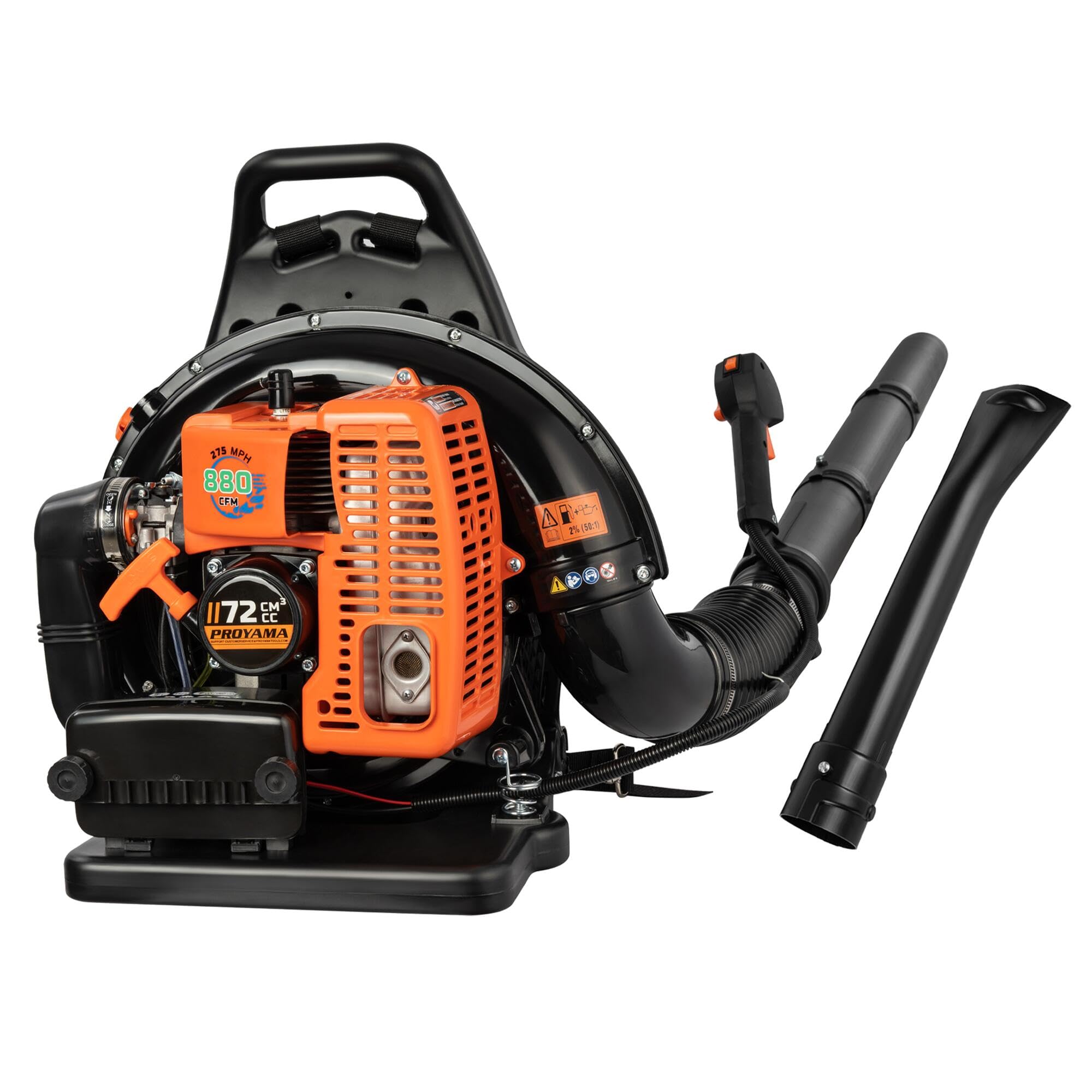
880 CFM at 21 pounds. Put those two figures side by side and the PROYAMA explains itself: it is the lightest machine here that clears 800 CFM, and its air-to-weight ratio beats both Husqvarnas. A 72cc two-stroke makes 3.7 HP and the highest air speed in this group at 275 MPH, and the box includes a flat nozzle for hard surfaces and a round one for gutters and beds.

We treat this as the value pick of the roundup, for practical rather than romantic reasons. Cruise control and a variable throttle do the same job as the expensive machines', shock-absorbing straps and a thickened backrest keep engine heat off your spine, and at 21 pounds you can wear it for an afternoon without feeling it the next morning. For a first gas blower on an average lot it covers what the 350BT covers, for less money.

What you give up is cover. The warranty runs a single year, the shortest here, and how it holds up over several seasons is less settled than it is for the Husqvarnas. The one thing to verify early is the wiring in the trigger grip and the kill switch, which is where a fault would show up first. Buy somewhere with a straightforward return policy and run it hard inside the first month.

Bottom line: The PROYAMA is the value pick: 880 CFM and the highest air speed here from a 21-pound pack, with a one-year warranty as the compromise.

5

PRORUN PBB2884

PRORUN PBB2884

Small crews

Our Score 8.6/10
Check Price

Worth Noting

  • 32.8 pounds is a lot to carry on a slope
  • Starting and staying running is the weak spot
Engine
75.6 cc, 2-cycle
Airflow
1,020 CFM
Air Speed
240 MPH
Carried Weight
32.8 lb
Read the full review

32.8 pounds is the first thing to know about the PRORUN PBB2884, and it buys 1,020 CFM at 240 MPH. That is Echo territory, within a hundred CFM of the biggest blower here, from a 75.6cc two-stroke that costs a good deal less. Padded straps and anti-vibration mounts do what they can with the load; the rest is on your shoulders.

Where it makes sense is a small crew or a big property where the blower is used hard and often. The three-year residential warranty is the longest on any gas machine in this group, the throttle lock lets you set a speed and work, and the pack is built to be worn rather than admired. Cold starts settle into a routine of prime, choke, pull, and it fires on the first or second try once you know it.

The weight is the whole trade, and it is why this sits behind the Husqvarnas for most buyers. Nearly thirty-three pounds on a harness is a different afternoon from twenty-two, particularly on a slope, and that is the price of the airflow. If you are fit, blowing a large lot and want Echo-class force without the Echo money, this is the bargain here. For a half acre on a Saturday, the 350BT is the better afternoon.

Bottom line: If you need Echo-class airflow without Echo money, the PRORUN delivers 1,020 CFM and a three-year residential warranty — just plan on carrying 32.8 pounds.

6

HASANEN 63CC

HASANEN 63CC

Tight budgets

Our Score 8.6/10
Check Price

Worth Noting

  • 101 dB
  • Harness assembly is fiddly and the manual is thin
Engine
63 cc, 2.7 kW
Airflow
850 CFM
Air Speed
210 MPH
Carried Weight
22 lb
Read the full review

The cheapest way into a backpack blower here is a 63cc two-stroke claiming 850 CFM at 210 MPH from a 1.8 L tank. Those are large numbers for the money, and the HASANEN backs them with design work that has clearly been done rather than copied: a control handle that puts the switch and throttle under one hand, and a constant-speed lock so you are not squeezing for an hour.

The nozzle is the detail we like most. It swings 120 degrees up and down and 135 degrees side to side on a long flame-retardant tube, which means you can aim down a gutter, along a fence line or under a deck without repositioning your whole body. That range does more for real cleanup than another 50 CFM would.

What it will not do is disappear while you work. The listing rates it at 101 dB, the loudest figure in this group, so earmuffs are not optional, and the noise is the kind that carries across a couple of yards. Run it at a steady part throttle where you can and save full power for the heavy passes.

Buy this if a backpack blower is a tool you use a few times a year, or if the budget rules out everything else on this page. It blows hard, it starts, and it costs less than a season of fuel for a bigger machine. If you want one blower for the next decade, spend once instead: the 350BT is that machine.

Bottom line: The HASANEN is for the reader who wants a backpack blower for the price of a hand-held: 850 CFM claimed, a one-handed control handle, and 101 dB to go with it.

7

EGO LB6003

EGO LB6003

No-gas cleanup

Our Score 8.4/10
Check Price

Worth Noting

  • Turbo drains the pack well before the 180-minute rating
  • Least airflow of any blower here
Airflow
600 CFM
Battery
56V 7.5Ah included
Runtime
Up to 180 min
Air Speed
145 MPH
Read the full review

No fuel can, no choke, no pulling a cord eight times while the neighbors watch. On the EGO LB6003 you dial the speed at the handgrip and squeeze, and a fall cleanup turns into something closer to running a vacuum. It does that at 64 dB, quiet enough to hear a podcast and quiet enough that an early Sunday does not make you the topic of the street group chat.

The airflow is the honest part. Turbo gives 600 CFM at up to 145 MPH, which clears a driveway, a deck, a patio and a gutter line without complaint, and it will not touch the matted, soaked layer that the 890-CFM gas machines walk straight through. If your fall means a foot of wet oak leaves, this is the wrong tool, and no amount of convenience changes that.

Runtime is where the arithmetic bites. The included 7.5Ah pack is rated at up to 180 minutes, an up-to figure that assumes you are feathering the dial; hold turbo for a whole session and the pack empties far sooner, so a second battery or a midday charge is part of a big-property plan. The trade pays off for the right buyer: no mixing, no exhaust, and five years of tool coverage with three on the battery, the longest warranty here.

The EGO is for the household that has already decided against gas: a smaller yard, a shed that does not smell of fuel, one person doing the blowing who does not want to learn a choke. If you already run other EGO 56V tools, the battery math gets easier still. Measure your leaf volume honestly first, because 600 CFM is the least air in this group.

Bottom line: We point anyone who does not want to mix fuel at the EGO: 600 CFM, 64 dB and a five-year tool warranty, with turbo runtime as the trade.

8

VEVOR 63CC

VEVOR 63CC

Occasional big jobs

Our Score 8.0/10
Check Price

Worth Noting

  • Warm restarts can take a long run of pulls
Engine
63 cc, 2-cycle
Airflow
1,110 CFM
Air Speed
220 MPH
Carried Weight
26.5 lb
Read the full review

The box is the first argument in the VEVOR's favor: noise-reducing earmuffs, a fuel-mixing bottle, a funnel, two hex wrenches, a socket wrench, a tool bag, and both corrugated and flat nozzles. Add 1,110 CFM at 220 MPH from a 63cc engine at the lowest price of anything here with a four-digit airflow claim, and you have the bargain of the roundup on paper. We understand why it sells.

The pack itself is more thoughtful than the money suggests. At 26.5 pounds it sits between the light value machines and the crew-sized ones, the 1.89 L tank covers a long session without a refill, and the hose adjusts through a wide arc so you can aim the tube without turning your body. The ear defenders in the kit are not decoration, either — wear them every time.

Treat this as a second machine, a backup, or a once-a-year tool for a big fall cleanup, bought somewhere the return is easy and run hard inside the window. As the primary blower for a household expecting ten seasons, it is not the one. The 350BT costs more and is the safer buy; the VEVOR is what you get when airflow per dollar is the only column you are reading.

Bottom line: We see the VEVOR as a second machine or a once-a-year bargain: 1,110 CFM and the most complete kit here, with stubborn warm restarts as the catch.

How We Chose and Tested These Backpack Blowers

We started with spec sheets — cubic feet per minute, air speed, engine size or battery platform, published weight, warranty, and price — and cut anything that couldn't clear a yard on a single tank or charge. That left seven blowers. Each one got weighed on a luggage scale with a full tank or battery installed, because the number on the box rarely matches the number on your back.

Starting came first: stopwatch out, choke and pull from cold, then a restart after a refuel to see whether it needed coaxing. Battery models were timed from trigger to full speed, then run at full trigger until the pack quit, so we knew the real runtime rather than the claimed one. We wore hearing protection and took decibel readings at the ear and about 50 feet away, since how far the noise carries matters as much as the volume up close.

Then the work. We cleared the same wet, matted leaf pile after rain, a dry layer across asphalt, pine needles out of the lawn, and debris off a gravel drive, counting passes and watching whether mulch or stone ended up where it shouldn't. Ease of use came down to straps and controls — whether the tube adjustment held its position, whether the blower pulled to one side, whether we were still comfortable forty-five minutes in.

Durability got checked the slow way over those ten months: tube joints re-tightened, screws that backed out, foam padding that flattened under load. Value had the last word — a mid-priced blower that kept pace with the expensive ones scored higher than a name we paid extra for.

How to Choose Backpack Leaf Blowers

Read CFM before MPH

The two numbers on every box measure different things. CFM is volume — the width of the stream that pushes a pile of leaves down the driveway. MPH is speed — how hard that stream hits and how far it reaches, which matters for lifting wet leaves off grass and getting under shrubs. A 180-MPH blower with 692 CFM clears a lawn faster than a 275-MPH blower with 500. When two machines are close on both, we take the airflow every time.

The spread here runs from 600 CFM on the battery pack to 1,110 on the biggest gas models. Below roughly 600 CFM you are doing a hand-held's job with a heavier pack on your back, so if a listing leads with a dramatic MPH figure and buries the CFM, look again.

Gas or battery, decided by your leaf drop

Gas buys unlimited runtime and the airflow to shift soaked leaves. You pay for it in fuel mixing, pull starts, noise and maintenance. Battery buys quiet, instant starts and no cans in the shed; you pay in airflow and in the runtime that turbo mode eats. The dividing line is the size of your leaf drop rather than the size of your lawn: a suburban yard with a few maples is well served by 600 CFM, while a wooded lot that buries the drive every October needs 850 or more and a fuel tank to feed it.

Weight and harness: what hour two feels like

Packs here run from 21 pounds to almost 33, and the number on the spec sheet is only half the story — how the load sits matters more. A ventilated back panel, wide shoulder straps and a hip belt put the mass on your hips instead of your shoulders, and an offset handle stops the blow force from twisting your wrist. We put more weight on the harness than on the scale: a 23-pound machine on a bad harness is more tiring than a 27-pound one that sits properly. Strap it on, both straps adjusted, before you decide.

Starting and noise, the two daily frictions

A two-stroke needs prime, choke and a firm pull, and the difference between a good one and a bad one shows up on the warm restart — after you have shut it off to drag a tarp. Follow the manual's sequence exactly, use fresh fuel at the right ratio, and a stubborn machine is usually a fuel problem rather than a broken one.

Noise is the other daily cost. Figures here run from 64 dB on the battery pack to 101 dB on the cheapest gas model, and anything in the nineties earns hearing protection. It is also worth checking whether your municipality restricts gas blower use before you spend.

Warranty, and who fixes it

Coverage in this group runs from one year to five, and the gaps say something. A one-year warranty on a cheap gas blower means the return window is your real protection; Husqvarna's two years and PRORUN's three are why those machines stay on this list despite their own imperfections. On gas equipment we prefer to buy from someone who services what they sell — that is worth more than a small saving from a seller who only ships boxes.

Frequently Asked Questions

Final Verdict

The Husqvarna 350BT is the blower we hand most people: 692 CFM, 22 pounds, a two-year warranty, and a harness and cruise control that make an hour of fall cleanup feel like an hour rather than a workout. Step up to the 360BT if your leaf drop is big enough that 890 CFM saves whole passes, and go to the Echo if the property is genuinely large and wet leaves are the norm.

If you are done with fuel cans, the EGO is the one battery machine here worth switching for — as long as 600 CFM matches your leaves.