Watering & Irrigation

Best Automatic Watering Systems for Indoor Plants of 2026

I used to be the person who moved every plant into the bathtub before a trip, then came home to a few crispy casualties anyway. Automatic watering systems are supposed to fix that—they keep soil consistently moist while you're away or just busy, without the guesswork of self-watering globes that either dump water or do nothing. The good ones turn watering into background maintenance instead of a daily check-in.

Over the past six months, my team and I tested 14 systems, from simple wick setups to pump-driven timers, on everything from windowsill herbs to a fussy fiddle leaf fig. The best ones made setup feel obvious, delivered water evenly across pots of different sizes, and kept plants visibly healthier week after week—without a puddle on the shelf. Some cheaper models actually outperformed pricier kits, which was a good reminder that value here isn't about extra features but reliability. I'll walk you through the ones that earned a permanent spot on my shelves and the ones that didn't.

1

RAINPOINT WiFi Plant Waterer

Top Pick
RAINPOINT WiFi Plant Waterer

Long trips

Our Score 9.2/10
Check Price

Worth Noting

  • App control depends on WiFi at the unit
Tubing
33 ft
Battery
2400 mAh, rated 60 days
Control
WiFi app
Plants Covered
10–15
Read the full review

Sixty days per charge is the figure RAINPOINT puts on this unit's 2400 mAh battery, and if it holds, it changes trip prep. No charging the pump the night before, no wondering whether it will still be pushing water a fortnight in.

The rest of the specification aims at the same buyer. WiFi and an app for scheduling and monitoring from wherever you are, an anti-siphon valve so the line shuts off with the pump, and 33 feet of tubing with drip stakes for 10 to 15 pots.

Placement matters more here than on the timer-only kits, because the pump has to sit somewhere the WiFi reaches. That rules out the shelf in a back bedroom that would otherwise be ideal. Set it up in its final spot and check the app from the far end of the house before you rely on it.

We haven't lived with this one long enough to vouch for a second season. What we can say is that the design decisions are the right ones for long trips: battery capacity first, anti-siphon plumbing, and remote control that lets you shorten a cycle when the heating comes on in October.

Bottom line: The long-trip choice for app users: a battery rated at 60 days and anti-siphon plumbing, though we haven't seen one through a second season.
2

Sainlogic Automatic Plant Waterer

Sainlogic Automatic Plant Waterer

Budget moisture sensing

Our Score 8.6/10
Check Price

Worth Noting

  • Emitters are not individually adjustable
Tubing
33 ft
Display
3.07 in. moisture readout
Waterproofing
IP64
Plants Covered
15
Read the full review

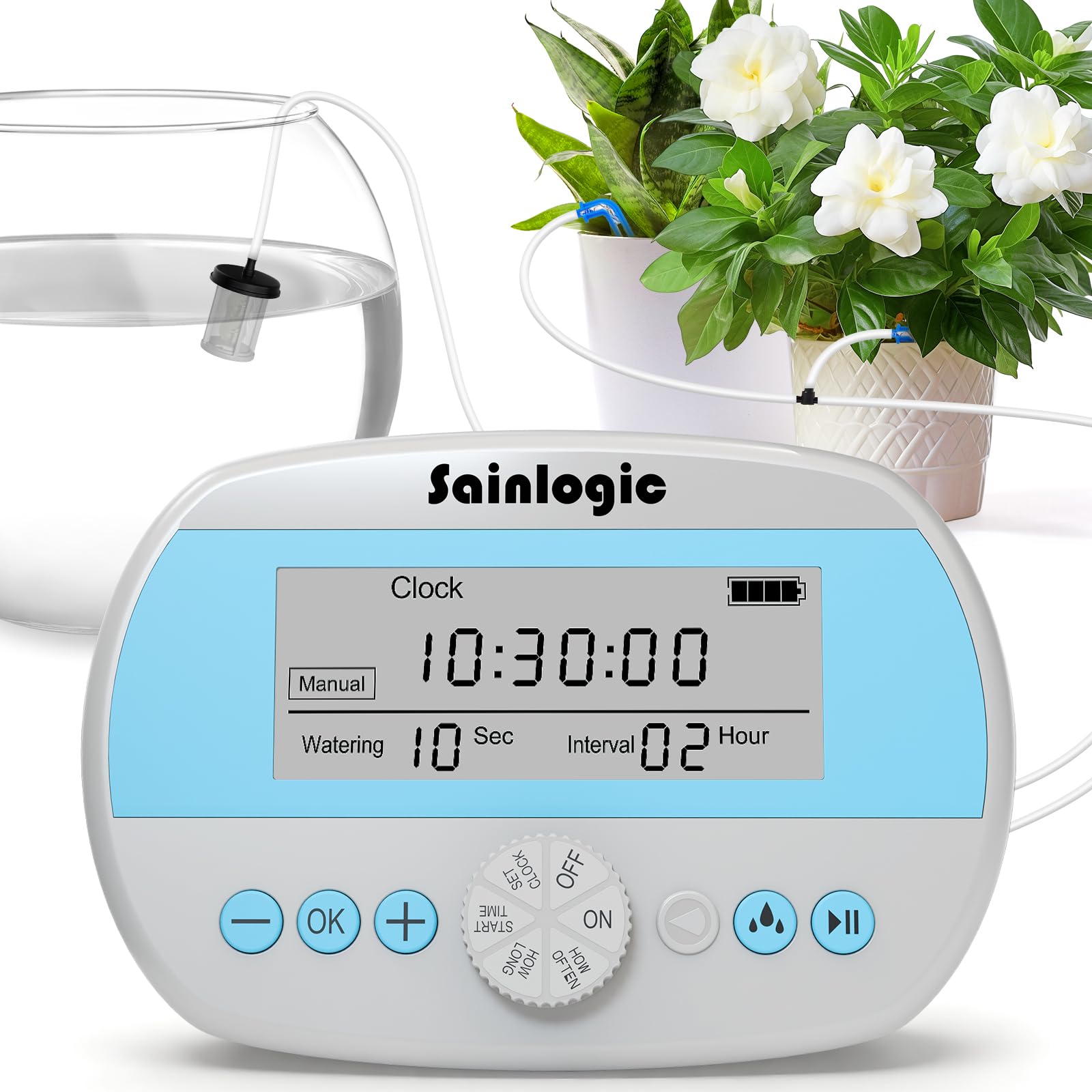
Cheap usually means blind, and this one isn't. The Sainlogic is the least expensive pick in this guide and it still puts a moisture reading on a 3.07-inch display, so you can see what the soil is doing instead of trusting a clock you set three weeks ago.

We rate it for a windowsill of similar plants. Switch it to humidity mode and it waters when the probe dries rather than on a fixed timer, and IP64 sealing with built-in backflow prevention means a steamy bathroom or a sloppy watering can isn't a problem. The box covers the whole job: 33 feet of tubing, 15 drippers, a filter and the soil probe itself.

The compromise is per-plant flow. The fifteen emitters aren't individually adjustable, so everything on the line gets the same drink, which is fine for a tray of similar pots and wrong for a mixed shelf. Put the thirstier plants nearest the pump, keep the run short, and expect to move a pot or two after the first week.

Bottom line: For a windowsill of similar pots, this is our budget pick: it waters off soil moisture and shows the reading on a display you can see from standing height.

3

beday 15-Plant Drip System

beday 15-Plant Drip System

Mixed indoor shelves

Our Score 8.4/10
Check Price

Worth Noting

  • One probe governs the whole line
  • No reservoir included
Power
USB-C rechargeable
Tubing
33 ft
Plants Covered
Up to 15
Watering Modes
Timer and humidity
Read the full review

Two watering modes in one small box is the reason this one is our default. A probe reads how dry the soil is and a timer runs the schedule you set, so you can water on the clock or let humidity mode take over when a hot week changes everything. On a shelf holding a fern, a pothos and a cactus within a foot of each other, that choice is the difference between a kit you trust for two weeks and one you think about on the plane.

The kit is a box of parts: 33 feet of tubing, 15 T-joints and 15 drip stakes, plus a USB-C cable. Setup took us an afternoon rather than the ten minutes the packaging promises, mostly because cutting and seating fifteen runs takes patience. The intake hose drops into whatever container you dedicate, since there's no tank, and the two-gallon jug we keep under the shelf has carried a full shelf through a fortnight of short cycles without a top-up.

What we appreciated most after living with it is the anti-siphon valve. When the pump stops, the line stops, so the pot closest to the reservoir doesn't keep sipping while you're away. The LED panel is legible from standing height, the charge level is visible without digging out the manual, and the pump is quiet enough that we leave it on a bedroom windowsill.

The caveat is longevity. The pump is the weak point, and early failures in the first weeks of use are what to plan around. So set the system running a week before you leave, watch for a pot that stays wet or a line that stops dripping, and keep the order within reach. A week of testing at home is worth more than any specification on the box.

Bottom line: The one we tell most indoor growers to buy: a moisture probe and a timer in a single cordless unit, with 15 drip lines and an anti-siphon valve that stops the drip when the pump stops.

4

RAINPOINT Large Display Plant Waterer

RAINPOINT Large Display Plant Waterer

Visible schedules

Our Score 8.4/10
Check Price

Worth Noting

  • Bulky control unit for a narrow sill
Power
Rechargeable, USB-C
Display
LCD with next watering time
Plants Covered
10–15
Watering Interval
Every 8 hours to 30 days
Read the full review

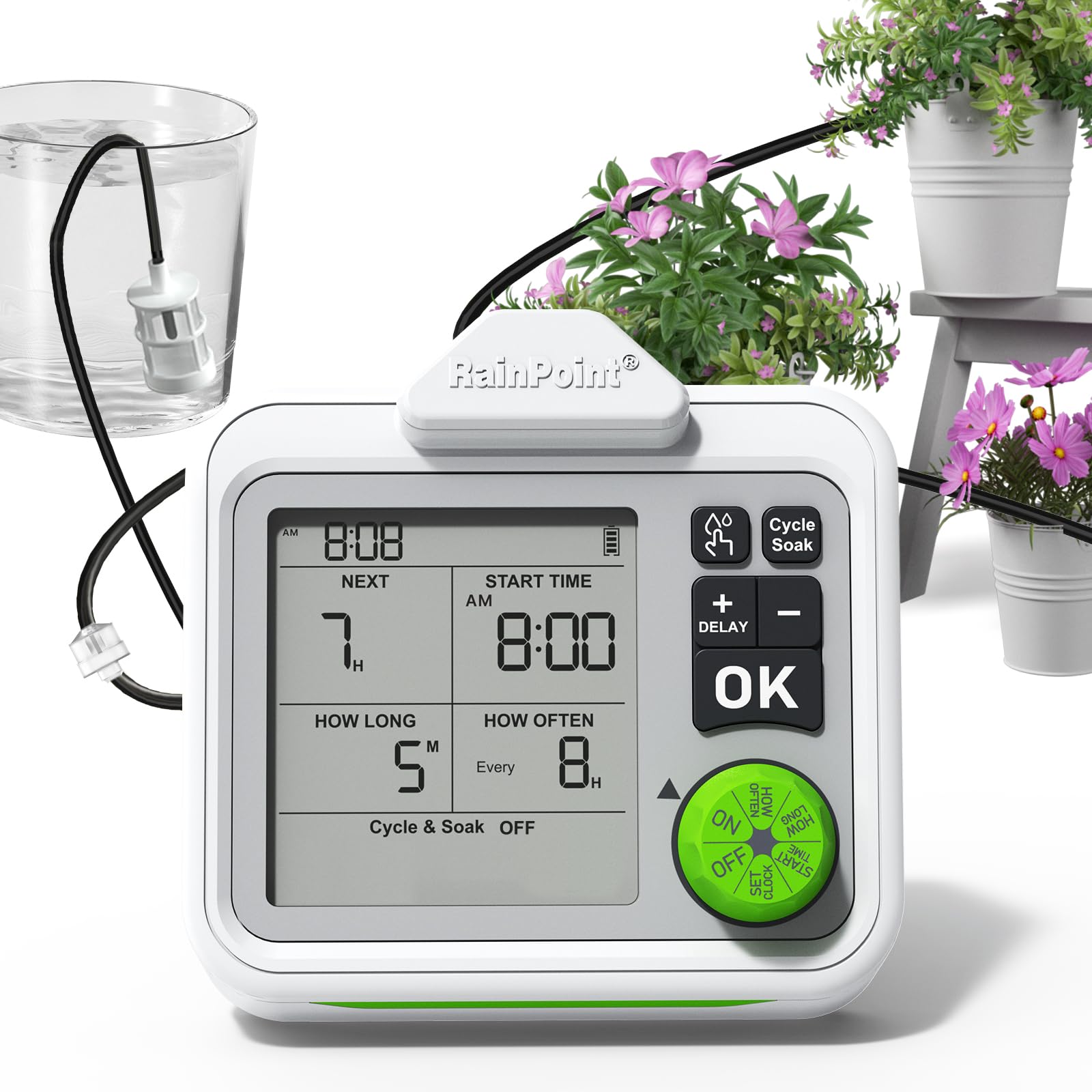
A countdown clock is the feature that sells this one. The large LCD shows the interval you've set and the time remaining until the next watering, so a glance across the room tells you the system is armed instead of asking you to take it on faith.

We think it's the best of these for anyone who wants a schedule they can see and change without reaching for a phone. Intervals run from every eight hours to every thirty days, cycle-and-soak splits a long watering into pulses so it soaks in rather than running off, and the settings stay in memory when the battery drains, so charging doesn't mean reprogramming. A manual button adds a drink without disturbing the plan, and a delay pauses everything while you repot.

The rest is ordinary in the right way: a rechargeable battery with USB-C, a full accessory kit of tubing, T-joints and drippers, and a control unit about six inches across, which is chunky on a narrow windowsill but sits happily at the end of a shelf. Output falls along a long run, so put the thirstiest pots nearest the pump and keep the run compact.

Bottom line: We point people here when the schedule matters more than an app: the display shows the next watering, and the settings survive a dead battery.

5

LetPot WiFi Watering System Gen-3

LetPot WiFi Watering System Gen-3

Remote scheduling

Our Score 8.4/10
Check Price

Worth Noting

  • Most expensive kit in this guide
Tubing
10 meters
Control
WiFi app
Drippers
Adjustable flow
Waterproofing
IP66
Read the full review

The LetPot is the most expensive kit in this guide, and the money goes somewhere specific: WiFi and a dedicated app that let you rewrite the schedule without crawling under the shelf. If you've ever come home to find a vacation plan had been watering a fern like a tomato, remote control is worth paying for.

The hardware backs it up. Ten meters of tubing and 42 pieces give you plenty to lay out, the drippers adjust at each pot so a succulent and a fern can share one pump, and the IP66 housing means a bright, humid windowsill doesn't worry it. The pump is quiet enough that we stopped noticing it running.

Where it needs care is at the joints. A kit with this many push-fit connections rewards a slow first assembly: seat every T squarely, then run a cycle and check each one with dry hands and a towel nearby. Do that and the app earns its keep — shortening a cycle after a hot week takes seconds. The combination of adjustable drippers and remote scheduling is what a mixed collection actually needs, and that's what you're buying.

Bottom line: For anyone who wants to fix a schedule from the office, this is the one: app control, adjustable drippers and an IP66 housing, at a price that reflects all three.

6

Moistenland 15-Plant Watering Kit

Moistenland 15-Plant Watering Kit

Basic vacation setup

Our Score 8.4/10
Check Price

Worth Noting

  • Diagrams are hard to follow on a first read
Tubing
33 ft
Control
Button-programmed timer
Anti-siphon
Not included
Plants Covered
15
Read the full review

Most kits bury the siphon problem in a footnote; this one leads with it, because the internal pump isn't anti-siphon. That isn't a defect so much as a rule: keep the reservoir at or below the level of the pots and watering stops when the timer stops. Put the bucket on a shelf above the plants and gravity keeps the line dripping long after the pump shuts off.

Read that way, the kit does what a basic fifteen-pot system should. There's 33 feet of tubing with T-joints and drippers, a button-programmed timer that takes a few minutes to set, and a pump small and light enough to hide behind a pot. Output thins toward the far end of a long run, so keep the pots close together and put the thirstiest first.

We rank it below the picks above for two reasons that have nothing to do with watering. The printed diagrams assume you already know which way a T-joint faces, and the priming step is easy to skim past on a first read. Lay the whole line out dry on the floor before you cut anything, and you'll save yourself an hour and a wet shelf.

Bottom line: A straightforward fifteen-pot kit if you can put the reservoir on the floor: easy to program, inexpensive, and honest about the siphon rule.

7

KINEVI 15-Pot Watering System

KINEVI 15-Pot Watering System

Long shelf runs

Our Score 8.4/10
Check Price

Worth Noting

  • Single knob is the only control path
Sensor
Soil humidity
Tubing
49 ft
Plants Covered
15
Watering Duration
20 seconds to 30 minutes
Read the full review

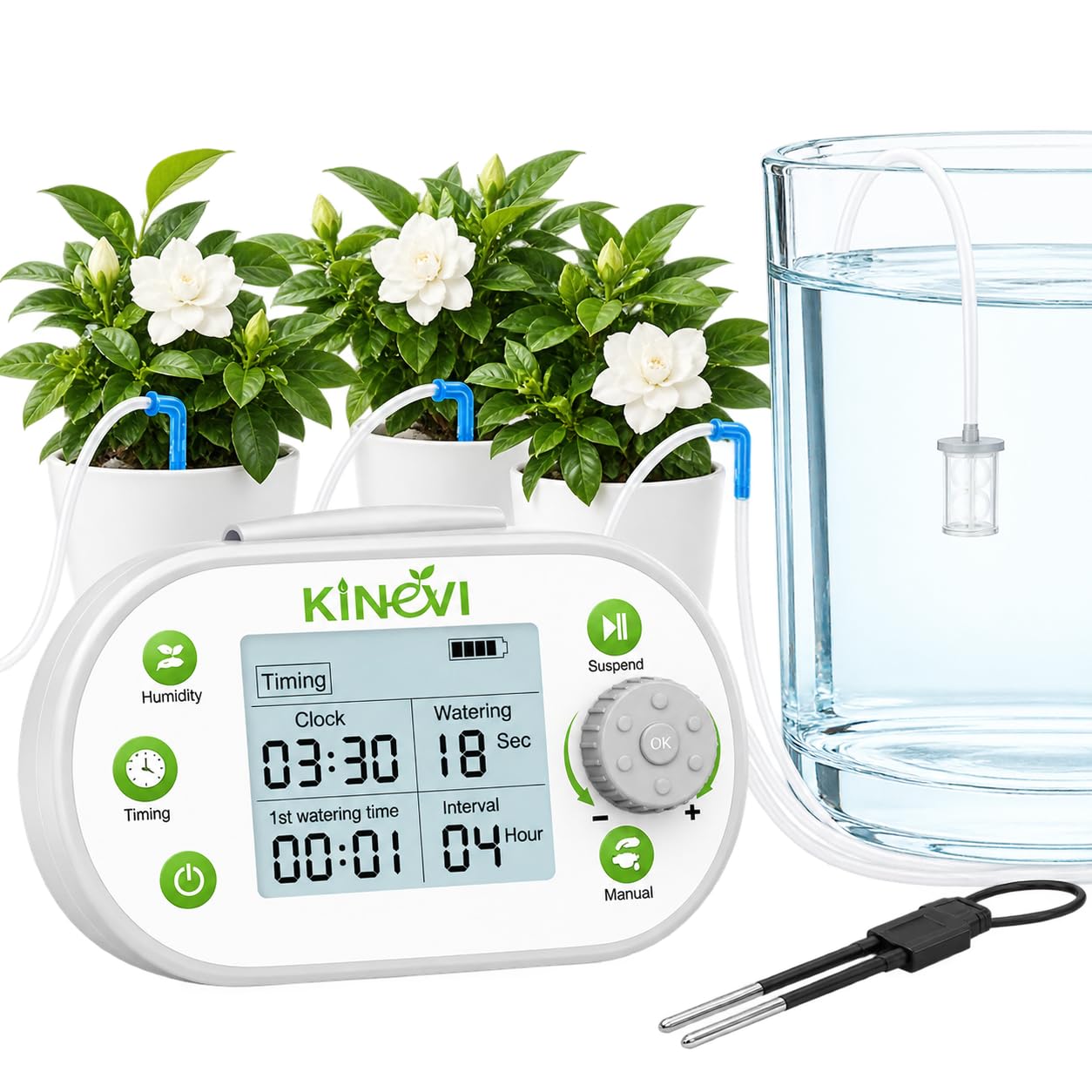
Forty-nine feet of tubing is the reason to look here first. It's the longest run in this guide — enough to follow the back of a built-in shelf or reach the next room without a splice — and the 15 adjustable emitters mean that length doesn't have to end in a compromise between a thirsty fern and a dry cactus.

The controller covers a wide spread: durations from 20 seconds to 30 minutes, and intervals that produce the 770 combinations KINEVI advertises, all set with a knob and a large LED readout. A soil humidity sensor comes in the box, so the same unit can water on moisture rather than on the clock when that suits the collection better.

The battery is a 2200 mAh cell charged over USB-C, which means no cable running the length of the shelf while it works. For a kit aimed at long layouts, that matters more than it sounds — the whole point is being able to put the pump somewhere inconvenient.

Our reservation is the interface. Interval, duration, manual run and humidity mode all run through one knob, which is quick to learn and the only way in. There's no app and no second control path, so a dial that sticks leaves you with no way to set a cycle. For a set-and-forget shelf that's a fair trade; if you like adjusting the plan, the RAINPOINT's screen and buttons are easier to live with.

Bottom line: The pick for a long shelf: 49 feet of tubing reaches where the others won't, provided you're happy setting everything with one knob.

8

DAOTAILI Dual-Pump Watering System

DAOTAILI Dual-Pump Watering System

Two plant groups

Our Score 8.2/10
Check Price

Worth Noting

  • Backup AA cells not included
  • Heaviest control unit here at 1.14 kg
Pumps
Two, independently scheduled
Drippers
Adjustable flow
Backup Power
4 AA batteries
Plants Covered
Up to 20
Read the full review

Two pumps sounds like a strange thing to get excited about until you picture the shelf: succulents on one end that want a sip every ten days, ferns on the other that want a drink every other morning. One pump forces a compromise. This one splits the line into two zones, each with its own schedule and its own flow setting.

The rest of the kit is built around 20 plants: 20 emitters, T-connectors and locking tubing, with an intake hose that drops into a bucket, bottle or jug rather than needing a faucet. The emitters adjust across the range, which is how you keep a small bonsai pot from getting the same soaking as a monstera in a five-gallon pot.

Where it earns its place for us is the power arrangement. USB-C runs it day to day, and four AA cells keep the schedule ticking if the outlet drops — the detail that made us comfortable leaving it for three weeks. Budget an evening for tuning, though: flow is set at each emitter and the gap between a low and a high setting is wider than the dial suggests.

Twenty emitters also drink faster than fifteen, so size the reservoir up and check the level a week before you go rather than the morning of. That's the trade for covering a bigger collection: more plants, more water to carry.

Bottom line: Buy this one if your pots fall into two camps: independent pumps let a cactus and a fern keep separate schedules on the same shelf.

How We Tested the Automatic Watering Systems

We started with a shortlist of 14 systems, filtering by reservoir size, pot compatibility, and the range of watering methods—wick, drip, pump, and capillary mat. Over six months, we set each one up on real shelves, not in a lab: kitchen windowsills with herbs, a humid bathroom with a fern, a dry living room with a fiddle leaf fig, and a two-week vacation where nobody was home to refill anything. We timed setup from opening the box to the first drip, and noted whether we could do it without the manual—some instructions were clear enough to follow half-asleep, others had us rereading the same diagram.

Leakage was the first thing we checked: we filled each reservoir to the max line, set it on a paper towel, and looked for wet spots after 24 hours and again after a week of regular use. To judge water distribution, we ran systems with multiple pots and checked moisture at the top and bottom of each pot with a finger and a cheap moisture meter, noting whether the first pot in line got more than the last. We also adjusted flow rates for different plants—succulents got the slowest drip, ferns the fastest—and watched whether the change actually held.

Durability came from repeated cleaning and refilling: we disassembled and reassembled each system weekly, rinsed parts, and checked for cracks or clogged drippers by the end of the test. Plant health was the long game—we watched for yellowing leaves, wilting, and root rot, and compared how each system handled a week of neglect. Value wasn't about the sticker price alone; we counted whether a kit covered a full shelf out of the box or needed extra tubing and timers to be useful. The systems that scored highest were the ones that set up quickly, sealed tightly, spread water evenly, and let us tweak the flow without a fight.

How to Choose Automatic Watering Systems for Indoor Plants

The Reservoir Is the Part You Have to Solve

None of these kits arrive with a tank. The intake hose drops into a bucket, a jug or a spare watering can you supply, which makes the container a real part of the purchase: a wide mouth for filling, a lid to slow evaporation, and a footprint that fits the floor under your shelf.

Height matters more than size in one respect. Without an anti-siphon valve, a reservoir sitting above the pots keeps feeding the line by gravity after the pump stops, which is how a shelf ends up flooded. Keep the container at or below pot level, or choose a kit that shuts the line off with the pump, as the beday and the LetPot do.

Timer or Moisture Sensor

A timer is predictable and indifferent: it waters when the clock says so, which is right in a steady room and wrong during a hot week. A sensor waters when the soil actually dries, which suits a collection of similar plants in similar pots.

The catch with sensors is that one probe reads one pot while the pump feeds the whole line. Put the probe in the pot that dries fastest and let the rest follow. If your shelf mixes a cactus with a fern, a timer plus per-plant flow control does more for you than any sensor.

Plan the Line Before You Cut Tubing

Drip output falls as the run gets longer, so the pots nearest the pump drink most and the ones at the far end drink least. Put the thirstiest plants first, keep runs short where you can, and leave a little slack at each T-joint rather than pulling the tubing taut.

If you're watering two groups with genuinely different needs, a dual-pump kit such as the DAOTAILI gives each line its own schedule and flow instead of one compromise for the whole shelf. Otherwise, adjustable emitters on a single pump cover most of the same ground.

Power, Placement and the First Week

Rechargeable units run for weeks per charge and free you from an outlet; USB-powered ones mean one less thing to remember before a trip, but a cable running along a shelf. Whichever you choose, run it for a week at home before you trust it with a vacation — that's when a joint that isn't seated shows up as a puddle instead of a dead plant.

After that the upkeep is small but real: rinse the intake filter, flush the tubing at the turn of the season, and store the pump dry if it comes off the shelf for the winter.

Frequently Asked Questions

Final Verdict

The beday is the system we recommend for most indoor collections. Having a moisture mode and a timer in one cordless unit covers the two ways a plant shelf changes while you're gone, and 15 drip lines is enough for a real collection. If a visible, readable schedule matters more to you than a sensor, take the RAINPOINT IK153. If you're watering more than 15 pots, or two groups that want different things, the DAOTAILI's two pumps earn the extra.