Poultry & Livestock

Best Automatic Livestock Waterers of 2026

The first winter I kept goats, I spent more mornings than I care to admit breaking ice out of a rubber tub with a fence post driver while the whole pen hollered at me. An automatic waterer is meant to end that: it holds a reserve, tops itself up through a float valve, and keeps clean water in front of animals that drink far more than most people expect. What it actually buys you is your schedule back — no hauling buckets twice a day, no guessing whether the tub tipped over overnight, no discovering at dusk that somebody knocked the hose loose.

Over the past ten months my team and I have had ten of these plumbed in and running — some off a hose bib, some off a gravity barrel — and the differences show up fast. The float valve is the whole machine; everything else is just housing. A waterer with a decent float and a bowl you can reach your hand into will outlast a fancier one with a valve you have to special-order. The picks below were sorted by how much water they hold, how loudly they complain when something's wrong, and how little of your Saturday they eat.

1

Ritchie Omni Fount 2

Top Pick
Ritchie Omni Fount 2

Cold-climate herds

Our Score 9.4/10
Check Price

Worth Noting

  • Premium cost among these picks
  • Heavy 41.4-pound unit is awkward to move alone
Power
Corded electric
Weight
41.4 lb
Capacity
28.3 liters
Material
Polyurethane and stainless steel
Read the full review

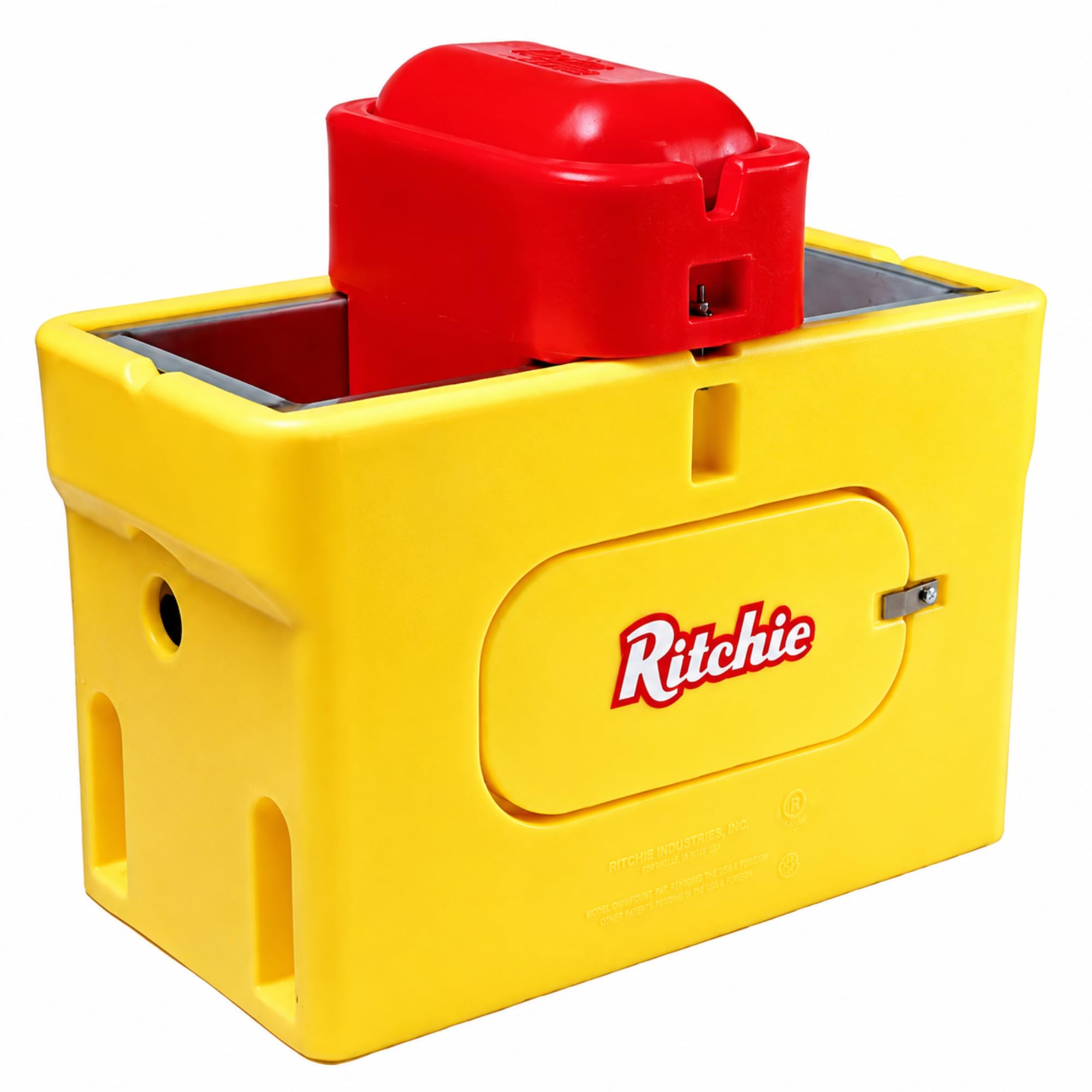
The Omni Fount 2 is the one here that solves winter, not just refilling. Heating elements sit directly under the stainless trough, and the polyurethane body is insulated at an R-factor of 7 per inch. We appreciate that arrangement because the heat goes where the animal drinks, while the insulation keeps the rest of the unit from bleeding heat into the barn.

At 28.3 liters, this is a trough for several horses or cattle, not a bowl for a goat pen. It weighs 41.4 pounds before you add water, and it needs a corded electrical connection, so plan on a permanent spot with a stout post or pad and a protected cord. The large access panel is a genuine convenience: you can reach the heating components and waterline without dismantling the whole fount.

This is the most expensive waterer in our group by a wide margin, and the install is a project. The payback is not having to chip ice or haul buckets through a cold snap. If you keep one goat or a few chickens, that trade is hard to justify; if you have horses or cattle and a frozen spigot every January, the capacity and heat are worth the premium.

Bottom line: If your water freezes or you keep a real herd, the Ritchie Omni Fount 2 earns the premium: heated, insulated, and built around a 28.3-liter stainless trough.

2

Abustle Pig 2.5L Bowl

Abustle Pig 2.5L Bowl

Goats and poultry

Our Score 8.8/10
Check Price

Worth Noting

  • Needs a separate 3/4-inch hose adapter
Weight
2.7 lb
Capacity
0.66 gallons
Material
304 stainless steel
Mounting
Wall, floor, or fence
Read the full review

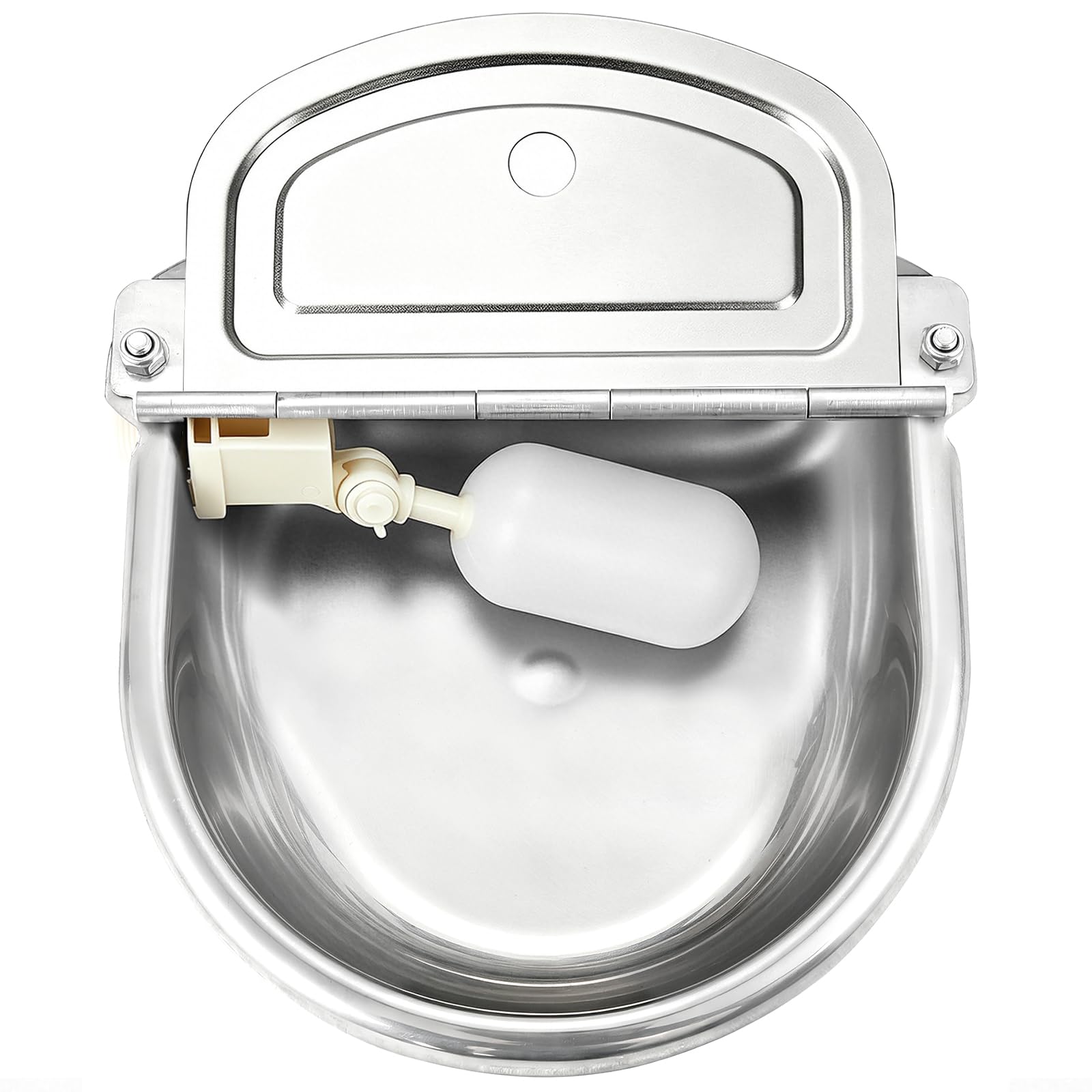
At 0.66 gallons, this is not a cattle trough, and that is the point. It is a compact stainless bowl for a goat pen, a sheep paddock, or a chicken run, and the smaller volume means you can mount it at a useful height without a massive bracket. The 304 stainless steel is the right material for a bowl that gets rinsed often.

The adjustable float arm lets you fine-tune the water level after installation, which matters more than it sounds. Set it too high and the bowl overflows onto the ground; set it too low and the float chatters. We like that the bowl can sit on the ground, hang on a fence rail, or be screwed to a wall through the two pre-drilled holes. At 2.7 pounds, one person can hang it without a helper.

The 1/2-inch valve inlet is the detail to catch before you start. Test the float in a bucket, then mount the bowl. If the float does not shut off cleanly at the level you set, sort that out before you drill.

For a small pen, this is a lot of convenience for the money. It will not keep up with a horse or a group of cattle, but for goats, sheep, and poultry it does the one thing that matters: keeps clean water in front of them without a daily refill.

Bottom line: The Abustle Pig bowl is our budget choice for goats, sheep, and poultry: a small stainless bowl that refills itself and mounts almost anywhere.

3

Lucky Farm 3.5L Bowl

Lucky Farm 3.5L Bowl

Goats and sheep

Our Score 8.8/10
Check Price

Worth Noting

  • Plastic body is not for cattle or horses
Drain
Drain plug
Capacity
3.5 liters
Material
Plastic with stainless baffle
Included Hose
1 meter
Read the full review

The feature that sells this bowl is the drain plug. Unscrew it and the bowl empties without tipping a full three and a half liters over the fence. We like that for a goat or sheep pen where hay and feed end up in the water; you can pull the plug, rinse, and refill without wrestling the whole unit off its mount.

Lucky Farm uses a plastic tank with a stainless steel baffle over the float assembly. That guard matters because animals nudge and chew at the float, and a protected float is less likely to be knocked out of adjustment. The float itself is adjustable: loosen the plastic nut, move the float up or down, and retighten to set the level.

The plastic body keeps the weight down and the price low. The included 1-meter hose and 3/4-inch garden-hose gasket give you a head start, though you still need to check that the hose route does not pull on the inlet.

For a small pen where cleaning is the chore you resent most, the drain plug is worth more than a fancy float. It is a practical, lightweight bowl rather than a forever fixture, and that is the right trade for a backyard flock or a few goats.

Bottom line: The Lucky Farm bowl is our plastic choice for goats, sheep, and poultry: a drain plug, a stainless float guard, and a simple float valve make cleaning easier.

4

Little Giant DuraMate 4 Gal

Little Giant DuraMate 4 Gal

Horses and goats

Our Score 8.6/10
Check Price

Worth Noting

  • No drain plug for emptying
Capacity
4 gallons
Material
Plastic
Mounting
Fence or wall brackets
Water Connection
3/4-inch garden hose
Read the full review

Four gallons is the number that makes this Little Giant the one we reach for first. That is enough that a horse or a few goats can drink without waiting on a bowl to refill, and the included metal brackets let you hang it over a fence rail or screw it to a wall instead of setting it in the mud. The float valve runs on water pressure alone, so there is no wiring and no pump to prime.

The connection is deliberately ordinary: a standard 3/4-inch garden hose threads onto the inlet. We like that because most of us already have a hose and a spigot, and replacing a damaged hose is easier than finding a proprietary fitting. The bowl comes with 30 inches of hose, which is enough for a nearby spigot but not for a run across the barn. Mounting hardware for the brackets is not included, so have lag screws or bolts ready.

The hose fitting is the part we watch. It can drip if the washer is missing or the threads are gritty, and a slow drip turns into a wet patch under the fence. Clean the threads, use a fresh washer, and check the connection after the first fill. The plastic body is lighter than a metal trough, which helps when you hang it alone, but it is not the same animal as an insulated heated fount.

For a first automatic waterer on a small homestead, this is the practical default. It will not heat water or serve a big herd the way the Ritchie does, but it keeps a horse or a pen of goats in fresh water without a daily bucket run. That is the job most of us need done.

Bottom line: For most small farms, the Little Giant DuraMate is our default: four gallons, fence brackets, and a standard hose connection make automatic watering simple for horses, goats, and cattle.

5

NATGAI 3L Bowl

NATGAI 3L Bowl

Wall-mounted bowls

Our Score 8.6/10
Check Price

Worth Noting

  • Mounting screws are not included
Drain
No drainage hole
Capacity
3 liters
Material
304 stainless steel
Mounting
Two rear holes
Read the full review

No drainage hole is the first thing to know about this NATGAI bowl. That sounds like a small detail until you need to empty it: you either tip the bowl or siphon it, and on a wall mount that is awkward. We still like the bowl for its simplicity, but we would choose it where you can lift it off the mount for cleaning, not where it is bolted permanently at shoulder height.

The 304 stainless steel body is the main attraction. It resists rust, wipes down easily, and has a polished surface that does not hold onto slime the way rough plastic can. The float valve refills automatically, and the two rear holes let you screw it to a wall or post. Match the fastener to your fence or wall before you start.

At 3 liters, this is a small-stock bowl: goats, sheep, poultry, or a couple of dogs. It is not sized for a horse or a cattle pen. The float is the part to test before mounting; fill it, watch it shut off, and adjust the arm if it keeps running. If the shutoff is not clean, fix it before you drill holes.

For a simple wall-mounted bowl in a barn aisle or chicken run, this is a good no-frills choice. The lack of a drain is the trade you make for a clean stainless basin with no plug to leak.

Bottom line: For a wall-mounted setup, the NATGAI bowl keeps it simple: 3 liters of 304 stainless steel, a float valve, and two rear mounting holes.

6

Ademon Stainless Waterer

Ademon Stainless Waterer

Small starter pens

Our Score 8.6/10
Check Price

Worth Noting

  • 2.5-liter bowl is small for large livestock
  • Short 80 cm hose limits placement
Weight
4.1 lb
Capacity
2.5 liters
Material
Stainless steel
Dimensions
10.6 x 9.84 x 3.94 inches
Read the full review

Countersunk bolts are the detail that makes the Ademon bowl nicer around horses and goats than a typical stainless basin. The hardware sits flush inside the bowl instead of protruding, so feed does not collect around it and a muzzle does not catch on a bolt head. The rest of the kit is built for the person who does not want a second hardware run: an 80-centimeter braided hose, two replacement float valves, and the fittings to connect it. We like the spare float more than the extra hardware; the valve is the part that eventually sticks, and a spare keeps the water on while you order a replacement.

The bowl has a 2.5-liter capacity and a float valve that runs on water pressure, keeping a steady level without electricity. The stainless bowl is easy to rinse, and the countersunk interior stays smooth.

Mount it level, because a tilted bowl changes where the float sits and can make the shutoff inconsistent. Test the valve through a full fill before you leave it connected.

For a first automatic waterer in a small pen, this kit removes the guesswork. It is not the cheapest bowl here, but the spare parts and hose make it a more complete package than a bare stainless basin.

Bottom line: The Ademon kit is our all-in-one starter for a small pen: a stainless bowl, an 80 cm hose, and two spare float valves in one box.

7

COMVIEE 2.5L Waterer

COMVIEE 2.5L Waterer

Small livestock pens

Our Score 8.4/10
Check Price

Worth Noting

  • Light-duty float and hose hardware
  • 2.5-liter bowl suits small stock only
Capacity
2.5 liters
Material
304 stainless steel
Warranty
One year
Kit Contents
Bowl, hose, two floats, connectors, bolts
Read the full review

What sets this bowl apart is the box, not the bowl. COMVIEE includes two float valves, a 1/2-inch female quick connector, a 3/4-inch male quick connector, a hose, and two expansion bolts. We appreciate the spare float most: the valve is the part that eventually sticks or drips, and having a replacement on the shelf means you are not hauling water while a package is in transit.

The bowl itself is 2.5 liters of 304 stainless steel, with a float mechanism that keeps a constant level. It is light enough to handle alone and the quick connectors make it easy to move between pens if you use more than one hose setup. The one-year warranty is also better than most of the small bowls here.

The inlet is the part to check before you bury the connection behind a fence rail. Mount the bowl level, test the float through a full fill and shutoff, and keep the spare valve dry until you need it.

For a chicken coop, a goat pen, or a small paddock, this is a sensible kit. It will not heat water, but it gives you the parts to keep a small automatic setup running without a second order.

Bottom line: Our pick when you want spare parts in the box is the COMVIEE kit: two float valves, quick connectors, and a stainless bowl for small stock.

How We Tested the Best Automatic Livestock Waterers

We started with spec sheets, comparing capacity, hookup type, and whether the bowl could be drained without dismantling anything. Anything that required soldering, sweating pipe, or a proprietary adapter just to attach a garden hose got cut, as did waterers where we couldn't find a replacement float for sale. That filtered a long list down to ten units, which we ran for ten months across a goat pen, a small cattle paddock, and a chicken run.

Each one got installed solo, with a wrench and a level and a stopwatch going, and we noted where the instructions lied about clearance. After filling, we laid a dry paper towel under every fitting and checked it a week later — a damp corner meant a leak we logged. To measure recovery, we dumped a five-gallon bucket and timed how long the float took to bring the level back. Each valve also ran through dozens of fill cycles by hand, and we watched for sticking, hissing, and that faint dribble that means the seat is already worn.

Then we just lived with them. In summer we watched for an algae film on the bowl and timed how long a scrub brush took, including whether the bowl drained fully or left a puddle you had to bail. We looked at whether hay and manure stayed out, whether water sat warm and stale, and how the housings held up through a hard freeze and a season of sun — cracks, chalky plastic, chewed fittings. Barn cats, chickens, and one very determined terrier told us whether the lip height worked for small animals, and we priced replacement floats to see what year three would actually cost. The ones that stayed in the pen are the ones below.

How to Choose Automatic Livestock Waterers

Match Capacity to the Animals, Not the Listing

Start with how much your animals drink and how many drink at once. A 2.5-liter bowl is fine for goats, sheep, chickens, or a couple of dogs, but it is not a cattle trough. Four gallons is a more realistic minimum for a horse or a small group of goats, and a 28.3-liter fount is the right idea for a barn with several head. We prefer buying once at the larger size to refilling a small bowl twice a day. If you are between sizes, go up.

The Float Valve and Hose Fitting Are the Weak Points

Every automatic waterer here depends on a float valve, and every float valve depends on a clean, well-seated connection. The common failure is not the bowl itself but a drip at the inlet or a float that never shuts off because grit or a bent arm keeps it open. Check the thread on your spigot and the inlet on the bowl before mounting. A 3/4-inch garden-hose connection is the simplest; a 1/2-inch inlet needs an adapter, and that adapter is often not in the box. Test the valve in a bucket before you drill holes.

Mounting and Drainage Decide How Much Cleaning You'll Do

A waterer on the ground is easy to set down and a nuisance to clean; one on a fence or wall stays out of the mud but can be awkward to empty. We look for a drain plug if the bowl will collect hay, feed, or algae. Stainless bowls rinse out faster than plastic, but a plastic body with a stainless float guard can still be a practical choice for goats and poultry. Before you mount, decide how you will tip or drain it, because that is the job you will repeat.

Heated Units Are a Winter Tool, Not a Default

Heat changes the purchase. A heated, insulated fount like the Ritchie Omni Fount 2 keeps a stainless trough open in freezing weather, but it needs a corded electrical connection and a permanent spot near power. If your winters do not freeze hard, a float-fed plastic or stainless bowl does the same job for far less. In a cold barn, put the heated unit on a GFCI-protected circuit and follow the maker's clearance and cord protection instructions. For a single goat or a few hens, the electrical run is usually not worth it.

Frequently Asked Questions

Final Verdict

For most homesteads, the Little Giant DuraMate is the automatic waterer we recommend: four gallons, a float valve that needs no power, and a fence bracket that keeps it off the ground. Add a spare hose washer and check the fitting once a season. If winter ice is your problem, step up to the Ritchie Omni Fount 2; its heated trough and 28.3-liter capacity are worth the premium for horses and cattle. For a goat pen or chicken run, the smaller Abustle Pig bowl is the budget choice.