Planters & Plant Supports

Best Self-Watering Planters of 2026

Self-watering planters work on one simple idea: a reservoir at the bottom holds water, a wick or a column of soil draws it up, and the plant drinks for a week or two without you. The details are what decide whether it works — a reservoir too small runs dry by Thursday, a wick too aggressive keeps roots wet until they rot, and a base too narrow tips the first time a plant leans toward the light. What you're buying is a few more days of grace between waterings, and a plant that forgives a long weekend away.

I've killed enough windowsill plants to be suspicious of anything labeled low-maintenance, so we spent eight months living with 12 self-watering planters — on a sunny sill, in a dim home-office corner, and out on a covered porch. The good ones let the soil dry slightly between drinks rather than keeping it uniformly soggy, and they looked good enough to leave out where guests see them. The picks below run from a large floor planter to a small herb pot, and each one earned its place.

1

QRRICA 5-Piece Self-Watering Pot Set

Top Pick
QRRICA 5-Piece Self-Watering Pot Set

Most houseplants

Our Score 9.2/10
Check Price

Worth Noting

  • Smallest pot is 7 inches
Use
Indoor/outdoor
Sizes
7, 7.5, 8, 9, 10 in
Set Contents
5 pots with saucers
Watering Method
Wick feeder with reservoir
Read the full review

Five pots spanning 7 to 10 inches, each with a removable wick feeder and saucer, make this the set we recommend first for most houseplant collections. The spread is the reason: you can move a pothos, a peace lily, and a mid-size philodendron onto the same watering system without buying three separate planters. The wick draws from a separate reservoir, so the soil stays evenly moist instead of sitting in water.

We prefer this wick-and-saucer arrangement to a pot with a sealed inner basket because it is easier to understand at a glance. Fill the reservoir, set the wick, and the plant pulls what it needs; the mesh drainage holes and saucer catch the overflow. The listed two-week interval is a useful ceiling, not a promise, since small pots in bright light will drink faster. The matte finish also looks less like a nursery pot than clear plastic, which matters if the planter is staying in the living room.

What we appreciate most is the way the five sizes share one method. Repotting day is simpler when every pot uses the same wick and saucer, and the 10-inch size gives a larger plant enough root room without turning into a floor planter. These are not delicate decorative pots; the plastic is light and the saucers are shallow, but that is the trade for a set that is easy to move and clean. For a collection that runs from small tabletop plants to a substantial floor plant, this is the most straightforward place to start.

Bottom line: Our go-to self-watering set for most houseplants: five useful sizes, a wick feeder, and saucers that keep water off the shelf.

2

YNNICO 6-Piece Self-Watering Planter Set

YNNICO 6-Piece Self-Watering Planter Set

Small houseplant sets

Our Score 9.2/10
Check Price

Worth Noting

  • Indoor use only
  • Largest pot is 8 inches
Use
Indoor
Sizes
5, 5.5, 6, 6.5, 7, 8 in
Set Contents
6 pots with trays
Watering Method
Wick string or bottom tray
Read the full review

A six-pot set with sizes from 5 to 8 inches is the budget route into self-watering, and the size ladder is what makes it useful. You get a pot for a small fern, one for a begonia, and an 8-inch option for something that has outgrown its nursery container, all sharing the same simple tray-and-wick setup. The matte plastic looks tidy enough for a windowsill, and the pots are light enough to move when you water.

We like that the wick is optional. Drop the string into the bottom tray and the pot becomes a bottom-watering planter; leave it out and you have a conventional pot with a deep saucer and good drainage holes. That flexibility is unusual at this end of the range, and it makes the set forgiving if you are still learning how wet a particular plant likes to be. The deep tray also catches a generous amount of runoff, which keeps shelves drier.

The plastic is light and the finish is simple, so the set disappears into a shelf rather than becoming a feature. What makes it worth buying is not the look but the coverage: several sizes, usable trays, and a wick you can add or leave out. For someone moving a windowsill of small plants to self-watering, that is enough.

Bottom line: A smart budget start for small houseplants: six sizes, optional wicks, and trays deep enough to make bottom watering useful.

3

Fielda 3-Piece Self-Watering Pot Set

Fielda 3-Piece Self-Watering Pot Set

Large houseplants

Our Score 9.2/10
Check Price

Worth Noting

  • Only three pots
  • No size below 8 inches
Use
Indoor/outdoor
Sizes
8, 10, 12 in
Set Contents
3 pots with saucers
Watering Method
Cotton wick with level window
Read the full review

A 12-inch pot is the reason to look at this set. Most self-watering sets here stop at 10 inches, so the Fielda three-piece gives a large monstera, fiddle-leaf fig, or big peace lily a reservoir without forcing it into a pot that is too small. The water-level window is the other feature that stands out: it shows the reservoir without lifting the pot or digging a finger into the soil.

The wick system is straightforward. Cotton wicks pull water from the detachable saucer, and the pots have drainage holes, so the roots are not standing in the reservoir. The indicator is built into the side rather than hidden under the rim, which makes the pot easier to live with on a schedule. The 8-inch size is still useful for a medium snake plant, while the 12-inch is the one that earns the set its place.

We recommend this set for someone upsizing one or two big houseplants, not for a shelf of small pots. Three pots in 8, 10, and 12 inches leave gaps in a mixed collection, and the 12-inch takes a serious amount of potting mix. What you get in return is fewer refills, a more stable pot for a top-heavy plant, and a water level you can read from across the room.

Bottom line: The set we choose when a houseplant has outgrown its nursery pot and you want to see the water level without lifting the pot.

4

UOUZ 13-Inch Hanging Planters

UOUZ 13-Inch Hanging Planters

Hanging displays

Our Score 9.2/10
Check Price

Worth Noting

  • No water-level window
  • Large for tight spaces
Use
Outdoor
Diameter
13 in
Reservoir
50 fluid ounces each
Set Contents
2 baskets with chains
Read the full review

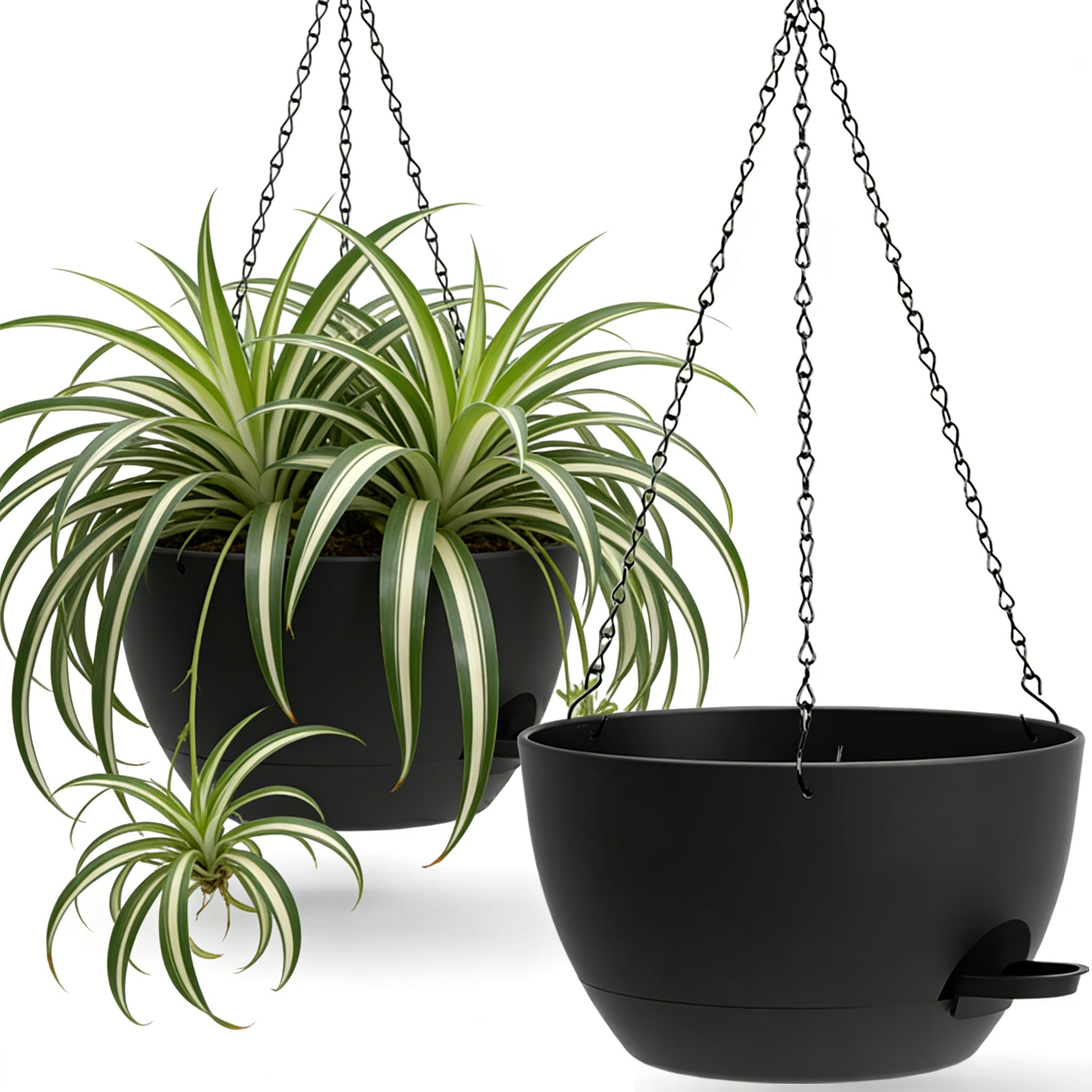
A 50-ounce reservoir in a 13-inch hanging basket gives each of these UOUZ baskets a lot of stored water. The wide planting well holds a fern, petunias, or trailing ivy without crowding the rim, and the included chain gives you a straightforward way to hang the pair from a bracket or ceiling hook. The black plastic is plain enough to disappear against a porch ceiling.

We like the two-pack for a matching pair of baskets, especially where you want the same watering routine on both sides of a door. The reservoir sits below the planting well, so the soil is not standing in water, and the basket is deep enough to hold a decent root ball. When the baskets are full, they are heavy; hang them from hardware rated for the weight rather than a decorative hook.

The reservoir is not visible from the outside, so you check the water level through the fill opening rather than watching a window. That is a small inconvenience, but it means the pot looks cleaner on the porch. For a pair of seasonal baskets, the capacity is the advantage; for a tiny window, the 13-inch size is more basket than you need.

Bottom line: Our pick for hanging color: two big baskets with generous reservoirs, included chains, and enough room for petunias or ferns.

5

Mayne Fairfield Tall Square Planter

Mayne Fairfield Tall Square Planter

Tall entryways

Our Score 9.2/10
Check Price

Worth Noting

  • Large 16-inch footprint
  • Needs a lot of potting mix
Capacity
8 gallons
Warranty
15-year residential
Reservoir
Reversible self-watering tray
Dimensions
16 x 16 x 28 in
Read the full review

At 28 inches tall and 16 inches square, the Fairfield is an entryway planter rather than a tabletop pot. It lifts flowers and greenery to eye level, gives a porch a finished look, and keeps the planting area off the ground and easier to reach. The traditional square profile is restrained enough for a front door without looking ornate.

The reversible tray is the detail that makes it more than a pretty box. Set it one way and it becomes a self-watering reservoir; flip it and the pot drains more freely. That flexibility matters outdoors, where a rainy stretch can overwhelm a reservoir and a hot week can empty one. The polyethylene is UV fade-resistant, and the 15-year residential warranty is a meaningful long-term vote of confidence for an outdoor pot.

We like it best for a front door that needs presence and can spare the floor space. A 16-inch footprint needs a real landing or porch corner, and the 8-gallon capacity means a lot of potting mix. The payoff is one planted Fairfield doing the work of several smaller pots, with the height making watering easier on your back. For a narrow step or a balcony rail, it is simply too much planter.

Bottom line: Our choice for a front-door anchor: tall, weather-ready, and fitted with a tray that switches between reservoir and drainage duty.

6

FaithLand 8-Inch Self-Watering Pots

FaithLand 8-Inch Self-Watering Pots

Large indoor pots

Our Score 9.2/10
Check Price

Worth Noting

  • Both pots are 8 inches
  • No visible reservoir window
Use
Indoor/outdoor
Size
8 in
Reservoir
Deep tray with fill lip
Set Contents
2 pots with trays
Read the full review

The deep tray and clip-on watering lip are the first things to notice on this FaithLand pair. You add water at the lip instead of lifting the pot or pouring over the foliage, and the tray holds enough that a medium houseplant is not asking for a refill every other day. The 8-inch size is a useful middle ground for a snake plant, a small monstera, or a patio herb.

The wick and drainage holes work together rather than against each other. The cotton rope pulls water up from the tray, while the holes let excess drain back down; the saucer catches what the soil does not take. The matte finish is plain enough to disappear in a room, and the pots are light enough to move without a wrestling match.

Both pots are the same 8-inch size, so this is not a set for a mixed collection of tiny plants. It suits two plants with similar water needs, or one plant now and another when you repot. The reservoir is not see-through, so you learn the refill rhythm by checking the soil rather than watching a water line.

We like the pair for two medium, thirsty houseplants that sit in the same room and ask for water on the same schedule. The fill lip is a genuinely useful touch, and the deep tray gives you a little slack on a busy week. It is a plain, practical set rather than a decorative one, and that is exactly what some shelves need.

Bottom line: A sensible two-pack for medium plants: deep trays, a clip-on fill lip, and wicks that keep water off the leaves.

7

T4U 4-Inch Self-Watering Pots

T4U 4-Inch Self-Watering Pots

Tiny plants

Our Score 9.2/10
Check Price

Worth Noting

  • Only 4-inch pots
  • Small reservoir needs frequent checks
Use
Indoor
Size
4 in
Set Contents
4 pots
Watering Method
Cotton rope with visible level
Read the full review

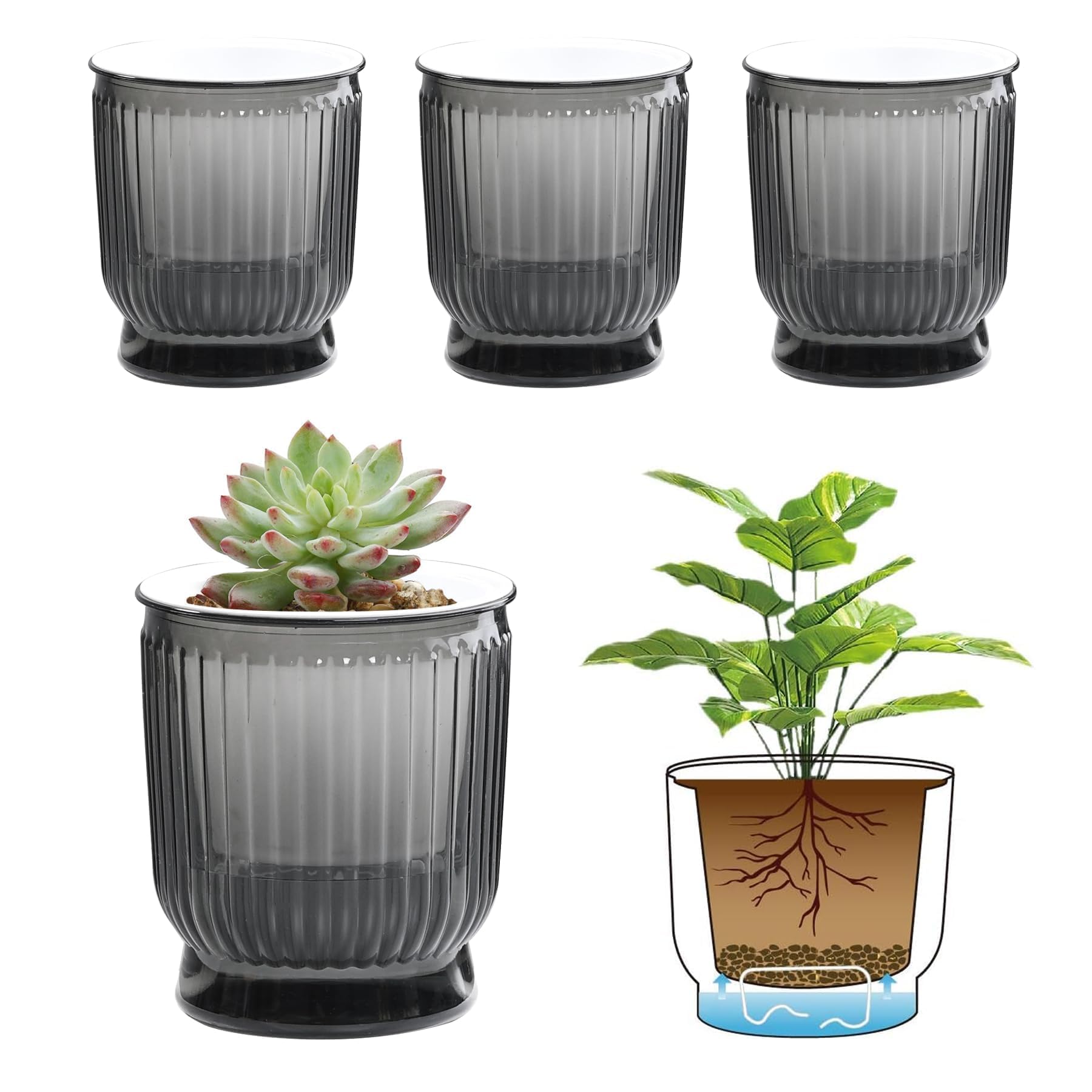
Four inches across, four to a set: T4U's planters are built for the small end of the houseplant shelf. Each pot has a double-layer body, a cotton wick, and a clear lower section that shows the reservoir level. The translucent gray plastic keeps the setup from looking like a science experiment.

The clear bottom is the practical advantage. Small pots dry out quickly, and a reservoir you can inspect without lifting the inner pot makes it easier to catch a dry spell before leaves wilt. The cotton rope pulls water up from the bottom chamber, and the inner pot keeps the soil out of the standing water.

The size is the limitation. A 4-inch pot suits an African violet, a small fern, a Venus flytrap, or a cutting that is ready for soil; it is not a pot for a monstera or a large peace lily. The reservoir is scaled to that small root ball, so it buys days rather than weeks. Check the water line every few days until you know how fast your plant drinks.

The PET body is light and easy to wipe clean, and the four-pack gives you room to group several small plants or keep spares. The translucent finish hides some of the mineral film that clear pots can show, though it still lets you see enough water to be useful. These are simple pots, but the visibility is the feature that earns them a place.

For a row of violets, a propagation shelf, or a kitchen windowsill of small herbs, this is the shape we prefer: compact, easy to check, and not trying to be a floor planter. For anything with a substantial root ball, choose a larger set and leave these to the small stuff.

Bottom line: A tidy small-pot set for violets and other little moisture lovers, with a reservoir you can inspect without disturbing the plant.

8

MIXC 18-Pack Clear Self-Watering Pots

MIXC 18-Pack Clear Self-Watering Pots

Propagation and nursery

Our Score 9.2/10
Check Price

Worth Noting

  • Bulk 18-pot commitment
  • Clear plastic shows algae
Use
Indoor/outdoor
Sizes
4, 5, 6.5 in
Set Contents
18 clear pots
Watering Method
Wick with detachable saucer
Read the full review

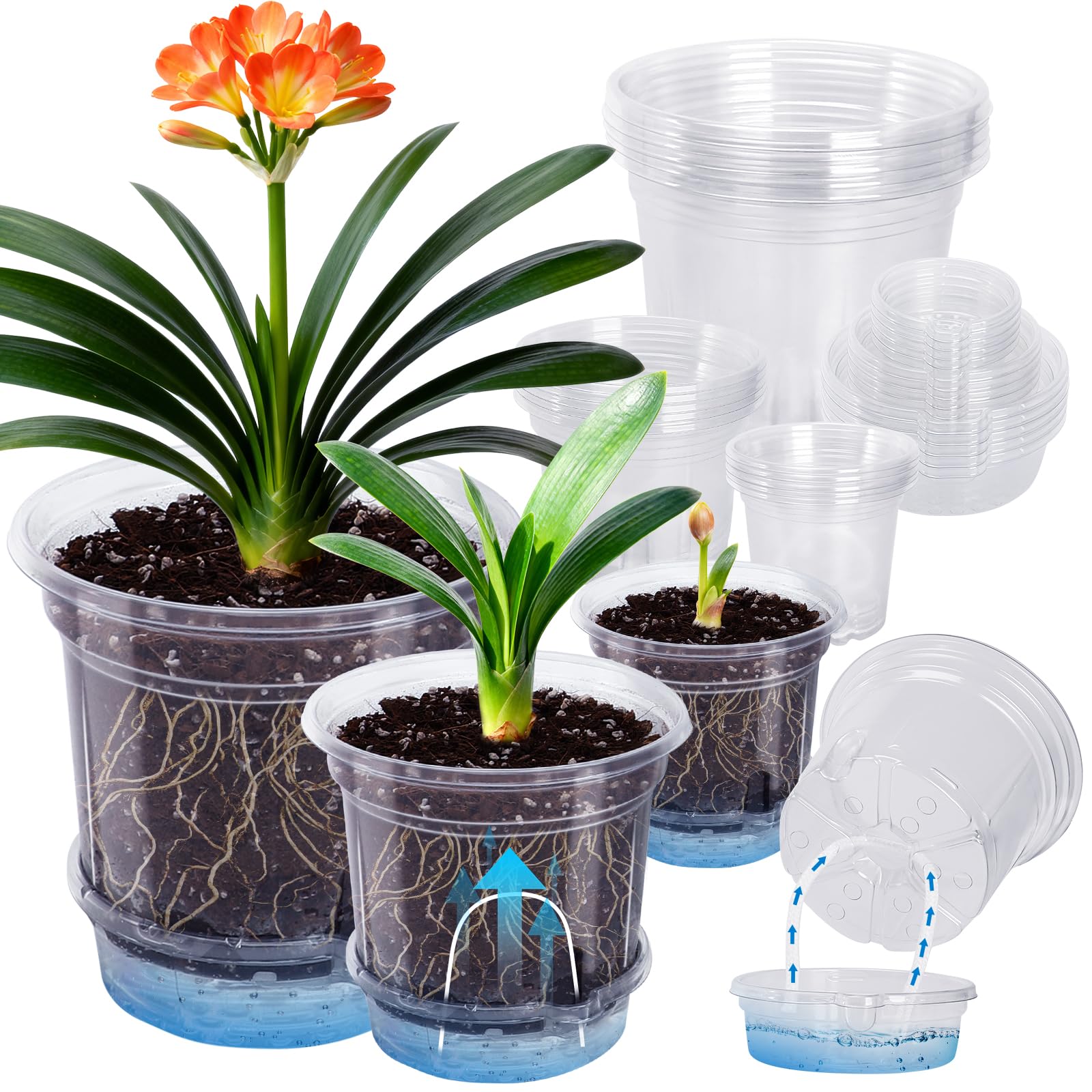
Eighteen clear pots in three sizes make this MIXC set a propagation and nursery kit first, a display planter second. You get six pots each in 4, 5, and 6.5 inches, every one with a wick and a detachable saucer. That is enough to move a batch of cuttings or seedlings onto bottom watering without buying individual pieces.

The clear walls are the feature to value. You can see roots reaching the edge, check whether the soil is staying evenly moist, and catch a reservoir that has gone dry before the leaves tell you. The pots are sturdy enough to reuse, and the wick-and-saucer setup comes apart for cleaning. They look like nursery pots because they are nursery pots.

Buy this only if the quantity makes sense. Eighteen pots take up storage space, and the three sizes are close enough that the 5-inch may become the default. The clear plastic also shows algae and mineral buildup faster than an opaque pot. For a propagation station, a community garden giveaway, or a season of seed starting, the bulk is the advantage; for three houseplants, it is more than you need.

We recommend it for anyone who starts plants in waves rather than one at a time. The clear walls and wicks make it easy to see what is happening below the soil, and the sizes cover the gap between a cutting and a full nursery pot. It is not the set to buy for a styled shelf, but it is the one we reach for at potting-up time.

Bottom line: Our bulk pick for propagation season: 18 clear pots in three sizes, each with a wick and saucer for bottom watering.

9

Keter Urban Bloomer Raised Garden Bed

Keter Urban Bloomer Raised Garden Bed

Patio herbs

Our Score 9.0/10
Check Price

Worth Noting

  • Shallow bed limits large vegetables
  • Walls can flex when filled
Use
Outdoor
Drainage
Open/close plug
Dimensions
32.3 x 14.7 x 30.7 in
Water Gauge
Built-in reservoir indicator
Read the full review

The Urban Bloomer is a raised bed for a balcony, not a full garden plot. At 32.3 inches long, 14.7 inches deep, and 30.7 inches tall, it gives you a workable herb garden without eating the whole patio. We like the working height for anyone who has tired of kneeling over pots, and the dark grey wood-look resin is restrained enough for a front porch.

The built-in water gauge is the useful part. It shows when the reservoir needs topping up, and the drainage plug lets you open or close the bed depending on whether you want a self-watering reservoir or free drainage. We prefer that kind of control on an outdoor planter because rainy weeks and hot weeks ask for different things. The bed is deep enough for herbs, lettuce, and strawberries, though not for a full-size tomato plant.

What we do not love is the amount of plastic for the planting area. The bed looks bigger than the soil volume feels once it is filled, and the walls can flex when you move it loaded. Set it in place before filling and treat it as a seasonal herb bed rather than a permanent raised bed. For a small patio, the working height and water gauge still make it one of the more thoughtful outdoor planters here.

Bottom line: A compact raised herb bed for a balcony or small patio, with a water gauge and drainage plug that make container watering more controllable.

10

D'vine Dev Terracotta Self-Watering Pots

D'vine Dev Terracotta Self-Watering Pots

Small accent plants

Our Score 9.0/10
Check Price

Worth Noting

  • Small planting cavity
  • No drainage hole
Use
Indoor
Set Contents
2 terracotta pots with glass cups
Outer Diameter
6.2 in
Watering Method
Porous terracotta
Read the full review

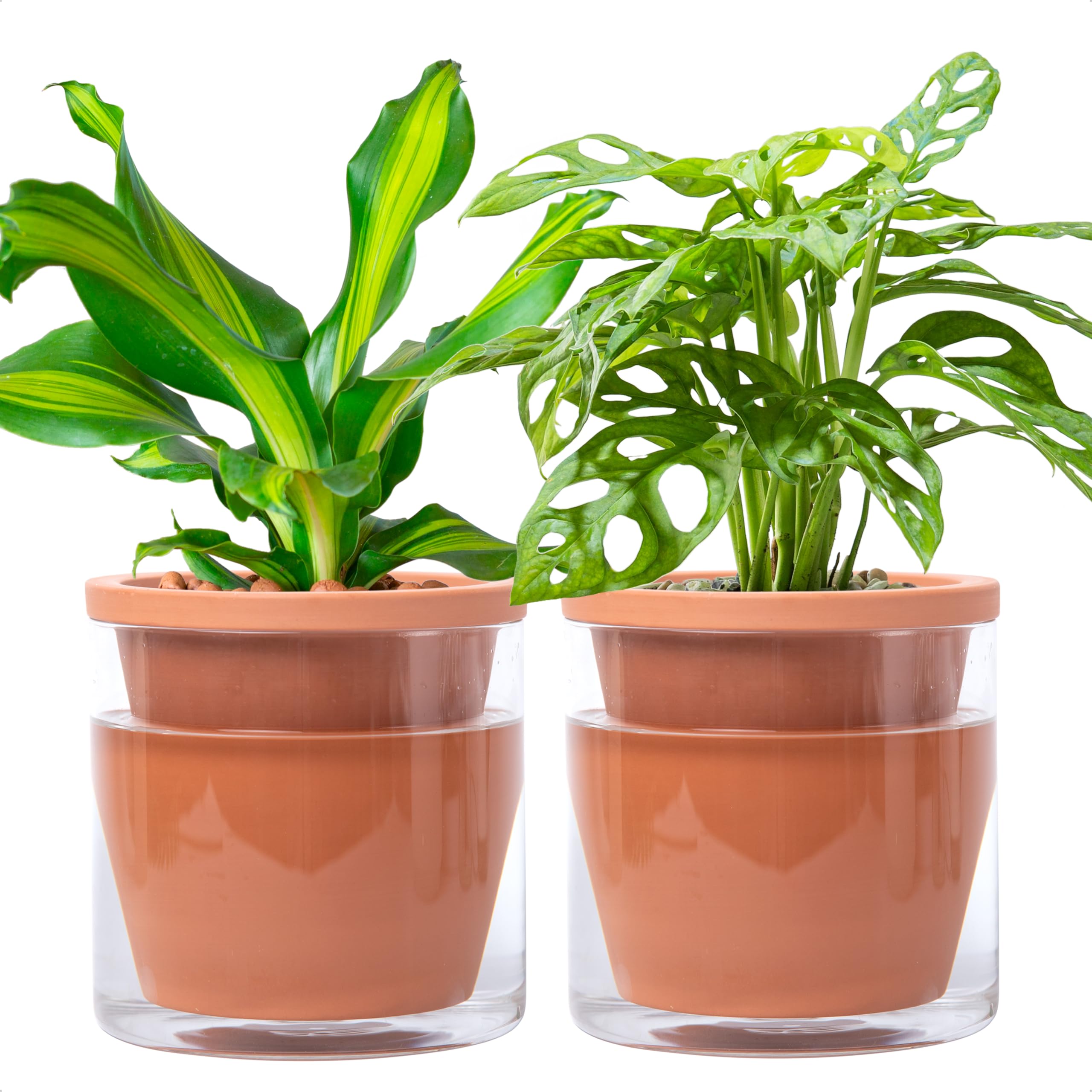
An unglazed terracotta cup sits inside a clear glass reservoir, which gives these D'vine Dev pots a different look from the plastic sets here. The water line is visible through the glass, and the terracotta is left matte and slightly rough rather than glazed. It reads as a small ceramic pot first and a watering system second.

The mechanism is passive. Terracotta is porous, so water moves through the pot wall into the soil slowly; there is no cotton wick, no inner basket, and no drainage hole. You fill the glass cup, the pot draws what it needs, and the tabletop stays dry. For an African violet or a small fern, that gentle, even moisture is easier to manage than a reservoir that floods the root ball.

The proportions are the part to check. A 6.2-inch outer diameter sounds generous, but the pot narrows toward the base, so the actual planting cavity is closer to a 4- or 5-inch nursery pot. Herbs, small violets, and compact ferns fit; a peace lily or a monstera does not. The clear cup also lets light reach the water, so rinse it between refills rather than letting it sit for weeks.

There is no drainage hole, which is both the point and the limitation. It means no drips on a wood shelf, but it also means you cannot flush the soil freely or leave the pot out in rain. For a plant that likes steady moisture and a sheltered indoor spot, that trade is reasonable. For a succulent or anything that wants to dry out hard, it is the wrong design.

We like these best as a small, good-looking set for a violet, a windowsill herb, or a fern that would otherwise need constant attention. The terracotta does the work quietly, and the glass makes the water level obvious. They are not the pots for a large plant collection, but they make a small one feel considered.

Bottom line: A decorative small-pot system for African violets and other moisture-loving plants, where the terracotta and glass do as much work as the reservoir.

How We Picked and Tested Self-Watering Planters

We started by rounding up every planter we could find with a genuine reservoir rather than a glorified drip tray, then cut the list by material, reservoir capacity, footprint, and price until we had 12 we bought ourselves. Each one got planted the same way — a pothos in the larger pots, basil in the small ones — so the comparison stayed fair.

Every reservoir was filled to its maximum line and then left alone. We logged how many days passed before the soil at root level felt dry, whether the top inch stayed dusty while the bottom was soaked, and how easy the fill tube was to reach without moving the pot or drowning the rim. Then we deliberately overfilled a few to see what happened: some drained quietly through a hidden overflow, others dumped water across the shelf.

Size claims got checked with a measuring cup — we poured in known volumes of soil to see whether a planter held what it promised, and set each one on a 12-inch windowsill to see what actually fit. Stability got the shove test on a slightly uneven floor with a top-heavy plant in place, and we noted which pots rocked or tipped. Finally, we wiped each finish weekly with a damp cloth to see how glazes and matte exteriors handled water spots and fingerprints, and weighed the price against reservoir volume and material — because value here is mostly reservoir per dollar and whether the thing still looks good after eight months.

How to Choose Self-Watering Planters

Start with the watering method

Most self-watering planters use one of three methods: a cotton wick from a reservoir, a bottom tray that water wicks into, or a porous terracotta wall. Wicks and bottom trays give you more control over how wet the soil stays, while terracotta is slower and better suited to a small violet or herb. If you want to switch between top and bottom watering, choose a pot with an optional wick, like the YNNICO set. If you want the reservoir to be visible, choose a clear pot or a level window. The method matters more than the shape of the pot.

Size the pot to the root ball

Measure the nursery pot, not the plant's leaves. Moving up 1 to 2 inches in diameter is usually enough; jumping from a 4-inch pot to a 12-inch planter leaves wet soil around roots that cannot use it. A self-watering reservoir makes that mistake worse because the water keeps coming. For a big monstera or fiddle-leaf fig, a 12-inch pot like the Fielda makes sense; for a windowsill of 4-inch plants, a 5- or 6-inch set is the better fit. Check depth as well as width, especially for plants with deep taproots.

Indoor and outdoor are different jobs

Outdoors, a planter has to handle rain, UV, and a reservoir that can overflow. Look for a drainage plug you can open in a wet week, as on the Keter Urban Bloomer, or a reversible tray that switches between reservoir and drainage, as on the Mayne Fairfield. Indoors, the priority is a saucer that keeps water off the shelf and a reservoir you can fill without moving the pot. A hanging basket needs a mounting point rated for the filled weight, not just a decorative hook. A pot that is merely weather-resistant can still drown roots if it has no overflow.

Plan the refill and cleaning routine

A self-watering pot is only convenient if you can fill it without dismantling the plant. Look for a wide fill opening, a visible water level, or a removable tray. The QRRICA's separate reservoir and the Fielda's level window both shorten the weekly check; a hidden reservoir turns it into a lifting job. Also plan for cleaning: wicks collect mineral deposits, saucers grow algae, and terracotta needs a scrub. A pot that is easy to empty and wipe will stay in service longer than one with a clever shape and a narrow neck.

Buy the set that fits your plant count

Sets are tempting because the per-pot cost looks lower, but storage and unused sizes matter. A three-pot set with 8-, 10-, and 12-inch pots is right for a few large houseplants and wrong for a shelf of 4-inch violets. An 18-pot propagation set is a season's supply, not a display collection. Count the plants you are repotting now, then add one or two spare sizes you will actually use. If you are unsure, start with a smaller set and learn how the reservoir behaves before buying in bulk.

Frequently Asked Questions

Final Verdict

QRRICA is the set we recommend first. Five sizes, a wick feeder, and a saucer for each pot cover the widest range of houseplants with one refill routine; the 7-inch minimum is the one limit to accept. If a single large plant is the job, Fielda's 12-inch pot and water-level window are the better shape. For a patio herb garden, choose Keter's raised bed and its drainage plug.