Garden Tools

Best Machetes for Brush, Yard and Camp of 2026

A machete is a lever with an edge on it, and almost everything you'll love or hate about one comes down to how that weight is balanced. Put too much mass out toward the tip and you'll clear a fence line fast, then feel it in your wrist by the third pass; go too light and the blade bounces off green wood instead of biting. The right one disappears into the swing, which is what turns a two-hour brush-clearing job into an afternoon you can actually finish — and that comes down to the steel and grind, the balance point, and a handle that doesn't twist in a sweaty palm.

1

Woodman's Pal Brush Axe

Top Pick
Woodman's Pal Brush Axe

Woody, tangled brush

Our Score 9.4/10
Check Price

Worth Noting

  • High price for a hand tool
Weight
1.9 lb
Blade Length
17 inches
Blade Material
High-carbon steel
Handle Material
Ash wood
Read the full review

The Woodman's Pal is the one tool here that does not feel like a machete in the hand. Its 17-inch high-carbon blade is broad and deeply curved, and the swing is closer to a light hatchet than to the whipping stroke you use with a Latin blade. That shape catches a stem and pulls through it as readily as it chops, which is why it is so good in tangled, woody growth — bittersweet, blackberry, vine maple, small saplings — the stuff that defeats a thin blade.

We think it earns its place for one kind of buyer: someone who clears heavy growth on their own land every season and wants a single tool to hand down. The ash handle is shaped rather than molded, the sheath is hand-sewn leather, and the whole thing is made in Pennsylvania with a lifetime warranty behind it. It also arrives genuinely sharp, which is not a given in this group.

The limits are worth being honest about. It is a 1.9-pound tool with a hooked profile, so mowing down a field of grass is slower work than it is with the Tramontina, and you feel the outlay every time you lift it. If your brush is mostly green and whippy rather than woody, you are paying for capability you will not use.

Bottom line: The one we choose for heavy, tangled brush: a deep-curved blade that pulls vines as readily as it chops, hand-finished and built to be handed down.

2

FLISSA 17.5-Inch Machete

FLISSA 17.5-Inch Machete

Light yard work

Our Score 9.4/10
Check Price

Worth Noting

  • Thin blade for hardwood
Sheath
Oxford with buckle closure
Blade Hardness
50–52 HRC
Blade Material
Stainless steel
Overall Length
17.5 inches
Read the full review

The handle is what we noticed first. FLISSA's molded grip has a soft, shock-absorbing feel that takes the sting out of repeated hits, and it is textured so your hand stays where you put it even when you are sweating. On a short tool you swing one-handed a lot, that matters more than the steel does.

At 17.5 inches overall with a short blade and a sawback, this is a yard tool rather than a trail tool: edging, cutting back perennials, clearing weeds along a fence, taking finger-thick limbs for kindling. It is balanced enough to control with one hand, the sawback earns its keep, and the Oxford sheath with its buckle closure is tidier than some sheaths on more expensive picks here.

It is a light machete and it knows it. The balance and the cushioned handle make long sessions of small jobs easy on the hand, and the one-year warranty covers it for the work it is built for. Keep it to green growth and small limbs and it will last.

Bottom line: A short, shock-absorbing machete that is easy to control one-handed around beds and fences, and the budget pick of this group.

3

Tramontina 18-Inch Wood Machete

Tramontina 18-Inch Wood Machete

All-round yard clearing

Our Score 9.2/10
Check Price

Worth Noting

  • No sheath in the box
Weight
7.05 oz
Blade Length
18 inches
Blade Material
Carbon steel
Handle Material
Wood
Read the full review

An 18-inch carbon steel blade on a plain wooden handle, made in Brazil, sold with no ceremony at all: the Tramontina looks like what it is, a farm tool. We put it through the ordinary mix a yard throws at you — green vines, tall grass, blackberry canes, saplings up to an inch — and it went through all of it on a light, fast swing. Of the tools here, this is the one we point a neighbor toward, not because it is the nicest object in the group but because it does the job without asking for much money or much technique.

The geometry is what makes it work. The blade is thin and the mass sits out toward the tip, so the tool does the cutting instead of your shoulder; next to a 2.6-pound chopper it is a different sport. In grass and brambles that thinness is an advantage — it whips through green stems that a thick blade has to beat its way past.

Two things caught us out on the first afternoon. The edge does not run out to the point — the last inch or so of the tip is blunt as shipped — and the factory grind is closer to a suggestion than a finished edge, so plan on a file and twenty minutes before the first real session. The wooden handle arrives rough enough that a bare hand notices; sandpaper and a wipe of oil turn it into a handle that fits. Carbon steel is the other trade: put it away wet and it spots with rust, but dry it, oil it, and the blade outlasts the handle.

Where it loses to the premium picks is finish, not function. The Woodman's Pal arrives with a hand-finished edge and a leather sheath; the Ontario carries a thicker, tougher slab of steel. None of that changes what happens when you swing at a vine. Buy this one, sharpen it properly once, and spend the difference on plants.

Bottom line: We hand this to anyone who asks what to buy: an 18-inch carbon blade that clears vines, grass, and light saplings for very little money, as long as you sharpen it once.

4

SOG Sogfari 18-Inch

SOG Sogfari 18-Inch

Camp and trail

Our Score 9.2/10
Check Price

Worth Noting

  • Blade can snap on hard knots
Weight
15.7 oz
Blade Spine
Sawback
Blade Length
18 inches
Overall Length
24 inches
Read the full review

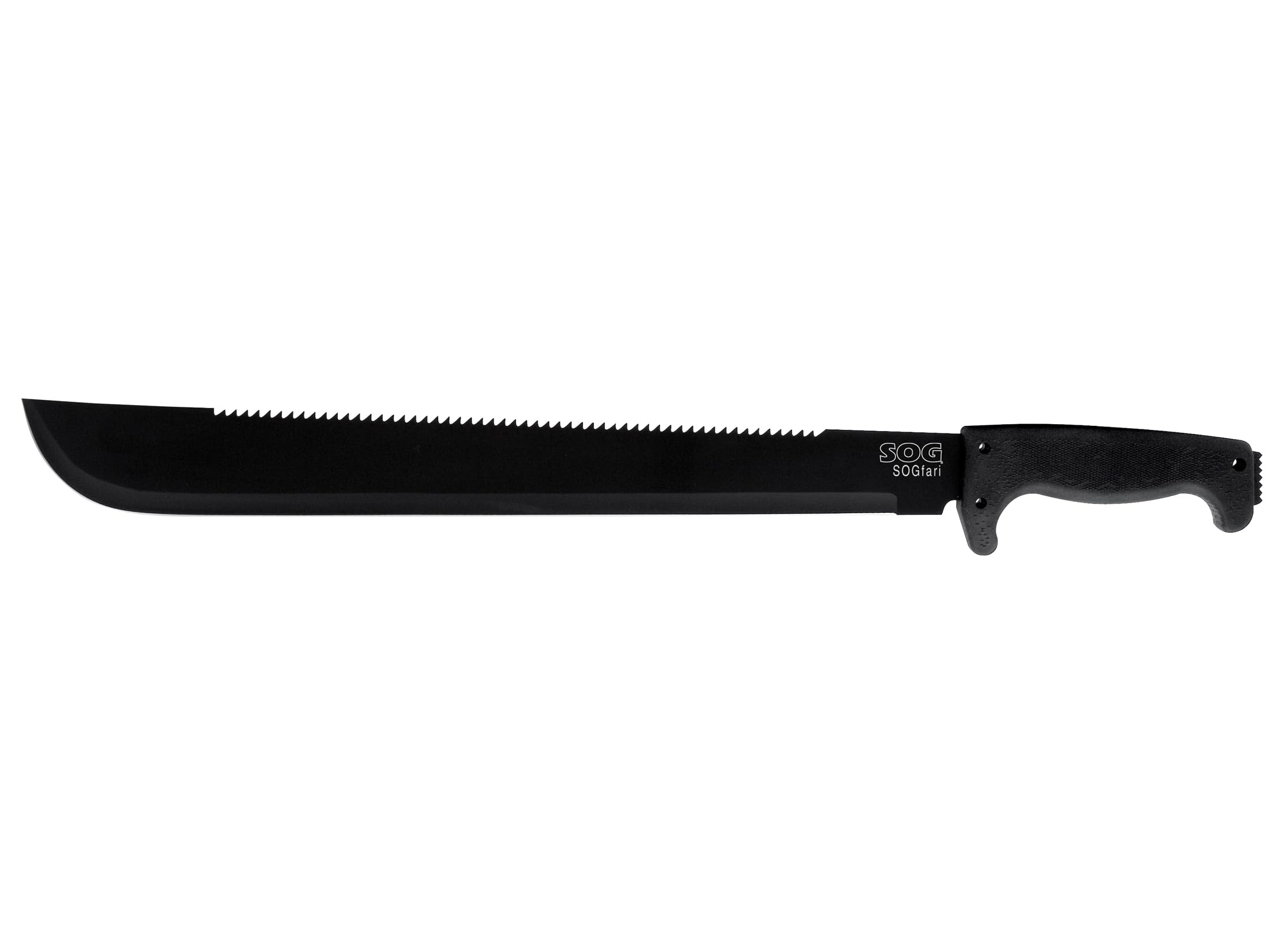
The sawback spine is the reason this one lives in a truck rather than a shed. Eighteen inches of blade with a row of teeth down the back covers the jobs a plain machete cannot: notching a limb before you snap it, cutting a shelter pole to length, clearing a trail without swapping tools. At 24 inches overall and 15.7 ounces it rides on a belt without dragging.

It arrives sharp — ours sliced hanging vines on the first swing — and the checkered Kraton handle is the most secure bare-hand grip in this group, wet or dry. At 15.7 ounces with the mass sitting forward of the handle, it swings like a much larger blade. The nylon sheath is plain and works, though its belt loop is the part most likely to give out.

For soft growth, camp chores, and damp country, this is the trade we take: stainless shrugs off rain and morning dew where carbon steel spots, and the sawback means one tool covers chopping and notching. If you have room for a single blade that does both, this is it; if it has to vanish into a daypack, take the Gerber.

Bottom line: Our pick for camp and trail: it arrives sharp, the sawback handles notching, and the textured handle is the most secure bare-hand grip here.

5

Gerber Versafix

Gerber Versafix

Packing light

Our Score 9.2/10
Check Price

Worth Noting

  • Short 9-inch edge for heavy clearing
Weight
11.2 oz
Cutting Edge
9 inches
Blade Material
Stainless steel
Overall Length
14.3 inches
Read the full review

Nine inches of cutting edge on a 14.3-inch tool is not a machete in the traditional sense, and that is exactly why we keep reaching for it: it is the blade that goes in the daypack, the kayak hatch, or the truck door because it is small enough that there is never a reason to leave it behind.

The weight-forward design is what makes it work. With the mass out at the front, it bites deeper than 11.2 ounces has any right to, and the high-durometer overmold handle is comfortable enough to use hard without gloves. We found ourselves using it where we usually drag out loppers — saplings, blackberry canes, the woody stuff along a fence line — because it is short enough to control in a tangle.

It is sharp rather than scalpel-sharp out of the box, and a few passes on a stone fix that; the stainless takes an edge easily. The nylon sheath is plain but holds the blade securely on a belt. Think of it as a big knife that chops rather than a small machete, and it makes sense.

Bottom line: We keep this one in the daypack: 14.3 inches and 11 ounces, weight-forward so it bites harder than its size on light brush.

6

Fiskars Machete Axe

Fiskars Machete Axe

Saplings and limbs

Our Score 9.0/10
Check Price

Worth Noting

  • Heavy at 2.6 pounds for long sessions
Weight
2.6 lb
Blade Length
18 inches
Overall Length
31.5 inches
Handle Material
Nylon
Read the full review

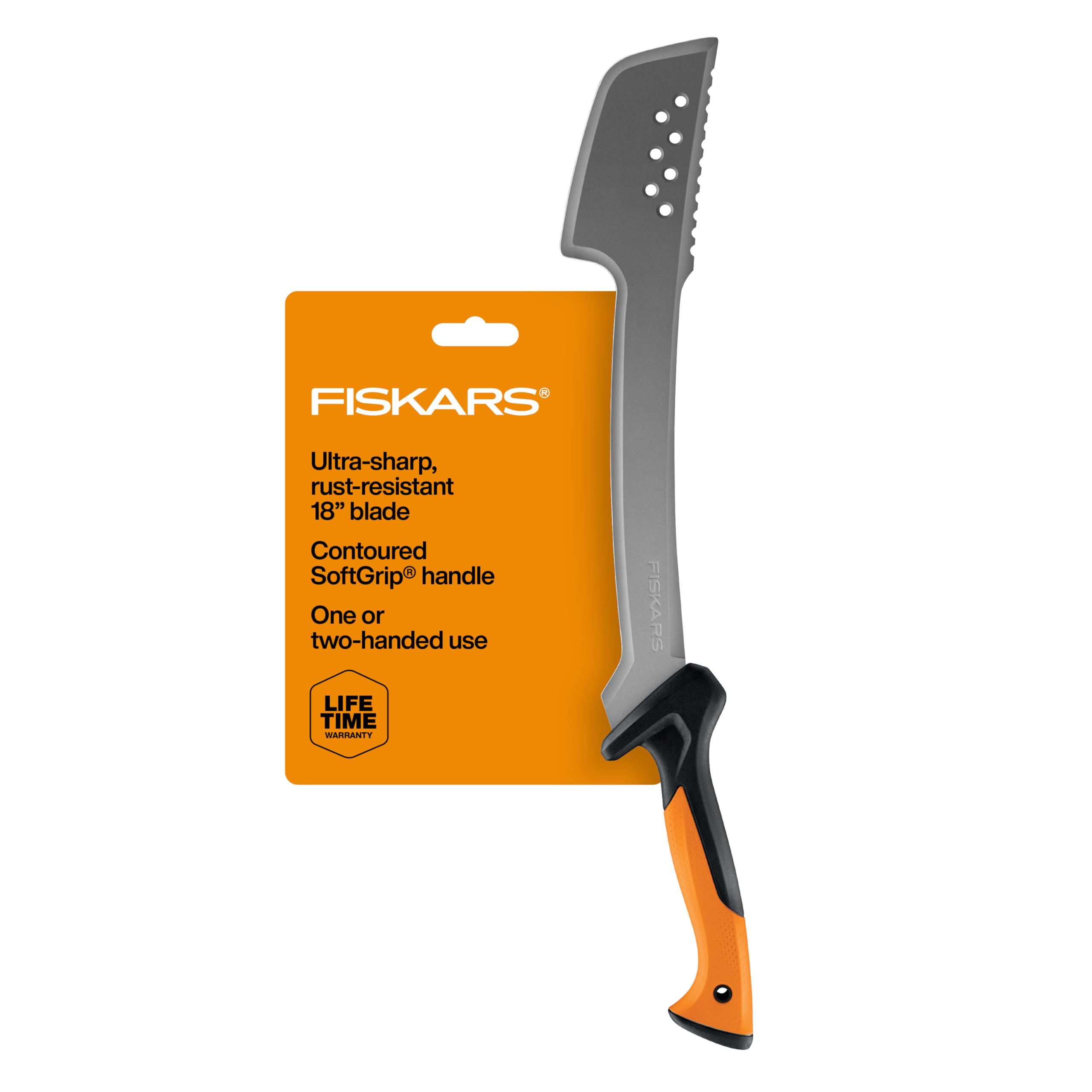
Fiskars built this as much axe as machete. There is a hardened head with a pronounced curve, a nylon handle, and 2.6 pounds of momentum behind an 18-inch blade; the tool runs about 31 inches end to end, so it wants room to swing.

On saplings an inch or two across, that weight is the entire story: one clean swing and it is through, which is not something we can say for the thin blades in this group. The low-friction coating helps the head slide out of a cut instead of sticking, and the curve gives you follow-through rather than a dead stop. At this length, big cuts want a second hand on the handle.

If your brush is woody — root suckers, saplings, palm fronds, storm-broken branches — this is the pick, and it is not close. It ships dull, deliberately, so plan on a file and twenty minutes before the first real session; a sharpened Fiskars is a different tool from the one in the box. If you mostly cut grass and vines with the occasional sapling, this is more tool than the job needs.

Bottom line: If your brush is woody, this is the pick: 2.6 pounds of axe-like momentum that takes saplings in one swing, provided you are ready to sharpen it before the first session.

7

Ontario 1-18 Military

Ontario 1-18 Military

Hard daily use

Our Score 9.0/10
Check Price

Worth Noting

  • Ships without a sheath
Weight
15.9 oz
Blade Length
18 inches
Blade Material
1095 carbon steel
Overall Length
24 inches
Read the full review

1095 carbon steel, 18 inches, hardened to 50–55 HRC, full tang under a molded plastic handle: the Ontario 1-18 is a military-pattern machete, and it feels like one. There is no decoration here, no coating, no contouring — just a thick slab of American steel on a handle built to be cheap to make.

Where it shines is work. The blade is thicker than most of the others here and carries enough mass to take limbs up to an inch without drama, and 1095 takes a keen edge and holds a working one through a long session. It is stiff enough that you can lean on it and light enough to carry on a belt all day.

The handle is the problem: hard, blocky, small, and slick once your hand sweats. Grip tape or a glove fixes it in five minutes, and it is the cheapest fix in this article.

None of that changes the steel. If you want a tool you can sharpen for twenty years and hand to someone who will abuse it, this is the one we point to; if you want something that feels good in the hand from day one, the SOG or the Tramontina gets you there faster.

Bottom line: For hard, repeated use: a full-tang 1095 blade that holds a working edge and sharpens easily, though the blocky handle needs grip tape.

8

Barebones Japanese Nata

Barebones Japanese Nata

Light chopping

Our Score 8.8/10
Check Price

Worth Noting

  • Blade can chip or snap under hard use
  • Handle feels forward-heavy mid-swing
Blade Length
12 inches
Overall Length
20.47 inches
Blade Thickness
5 mm
Handle Material
Walnut wood
Read the full review

Walnut handle, copper rivets, a 5 mm slab of stainless with a straight edge: the Nata is the best-looking tool here, and in a category where nearly everything is black plastic that counts for something. It looks like it belongs on a wall until you pick it up.

What it is, is a Japanese-style hatchet-machete: 20.47 inches overall, a 12-inch blade, full tang, and a riveted 900D sheath that feels like it will outlast the finish. The walnut stays warm and grippy in a way molded handles do not.

It is a chopper rather than a slasher. The thick stock and the straight edge want wrist-thick branches, roots, and kindling rather than grass, and when the swing is clean it hits well above its length. That is a narrower job than a Latin blade's, and it is a job this one does well.

For kindling, garden clean-up, and a shed you enjoy looking at, this is the nicest tool here to own — provided your brush stays under about an inch and a half and you keep the swing honest. If you are clearing a summer's worth of overgrowth, the carbon steel picks are safer company.

Bottom line: The best-looking short chopper here, and a good one for wrist-thick branches if you keep the swing clean and the wood green.

How We Tested Machetes in the Field

The shortlist started with every machete we could get our hands on from makers that keep turning up at farm-supply counters and in customer reviews — roughly 60 models — then got cut down by steel type, listed blade length, whether a sheath came with it, and price. Fourteen made it into testing, and we used all of them for four months.

Everything was tested where machetes actually live: a tangle of blackberry and ivy along a fence line, a yard full of storm-downed palm fronds, and a camping trip where the same blade had to split kindling and trim tent stakes. Sharpness got measured by counting swings — how many it took to cut through a two-inch green sapling — then counting again after 200 cuts to see what the edge did.

Grip was judged with wet leather gloves on, swinging until my forearm tired: I noted which handles rotated, which raised hot spots, and whether the rivets stayed tight afterward. Blades were left out overnight in the dew to see how quickly the steel spotted, and every sheath went on a hike — shaken upside down, worn on a belt for an hour, checked over for stitching and belt-loop wear.

Construction and versatility decided the last few spots. Anything that rattled at the handle or couldn't manage vines and light limb work both got marked down no matter how well it chopped, and price factored in at the end: a blade that costs twice as much has to cut noticeably better to be worth it.

How to Choose Machetes for Brush, Yard and Camp

Match the blade to the growth

A thin, springy Latin-pattern blade like the Tramontina's slices green stems and grass with almost no effort, and it is miserable in dry, woody growth. A thick, axe-like tool such as the Fiskars has the opposite personality: it splits saplings and root suckers and batters through soft growth that a thin blade would cut more cleanly.

Walk your property before you shop. Mostly whippy and green, buy thin; thumb-thick and woody, buy weight. Owning both costs less than buying the wrong one twice.

Steel, and the edge it arrives with

Carbon steels such as 1095 and the Tramontina's blade take a keener edge and resharpen easily, but they rust if stored damp. Stainless shrugs off weather and, in the thin grinds used here, can be brittle enough to chip or snap. Neither is an upgrade on its own.

Assume the factory edge is a starting point. Most machetes arrive noticeably less sharp than a working tool should be, and twenty minutes with a file is the difference between a chore and a pleasure.

Weight, balance, and how long you swing

Between the 15.7-ounce SOG and the 2.6-pound Fiskars there is a different working day. A heavy head does the cutting for you in short bursts and wears you out over an hour; a light blade lets you keep going but needs speed rather than force.

Balance matters as much as the number on the page. Mass out at the tip adds bite; mass in the handle makes a tool feel dead. If you will be swinging for more than twenty minutes at a stretch, go lighter than you think you need.

Handles, sheaths, and upkeep

A full tang, with steel running through the handle, is what keeps a machete from loosening up after a season. Beyond that, handle shape is personal: molded plastic ignores weather, wood feels better and needs an occasional oiling, and wrapped cord looks right and wears through.

Check that a sheath is included at all, because some tools ship without one, and a sharp machete with nothing to hold it is a storage problem. Wipe carbon steel dry after every wet session and oil the wood once a season, and the blade will outlast the handle.

Frequently Asked Questions

Final Verdict

For most yards, the Tramontina is the machete to buy: 18 inches of carbon steel that slices green growth on a light swing, needs one sharpening session to become itself, and costs little enough that you can keep it in the shed without ceremony. Sharpen it, oil it, and it handles everything from brambles to thumb-thick saplings.

Two situations change the answer. If your brush is woody — saplings, root suckers, storm damage — the Fiskars' axe weight is worth the fatigue, and if it is tangled and you will be at it every season, the Woodman's Pal is the lifetime tool. And if the machete would otherwise stay home, take the Gerber Versafix; a 14-inch tool in the pack beats an 18-inch one in the garage.