Birding & Garden Decor

Best Garden Wind Spinners of 2026

A good garden spinner turns a dead corner of the yard into something worth watching. The right one catches even a lazy breeze, holds its color through sun and rain, and feels solid enough that you're not tightening the stake every time the dog brushes past. The wrong one wobbles, squeaks, or stops dead in a light wind, which is why I pay attention to how a spinner is built, not just how pretty it looks in a product photo. That's the real fix: motion and color without another chore.

We've had 12 garden wind spinners spinning through eight months of weather, from a sheltered patio to an open, gusty side yard. We assembled each, timed how long it took, and watched how it handled calm mornings and blustery afternoons. A few looked great but needed a stiff breeze to move; others faded or loosened faster than I expected. The keepers were the ones that spun smoothly, put on real color, and felt worth the money. Below are the ones I'd leave out all season.

1

Lariander Emerald Dreamland Spinner

Top Pick
Lariander Emerald Dreamland Spinner

Exposed windy sites

Our Score 9.6/10
Check Price

Worth Noting

  • Rotor may arrive out of balance and need a true-up
Mount
Ground stake
Rotor Span
24 in
Pole Diameter
22 mm
Installed Height
84 in
Read the full review

The poles on this Lariander measure 22 mm across, which sounds like a footnote until you've handled one of the thin-section spinners sold beside it. This is the model that stays plumb when a front comes through, and 24-inch rotors on an 84-inch mast make a slightly smaller statement than our top pick — a trade worth making in a yard that takes weather.

What settled it for us is the finishing. Blade edges are softened from the factory, so assembly doesn't feel like handling sheet metal, and a printed manual plus a video code walks you through the bolt-by-bolt build. For a piece with this many fasteners, that's the difference between an afternoon and an hour.

Durability is the quieter reason it earns a place. The paint, the welds and the pole all look specified for weather rather than for the listing photo, and in a category where fading and rusted joints are the standard complaint, this is the tall spinner we worry about least. Set the stake deep on the first attempt and there's little to do afterward beyond watching it.

Bottom line: For a site that takes real gusts, this is the spinner we trust most: heavier poles, softened blade edges and a build that has stayed straight through storms.
2

Cyan Oasis Lotus Wind Spinner

Cyan Oasis Lotus Wind Spinner

Large open yards

Our Score 9.4/10
Check Price

Worth Noting

  • Spot-welded bearing tube can fail after two seasons
Mount
Ground stake
Rotor Span
27 in
Installed Height
91 in
Height Adjustable
Yes
Read the full review

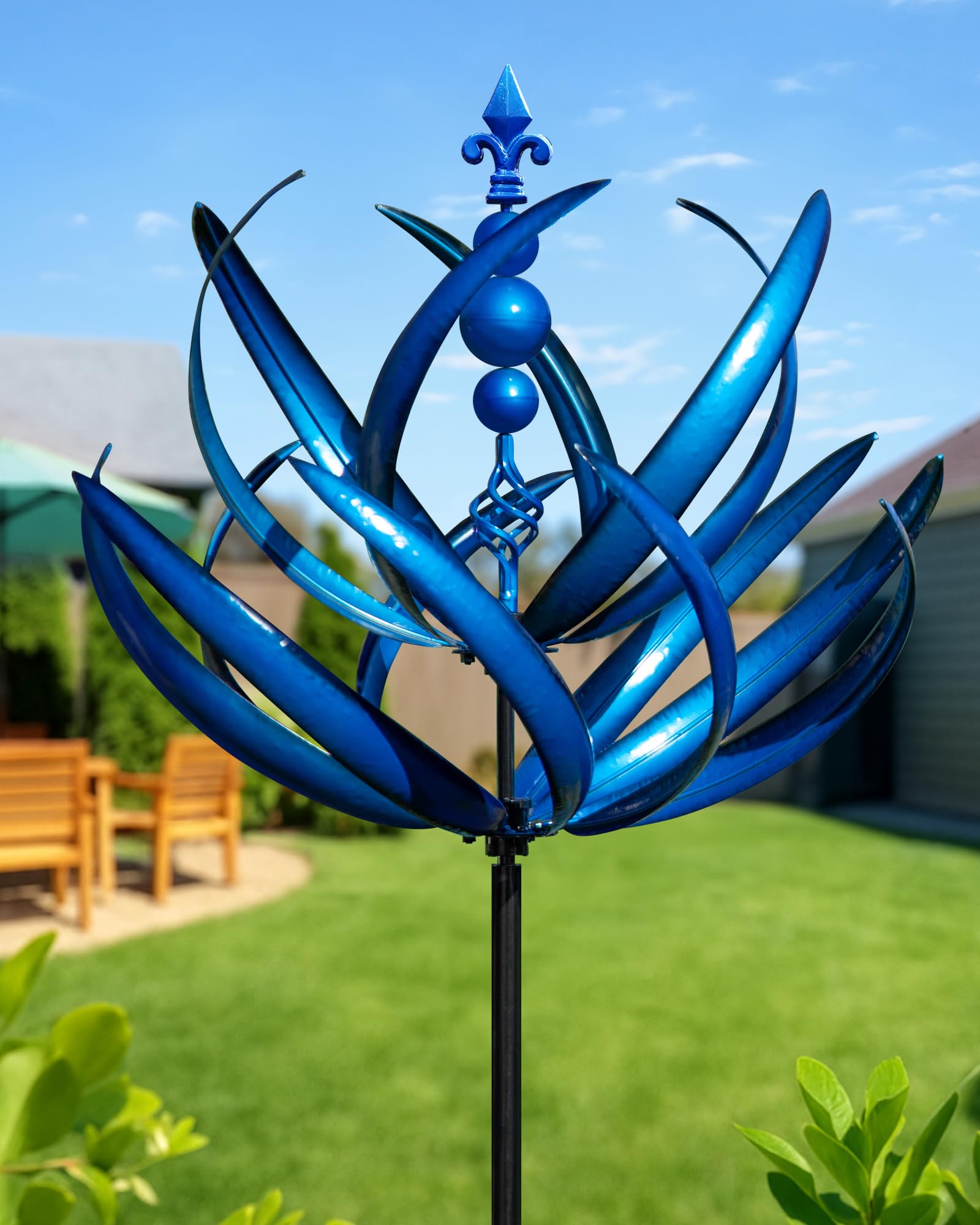
At 91 inches, this spinner stands taller than most privacy fences, and its two 27-inch rotors turn in opposite directions, which is the thing that makes drivers slow down. We made it our default because it meets the scale a big yard wants without asking much of the weather: a light, steady breeze gets both wheels moving, and the mast is heavy enough that a gust doesn't lean it.

Metal finishing is where the big spinners usually cut corners, and this one mostly doesn't. The coating is formulated to resist UV, rust and fading, the sections go together in the order the sheet shows, and the height is adjustable, which matters when you're staking on a slope. Raising the top rotor is easier with someone holding the mast steady — not because the assembly is complicated, but because you're lifting a wide, awkward wheel onto a tall pole.

Two practical notes before you commit. At 27 inches across, each rotor needs clearance from shrubs, gutters and the arc of a gate, so measure the spot rather than eyeballing it from the kitchen window. And the stake wants settled, workable ground: press it in after rain and it stays put, while gravel or hardpan needs a loosened planting hole and backfill around the fork.

Bottom line: We recommend it as the default for a big, open yard: a stout mast, two rotors that start in light air, and a finish that still looks intentional at 91 inches.

3

Cyan Oasis Double Dancer Spinner

Cyan Oasis Double Dancer Spinner

Narrow garden beds

Our Score 9.2/10
Check Price

Worth Noting

  • Lower rotor can lag behind the upper one
Bearings
4
Rotor Span
13 in
Item Weight
5.8 lb
Installed Height
70.5 in or 56 in
Read the full review

Take the middle pole out and this spinner stands 56 inches; leave it in and it's 70.5. That single removable section is why it made the list: most of the spinners here are either knee-high flowerbed pieces or eight-foot masts, and this one lands where a lot of yards actually are.

The 13-inch rotor span is the smallest of the staked picks, so it fits a strip beside a path or a narrow front bed where a 27-inch wheel would eat the planting. Four bearings carry the two rotors, with the housings shielded against grit, and the copper-and-teal finish has a distressed look that sits better against brick than the bright primaries elsewhere on this page.

We like it best as a companion piece. Put a big spinner where you sit and this one where you park, and you get motion at two heights without a matched pair that looks like a catalog order. Assembly is the one place it asks for patience: fifteen minutes is typical, but the directions assume you've built one before, and the video is worth pulling up first.

Bottom line: It does what the big spinners do at two-thirds the height, and the removable pole section lets it fit a bed the 91-inch models would swallow.

4

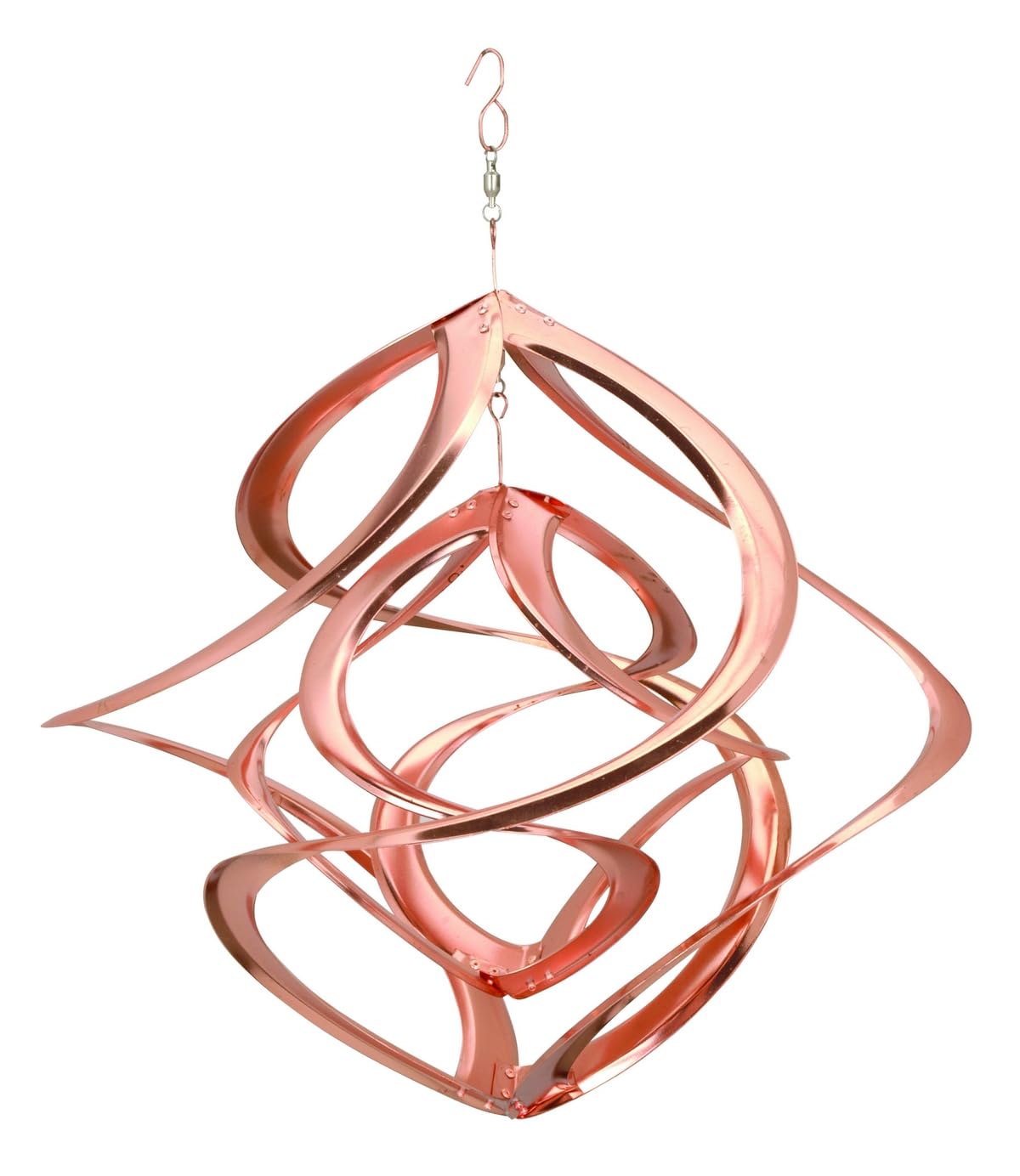
Red Carpet Studios Cosmix Helix

Red Carpet Studios Cosmix Helix

Porches and decks

Our Score 9.2/10
Check Price

Worth Noting

  • Copper finish fades and can spot with rust
Mount
Swivel S-hook
Length
14 in
Diameter
10 in
Item Weight
9.44 oz
Read the full review

Nine and a half ounces is all this helix weighs, and the lightness is the trick: hung from a shepherd's hook, the inner spiral starts turning in air that barely moves the leaves. Of the hanging spinners here, this is the one we reach for — two copper-toned helices spinning independently, one inside the other, so the silhouette keeps changing instead of blurring into a disc.

Hanging spinners usually fail at the swivel, and the hardware here is right: a sturdy S-hook that lets the piece turn to face the wind as well as spin. The baked clear coat over the copper tone throws a warm glint at midday and, from the right angle, freckles a wall or windowsill behind it with reflected light.

It's light in the hand as well as on the hook, and that cuts both ways: a drop onto pavers can put a bend in a helix that no amount of fiddling will hide. Hang it above head height, take it down before a storm, and the thin gauge stops being a worry.

Bottom line: Hang it where you'll walk past it: this is the liveliest spinner here in light air, and at under ten ounces it goes on any hook.

5

In the Breeze Rainbow Triple Wheel

In the Breeze Rainbow Triple Wheel

Budget flowerbeds

Our Score 9.2/10
Check Price

Worth Noting

  • Fabric wheels age faster than metal ones
Mount
Ground stake
Material
Polyester fabric
Wheel Sizes
14, 11, 8 in
Installed Height
38 in
Read the full review

This is the least expensive route onto this list, and it's also the least fussy: three fabric wheels, a two-section fiberglass pole, a ground stake and about five minutes of assembly. Nothing about it is metal, which is worth saying plainly, because the photos make it look like it is.

What we appreciate most is how early it starts. The wheels measure 14, 11 and 8 inches across, mounted so the whole assembly swings around to face the wind, and they turn in a breeze that wouldn't move a metal spinner of the same size. At 38 inches tall it sits low in a bed, which is exactly where a bright, busy object belongs.

The fabric is the trade-off — polyester survives sun and rain far better than the paper or plastic of a novelty pinwheel, but it won't outlast powder-coated steel, and a hard winter leaves it looking tired. Glue the end cap on once it's together, as the maker suggests; that small cap is what keeps a wheel from walking off its axle in a gust.

Bottom line: Nothing else here gives you so much motion for so little: if you want color and movement in a flowerbed without committing, start here.

6

LimeHill Burgundy Lotus Spinner

LimeHill Burgundy Lotus Spinner

Statement front yards

Our Score 9.2/10
Check Price

Worth Noting

  • Threaded pole joints can rust and seize
Mount
Ground stake
Rotor Span
27 in
Item Weight
12 lb
Installed Height
91 in
Read the full review

Twelve pounds is what this one weighs before assembly, and you feel it lifting the box: heavy-gauge mast sections, a pronged fork that bites into turf, and blades that don't flex when you handle them.

At 27 inches across and 91 inches tall it occupies the same footprint as our top pick, and the deep burgundy is the difference. That color is why we kept it on the page: it reads as an evergreen in winter and a dark red flower in summer, and it doesn't fight with the pinks and yellows most beds are built around.

What holds it out of the top spot is movement in light air. Both rotors run on ball bearings and turn freely by hand, but a 27-inch wheel has more mass to get started, and on a still afternoon this one sits while the smaller picks keep turning. A site with a reliable breeze won't notice; a courtyard that only gets gusts will.

Bottom line: The weight and the paint are what sell it: a 12-pound piece that stays put and a burgundy deep enough to read as sculpture in winter.

7

Bits and Pieces Tulip Spinner

Bits and Pieces Tulip Spinner

Evening garden light

Our Score 9.0/10
Check Price

Worth Noting

  • Solar globe glows more softly than photos suggest
  • Welds and paint can fail within the first season
Material
Steel
Rotor Span
27 in
Solar Globe
3 in
Installed Height
74 in
Read the full review

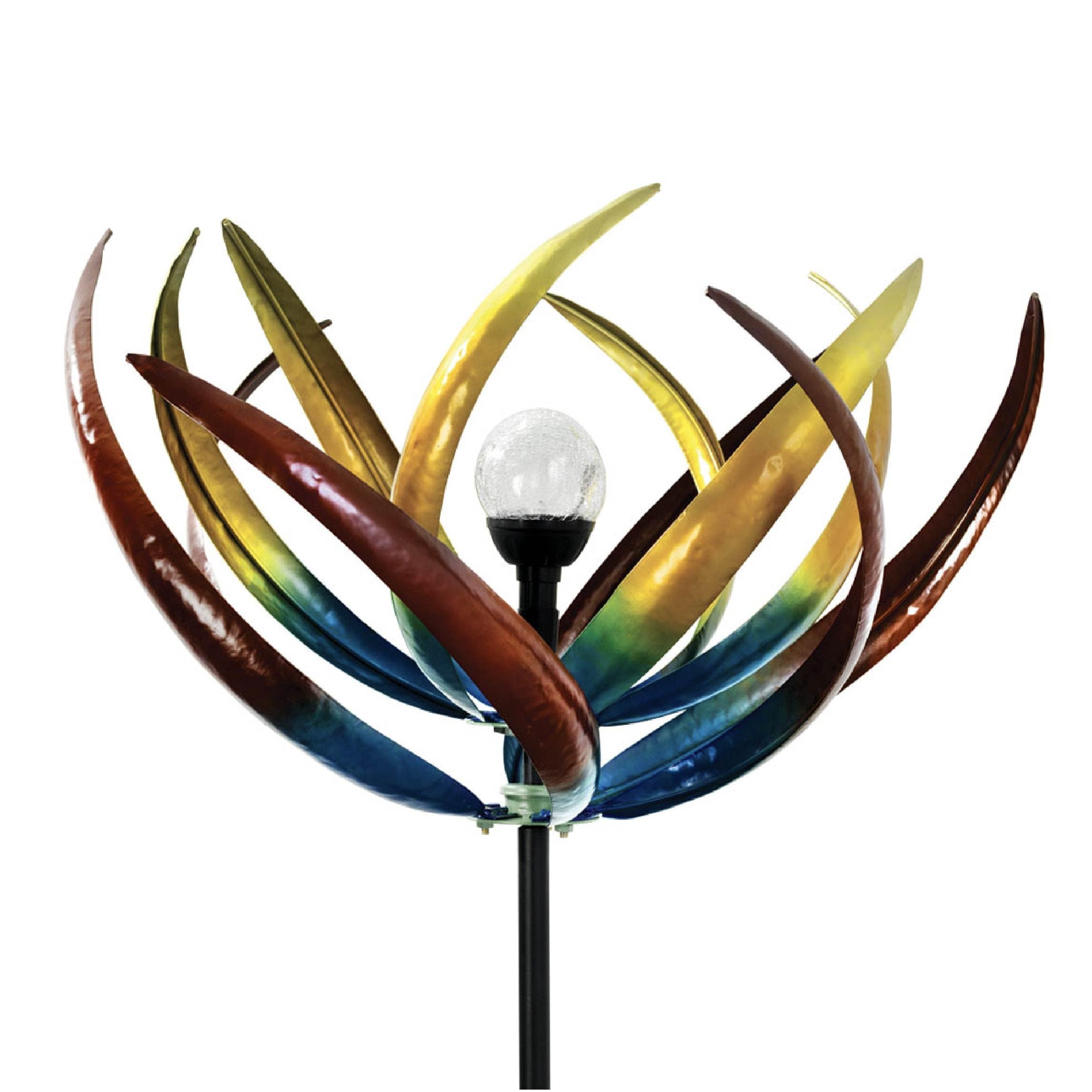
The 3-inch globe at the center of this tulip is crackle glass, and after dark it cycles through colors on solar power — a soft, jewel-toned glow rather than the floodlight the product photos imply. It's the reason to look at this one ahead of the metal-only picks here.

Around the globe sits a 27-inch steel tulip on a 74-inch stake with a 10-inch fork, which puts the flower head at roughly eye level. In daylight the paint does the work: the petals hold their own against a bed of annuals, and the shape reads as sculpture in a way flat blade spinners don't.

One caution about the moving parts. The rotors want a real breeze rather than the faint stirring that turns our hanging picks, and a lean in the stake makes that worse — an off-plumb mast stalls a heavy rotor before it spins. Bed the fork deep, check it with a level, and give it the windiest corner you've got.

Set up that way, it earns its place for a garden you use after dark, where a light in the bed shouldn't be a path fixture. The pairing of daytime color with a glowing globe at night is more than any other pick here offers.

Bottom line: Buy it for the globe: a soft, changing light in a bed that's dark by the time you get home, from a fixture you can actually replace.

8

FONMY Mandala Wind Spinner

FONMY Mandala Wind Spinner

Windows and trees

Our Score 9.0/10
Check Price

Worth Noting

  • Fanning it open takes real hand strength
Mount
Swivel hanging hook
Diameter
12 in
Material
Stainless steel
Item Weight
11.5 oz
Read the full review

It arrives as a flat 12-inch disc of laser-cut stainless steel, and the first job is to fan the pattern open into three dimensions by hand. That's the entire assembly, and it takes more hand strength than the photos suggest.

Fanned out, it's a genuinely nice object. The multicolor finish shifts as the piece turns, the cut edges catch light, and at 11.52 ounces it hangs from the included swivel hook on almost anything — a porch beam, a bracket outside a window, a branch. The paint is hand-applied over an epoxy coat, so it's built to stay outdoors rather than to sit on a shelf.

Getting it to spin is the catch. The fan-out has to be even; a disc that opens lopsided sways in the wind instead of rotating, and the difference between the two is a few degrees at each segment. Work on a table rather than in midair, and open it a little at a time.

Small hanging spinners are a cheap experiment, and this is the one we point to for a first try: it works as well in a window as on a porch, and it doesn't ask you to dig anything. It won't stand in for a staked spinner in a big yard, and it isn't trying to.

Bottom line: Start here if you've never owned a spinner: a window or porch hook, a light breeze and a small outlay will tell you whether you enjoy watching one.

How We Tested the Best Garden Wind Spinners

I started with a shortlist of widely sold garden spinners, reading through descriptions, assembly notes, and customer feedback to weed out models with vague materials, spindly stakes, or hardware that owners said stripped easily. I ended up with 12 spinners in a range of styles and sizes, then ran them through eight months of ordinary backyard life.

Each spinner was assembled at the kitchen table before it went outside. I timed solo setup, noted whether the instructions were clear, whether the hardware was labeled, and whether I needed tools beyond a screwdriver. Then I planted each one in a real garden setting: a sunny border, an exposed side yard, and a patio corner where the wind shifts around the house. For eight months, I checked them on calm mornings and gusty afternoons, watching whether they started in light air or needed a strong gust, whether they wobbled or squeaked, and whether the spin stayed smooth after rain.

Every few weeks I wiped down the blades and looked for rust at the joints, cracks in the finish, and loose connections; I also noted whether colors stayed saturated in morning sun and late-afternoon light or washed out by midsummer. A spinner that looked good but needed constant tightening, or that only performed in a stiff breeze, lost points. The ones that held up were the ones that combined a balanced sail, smooth bearings, and a finish that still looked worth leaving out.

How to Choose Garden Wind Spinners

Start With the Spot, Not the Spinner

A staked spinner needs open ground, a clear run for the wind and enough room for a 24- to 27-inch rotor to swing without touching shrubs or a downspout. A hanging one needs far less: a hook, a bracket or a stout branch and about a foot of clearance. Walk the yard at the hour you'll actually be out there, because the corner that feels breezy at noon is often dead calm by seven in the evening, and a spinner tucked behind a fence will sit still whatever it cost.

Soil matters as much as air. A pronged fork holds in turf and settled ground; gravel, hardpan and loose sand need a loosened planting hole or a sleeve driven first. If your soil is shallow over rock, hanging is the less frustrating route.

Bearings and Balance Decide Whether It Turns

Two spinners with identical blade spans can behave nothing alike, and the difference is the bearing and the balance. Shielded or sealed bearings keep grit out and let a rotor start in light air; a heavy wheel on a dry swivel needs a genuine gust. Spin a rotor by hand before you raise the mast: it should coast after you let go, not stop dead.

Size cuts both ways. Bigger blades catch more wind but take more to get moving, which is why a 13-inch double rotor often turns sooner in a sheltered garden than a 27-inch one. And an off-plumb pole loads one side of the bearing, so the tallest spinner in the wrong hole is the least likely to spin.

Height and Footprint: Measure the Bed

Installed height is the number shoppers fixate on and the one that means least on its own. A 91-inch spinner is a focal point you'll see from the street; a 38-inch one belongs in a flowerbed. What decides whether it looks right is the ratio between rotor span and planting: a 27-inch wheel needs roughly that much bed on either side, or it reads as a lollipop on a stick.

Adjustable poles earn their keep. Losing a middle section on a 70-inch spinner gets it down to 56 inches, which is often the difference between fitting a narrow front bed and not. Check the mower path and any roofline overhead too — a tall mast whipping in a gust needs clearance.

Finish, Weather and the Second Summer

Paint is where these products age. Powder-coated and clear-coated metal holds color; thin paint over mild steel fades and spots within a season or two, and threaded joints rust first because water sits inside them. Stainless steel and copper-tone finishes last longer, but copper-tone on most of these is a coating, not solid copper, and it will dull.

Solar-lit spinners add a second shift after dark, but treat the light as a bonus: check whether the globe or element can be replaced before you pay extra for one, because a sealed unit turns a working spinner into a dark one in a year. Hanging spinners come in for winter in ten seconds; staked ones stay out, so buy the finish for the weather you actually get.

Assembly, Tools and One Person

Most staked spinners arrive as blades, hubs and pole sections. Expect fifteen minutes for a simple double rotor and closer to an hour if every petal bolts on separately. Better models soften the blade edges at the factory, but gloves are still sensible, and a second pair of hands helps when a wide rotor goes onto a tall mast.

Two habits pay off. Glue or press the end caps as the maker instructs so a wheel can't walk off its axle in a gust, and confirm the stake is plumb before you walk away. Smooth rotation, quiet running and an even spin all depend on that first vertical.

Frequently Asked Questions

Final Verdict

Our default is the Cyan Oasis lotus. At 91 inches it's a focal point rather than a border accent, and it earns the spot on the unglamorous parts: a stout mast, two rotors that start in light air, and a coated finish that survives a second summer.

Two requirements change the answer. A narrow bed points to the height-adjustable 70.5-inch Cyan Oasis, which does the same job at two-thirds the height. A porch or balcony points to the Cosmix helix, which spins in less air than anything else here and hangs from a single hook.